
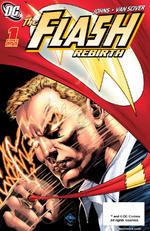
 The writers and artists have changed. The face under the Flash’s mask has changed. But there’s one thing that the three Flash relaunches we’ve seen since Infinite Crisis all share: pacing.
For some reason, every time DC has relaunched the Flash lately, they’ve done it with a slow burn.
Rising Action: Speedsters Slowing Down
Now, I have no problem with slow burns in general. I really did like most of Final Crisis, for instance (and that was almost all slow burn), and as frustrating as Flash: Ignition was at the time, I really like the story in retrospect — but as a break from the crazy pace of Run Riot and Blitz. Just about everything I’ve read or watched by JMS has used a slow build-up to something huge, from Babylon 5 to Squadron Supreme (some to better effect than others).
But I don’t think it’s the best structure to launch a character whose main claim to fame is speed…especially when it’s serialized.
Quick Starts
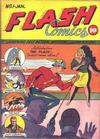 In 1940, Flash Comics #1 featured a 15-page origin story starring Jay Garrick. He got his powers, appeared in costume, and solved a case all in 2/3 the space typically available to a modern comic book. (Admittedly, comic book storytelling was much less detailed at the time.) The series lasted 10 years and spawned a spin-off series All-Flash as well as a regular solo feature in Comic Cavalcade.
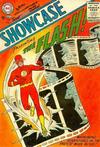 In 1956, Showcase #4 featured two stand-alone stories starring Barry Allen. The first one introduced the character, gave him his powers, had him appear in costume and defeat a villain. Again, in half an issue. After several more try-outs, The Flash launched in 1959 and lasted 26 years.
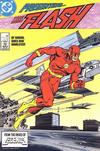 In 1987, Flash vol.2 launched with a two-part story starring Wally West. He already had the powers and costume, and the two-parter split its time between establishing his character and fighting a villain. The series lasted 19 years and ended only because DC wanted to replace the Flash again for its sequel to Crisis on Infinite Earths.
What do these three successful launches have in common? What’s different about them when compared to the 2006 launch of Flash: The Fastest Man Alive or the 2007 relaunch of Flash vol.2?
They opened with stories, not with setup.
Plodding
Now let’s look at the last few years.
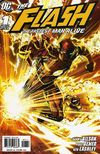 2006. Flash: The Fastest Man Alive launches with a 6-part epic. Bart Allen spends the first issue moping around. In issue two his roommate gets super-powers. On the last page of issue #2, Bart finally puts on the Flash costume. It takes 6 issues before anything is resolved, like defeating the main villain, offering a hint about why Bart aged 4 years between two issues of Infinite Crisis or where Wally and his family went, or getting Bart to act a little bit like the impulsive hero he used to be. By issue #8, DC decides to end the series quickly and brings in a new creative team to kill the character off.
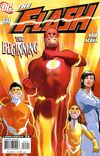 2007. Flash vol.2 picks up again where it left off, with a 6-part epic. A short adventure at the beginning leads into Wally and Linda talking about their kids for most of the issue until an alien shows up on the last page. The next few issues focus heavily on the kids and on flashbacks. By the time the story is finished, fan reaction is so bad that Mark Waid drops the book like a hot potato. The series manages one more storyline (another 6-part epic!) before DC decides to pull the plug and brings in yet another creative team to wrap things up.
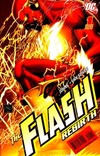 2009. Flash: Rebirth stars Barry Allen in yet another 6-part epic. The first issue features a few hints of conflict and speed, but mostly Barry mopes around and talks to his friend Hal. The second issue offers a few more hints, and the third finally completes (we hope) the setup. He’s still acting very un-Barry-like here, but seems more like his old self over in Blackest Night. Sales are good, but critical reception has been mixed and dropping, with the major complaint being that it’s moving too slowly. It doesn’t help that half-way through, the book stops dead for nearly 3 months.
Sure, these relaunches are being written with the eventual collected editions in mind. Most comics are, and in general that’s fine if you want to tell a story that can use the space.
The problem is that Flash: Rebirth isn’t just a story. It’s also a relaunch. Its job is more than just selling hardcovers and paperbacks over the next dozen years. It’s immediate job — probably its more important job — is convincing readers now to start reading The Flash again and keep reading after Rebirth concludes.
Full Speed Ahead
Remember “One Year Later?” After Infinite Crisis, all of DC’s storylines jumped ahead one year. Some series essentially started over and set up a new direction, but others hit the ground running and filled in the gaps along the way. Outsiders certainly had its faults, but that’s one thing it got right.
I think DC should have done this with The Flash.
Imagine a parallel world in which DC didn’t spend a year building up to Flash: Rebirth, another 9 months on Flash: Rebirth itself, then three months on Blackest Night: The Flash before launching a new series two years after his return. (April 2008 to March 2010 at the earliest.)
Imagine instead that DC simply relaunched the book, stopped focusing on Wally West, and started focusing on Barry Allen. Now imagine that they started with a series of done-in-one or two-part stories in which the reader would get a complete story every month or every two months, while issues like Wally’s status and setup for future stories are dealt with in continuing subplots.
Now imagine that after 6 months to a year of actually seeing Barry Allen be awesome on a regular basis instead of being told that he’s awesome, then we get a big, epic Flash story.
Wouldn’t that be fantastic?
As things are now, it feels like the Flash has been taxiing around the runway for the past year, and won’t actually go anywhere for another six months.
(Expanded from a comment at Rokk’s Comic Book Revolution).
I really wonder if DC sees this at all – or simply believes that this 6 issue formula to sell trade paper backs is the best way to go?
The thing that bothers me the most is that (with respect to Geoff Johns comments on what Rebirth is about) it makes absolutely no sense.
Geoff said:
“We get so wrapped up in that, so wrapped up in everything and trying to get information as fast as we can. And that’s something that can remove you from your friends, your family, the reality of things. You get so caught up in this life of “go go go.” You ever been with somebody who’s always thinking, “Where do I have to go next?” And they’re always a little spacey. You’re always, “I need more time, more time, more time.” You’re cramming in more and more things, trying to go faster and faster… He’s that fast and he still wants more time. So that means that as fast as we can go, we’ll never have enough time. There’ll never be enough time for all we want to do.”
This existential idea that we can never do enough is a great ironic twist applied to a speedster. But it makes absolutely no sense to apply it to a veteran silver age character who exemplifies love of family and friends more than just about any other DC character. Barry is going to step away from the wife he decided to have children with just before she was murdered, with whom he gave up being the Flash to live in the future… all because he’s compelled to take care of business? Really?
Geoff:
“That whole thing comes from the fact that Barry Allen is always late. He’s always late, so instead of it being a joke, let me turn it into a character trait. Let me turn it into him learning. By the end of the series — I don’t want to spoil it, but at the end of it, the last scene is all about that. Sometimes you need to stop.”
Maybe Barry’s habit of being late came off as comedy relief but what may not have come across is that through the years it firmly established Iris as Flash’s anchor. Sometimes she got bitchy – but she grounded him and he always came home. Sound familiar? Any issue Barry had with his priorities was resolved in #275 page 8. Take it for a spin.
At this point it wouldn’t make sense if used with Wally either given his experience and priorities. It may very well have been perfect to run with it for Bart’s launch – he was still green and “impulsive.” I can think of no better way than to make him a tad more mature than his a.d.d. days and yet still leave him room to grow through such a dilemma.
And by the way, how is this particular angle serve as a character relaunch? Certainly Grant Morrisson had aleady delivered Barry into the arms of Iris in Final Crisis but the way the series kicked off felt like a story already in progress. Rebirth hasn’t introduced an effective character engine for Barry to grasp the imagination of new readers – and they certainly can’t expect to hold the attention of Barry fans with the delays in release.
It seems flash rebirth is abit redundant now….it has stopped, seems forgotton about, and as we read Barry’s latest adventure(In BN) he seems back to his old self….any real reaason to continue tbh ?
Excellent Post. Only thing I would “change” would be a more shared focus of what’s going on with Wally(and his family) because I would no doubt be one of those people bitching about the lack of my favorite character.
Thanks!
Good point on including Wally & family. IMO the second biggest problem with Flash: The Fastest Man Alive (after the pacing) was the fact that it waited so long to even address the question of what had happened to the previous Flash. Then when they did, it was in such a way that it was unclear whether the alternate world they’d gone to was even still around after the conclusion of Infinite Crisis.
Wow, if DC is reallly focusing on collecting six issues into trades then there lies the problem – their focusing on the end result and not the road traveled to get there. Sounds like they are not very customer focused with the REBIRTH, too. Deadlines are deadlines and DC is old enough to be able to manage them by now.
The Corp is old enough but it is still run by humans who age or leave and the deadlines are subject to that problem.
I think the fact that they’ve relaunched the book so many times and we keep coming for more is a testament to the fact that they can’t kill The Flash, no matter how hard they try.
As Homer would say, so far Flash: Rebirth has been “Booooring”.
We may keep coming back for more, but we don’t always stay.
Readers (well, retailers) bought 120,000 copies of Flash: The Fastest Man Alive #1. By the end of the first arc it was down to 56,000. We bought nearly 73,000 copies of Flash v.2 #231, but by the end of that arc it was down to 41,000. By the end of the second arc it was below 30K.
So far, sales on Flash: Rebirth have been strong, following typical miniseries attrition. The question is, what will sales look like on issue #6? Or, more importantly, a few issues into Flash vol.3?
I guess that they start wrong with the assumption, that “you need a relaunch”.
A relaunch will most likely attract new readers and will probably cause retailers to order a few extra copies of the book, but what usually brings more people to a book is good writing and good art.
Before Johns and Kolins worked on the Flash nobody knew them, despite that, there was a constant flow of positive reviews of the book, good word of mouth, and the book started (slowly), to attract new readers month after month.
Is more likely that you’ll have a successful book if you give it to people who actually want it, instead of just taking advantage of your exclusive contracts to assign people to it.
IMHO, Johns shouldn’t be writing the Flash. I haven’t made up my mind about Rebirth just yet, but I think that he already wrote all the good stories he possibly could with the character, to the end of his run he was heavily repeating himself (IMHO). No writer should overstay his welcome on a book, and I think that the average writer can’t keep writing good stories for more than 5 years or so, after that they should move on.
I’d like to see Andy Digle writing the Flash… I really liked his Adam Strange miniseries before they forced him to link it to Infinite Crisis, and successfully ruined it.
The notion that good writing/art brings people to a book is, sadly for the most part, wrong. I can help and it does, you can just look at Geoff’s numbers on his run, thats one of the few times ever that numbers spiked without major crossover events, relaunch, or a big name creative team coming on board. But even with that book it eventually falls to the same comic peril that absolutely every other ongoing does, standard decay. Every title, no matter what reaches a point where they start to lose readership, doesn’t matter the quality, it happens to everything. It had nothing to do with what was going on in the book, after any surge in readership it starts to fall off.
Things that do increase initial numbers (and really, thats what the companys care about NUMBERS, not READERSHIP) if you look at the sales figures regularly: The Same books (X-men, Avengers, Spider-man, Wolverine, Batman, Superman). Or issue 1’s and 2’s. Look at Powergirl, her book debuted as one of DC’s highest, but I doubt if the current issues will be very high at all, not because the writing is any better or worse, but because collectors don’t collect #4’s. And the book will probably be cut, despite like I said, debuting incredibly high. And even IF, hypothetically they dude a new Flash #1 directly after Flash Rebirth #6, you would see higher number in 1. Because it’s a one. Doesn’t matter if it’s the same creative team or not, doesn’t matter how horrible the numbers on 6 could hypothetically be.
Comics function in a collectors market, they are perpetually treated as collectibles. That drives a larger portion of the sales than most actual readers care to admit. But there are people who will go into stores and pick up every new #1, just because it’s a #1, never read it, store it, and go on about their business.
That was the market of the 90s, I doubt collectors are still out there, since there is very few people willing to pay 20 dollars on a #1 a year after it was launched.
Is true that #1s attract buyers, but of of those buyers are the retailers, and most of the times because they need to order 10 issues to get a variant cover which they can sell a little higher (and return the left overs).
If the relaunches were the answer, you’d only ever see books reaching #6 and nothing else… the TPBs are the ones that keep the money flowing and you’d have to ask yourself what is more likely to attract readers, a book that has been around for 5 or more years with good reviews, or a book that has been relaunched 3 or more times and has the reputation of a bad read, a “hit & miss”, whatever.
A Relaunch thinking only on the few thousand extra copies you are going to sell is food for today and hunger for tomorrow, a well-thought relaunch with the right people in charge will be sold for years, maybe decades… there is a reason why Waid’s a Johns’s TPBs keep selling after so many years and others simply don’t.
I can’t agree with you on this.
The very face of the comic book has changed. It’s not about telling the set up story as fast as possible, it’s about telling the best story possible.
If comics were still being written like they were in the 40’s, or the 60’s, or even the 80’s, I wouldn’t be reading that many.
The Flash: Rebirth has to be THE set up story. It has to tell any new reader who will ever want to pick up the Flash book what it is all about. Not just now, but in a few years when the equivalent Flash stories of the Sinestro Corps War and Blackest Night start, Flash is going to get new readers.
Are long setups going to kill the Flash? No. The difference will be that when the first arc of Fastest Man Alive was over, it still sucked. When the first arc of The Wild Wests was over, it still sucked. When Flash: Rebirth is over, we are going to have a masterpiece that you can sit down and read in one sitting, and no one is ever going to care about how fast the issues came out ever again.
If the pacing of the single issues is what you worry is going to kill the Flash, then my counter is that once all of them are out, and the trade is too, there is no more wait and that problem is no longer important.
If Flash: Rebirth were a stand-alone story, or a story in the middle of a series, I’d agree with you: it should take as much time as it needs. But it’s not a stand-alone story.
The primary purpose of Flash: Rebirth is to hook readers on the new series. For that, you want to be able to hand someone an issue and completely blow them away. If the audience gets bored and leaves, the book might not get to the Sinestro Corps equivalent.
Yes, DC should plan for the future, but not at the expense of today.
I guess my point is that you hook new readers by handing them the trade of Flash: Rebirth, not by handing them any single one issue.
Why wait until April 2010, two full years after Barry’s return in DC Universe #0, to hook potential readers?
Actually, that’s the hardcover release. No doubt it’ll be at least another six months to a year before the trade paperback is released.
I guess we’ll just have to see. I think we are on the brink of a new golden age of Flash adventures. I’m sure people had similar arguments on Green Lantern sites when there was a large delay in the Green Lantern: Rebirth series. Now it is one of the most popular comics.
I want to clarify that this post is not about the scheduling delays. I expanded it from a comment I made on Rokk Krinn’s review of issue #3, the day after it came out. At the time, I had no reason to believe we’d be waiting longer than 6 weeks for the next issue.
It’s about story structure, and how the structure chosen to relaunch the Flash interacts with the nature of the character, with serialized publishing, and with the goal of launching a series based on a troubled character.
You are making a big assumption there… that this book is going to be great.
All this is ultimately for yourself to decide (and myself too), but I don’t think that GL: Rebirth was such a great story, neither were the first 12 or so issues of the new Green Lantern book. It really picked up when they started the Sinestro Corps story, but I still think that GL is just and entertaining book, nothing else.
The Flash is such a well known character that it really doesn’t need that much of a set up, besides, there isn’t much to know either, he is fast, he is good, he fights crime, period.
I agree with fastest, it has to be this way. I think Ethan Van Sciver said in a recent interview that they started out slow on purpose. They want the issues to slowly get faster like its gaining momentum. I think on comic geek speak.
No, it doesn’t have to be this way. There are plenty of story structures out there that they could have chosen. A slow build isn’t the only option.
I hope the story does pick up. I’d really like to go home from the comic store next week and have Flash: Rebirth #4 turn out to be the best comic I’ve read in months. But the last issue, which probably should have been the point where everything kicked into high gear, really underwhelmed me.
Unfortunately, I have to agree.
I am hopeless Flash tragic, and haven’t missed an issue of Flash in well over 20 years, but Rebirth has done NOTHING for me.
If a hardcore fan is underwhelmed, what do you think new readers make of this book and it’s ‘slow burn’.
The whole idea clashes when you’re writing ‘The Fastest Man Alive’.
Still, I’m hanging in there, hoping the last three issues, when they eventually arrive, knock my socks off and leave me eating my words.
The thing I hated about Flash: Fastest Man Alive was that it ended just as it started to get good. When Marc Guggenheim took over for the disaster known as Bilson and DiMeo the book really started to flow nicely. If not for killing off the adult Bart, I thought Marc Guggenheim could have gone on to do for Bart’s Flash what Mark Waid had done for Wally’s Flash… Incidentally I also really enjoyed Guggenheim’s short-lived TV series Eli Stone which he was listed as a writer and producer (along with Greg Berlanti).
Now that Barry is back, I’d love to see Wally don the Walter West/Dark Flash costume or some variation thereof to better differentiate his costume from Barry’s. As it stands right now his and Barry’s costumes are way too similar.
.-= Perplexio’s latest blog post: Bill Champlin leaves Chicago =-.
I actually liked Bilson and Dimeo, but I viewed and still view guggenheim as the the disaster. Partly because he had Bart as too powerful a character and partly because he ignored the Rogues real personalities in place of the personalities he wanted to give them.
But he developed Bart so well. I thought Bart following in his grandfather’s footsteps (going to the Police Academy in LA to become a cop) was a nice touch.
As for how he wrote the rogues I think Guggenheim was forced to write them that way as the plan was to kill off Bart and DC really didn’t give him enough time to build up a plausible backstory as to why the rogues would suddenly want to kill a Flash when (other than Kadabra) they’d never really had that motivation before. So Guggenheim was forced to completely ignore the rogues personalities and re-write them in such a way that it was plausible for them to want to kill Bart. So I blame all that a bit more on Didio than on Guggenheim.
Are you just assuming he was writing the rogues the way he did because he was forced or do you have evidence.
besides countdown of course.
I don’t believe the decision to kill off the adult Bart was Guggenheim’s. He wasn’t forced to write the rogues the way he wrote them but he was put into a position where he had to create a motivation for them to want to kill Bart within a relatively short timespan. I felt he did the best he could with the limited time he had. Could it have been written better and/or fleshed out more? Absolutely! But could it have been written better within the time constraints– that’s a tougher call.
I thought Final Crisis: Rogues Revenge made up for how sloppy the rogues were written in the last couple issues of FFMA. Granted the latter wasn’t Guggenheim’s work.
I do hope that with Flash: Blackest Night that both Zoom and Thad Thawne (as Kid Zoom, not as Inertia) are brought back though.
I think he will survive, I’m really hoping Geoff knocks it out of the park with the conclusion and the new #1.
I agree on a number of levels.
For one, I think the 6-issue story arc “mandate” needs to go. I realize that this is some magic number they’ve come up with to reap the most gain out of both the monthly and TPB end of the biz, but its usually too long to hold the interest of the monthly reader. Its sort of a self fulfilling deal with the “wait for the trade” trend, if you ask me.
Secondly, I agree about too much SETUP! I TOTALLY agree with your statements about Barry’s Blackest Night appearances being more satisfying than those in his own book. And these are fleeting moments. At least by issue 3 it feels more like a story– but it took to long to build up to.
I would have much rather had a situation where they start the ongoing series with everything in place and a STORY. Frankly, he came back in Final Crisis, he’s back, have a couple sublot points about him adjusting, I’d be happy. Anything else we could get along the way.
This is a bit of naysaying for the sake of it, isn’t it? “What happens if this series continues to not wow me?”
Let’s get out from underneath our Afghans and think for a moment: Rebirth is disappointing to some long time fans. Okay.
But it’s still one of DC’s top selling comics, and it will still spark a LOT of interest for this year, and next. Even if it is mostly setup for the next act.
In fact, potentially because it’s setup for the next act: Readers tend to trust Johns, because he rarely disappoints. Here he obviously has a long-term game plan. His books tend to be huge roller coasters that build and get stronger over time.
If this is anything like his GL run, Flash will become a big deal, really for the first time.
i hope you’re right.
Lets not forget that a main reason attributed to the low ratings and cancelation of the TV show was due to the delaying of episodes being aired.
Someone earlier posted that good writing and art don’t attract readers to a book. What? Sorry? I was an avid reader of the FLASH ever since the mid-eighties relaunch and was devistated at the (IMHO) drop in quality after Waid left. I stopped. Same with SUPERMAN after the departures of Ordway, Jurgens, Grummet, etc.. So don’t say that it doesn’t matter. It does.
It matters to some degree, and on an individual level sure, but on the 10’s of thousands of readers scale? A number 1 is always going to draw more readers in than the best story in the world. You can solicit, advertise and promote a new number 1, and no matter what, as long as it is in fact a number 1 on the cover, it’s going to sell. But you can’t sell people a story is amazing or brilliant until the story has actually already come out, at which point print runs are already done, store orders have been sold from the distributor.
I can’t believe I’ve finally seen someone admit that Flash: rebirth is not made of gold.
Some of us, like our podcasting buddies, seem to want awesomeness so much that we will enumerate a bunch of problems with a series yet quickly follow that up by proclaiming “five stars!”
That makes no sense.
.-= West’s latest blog post: SkyFire is a bad mutha… =-.
Statements on the internet in type are FAR more likely to be negative than verbal recordings. The illusion of more anonymity goes a long way towards people being more honest, or more unnecessarily nit[picky and critical.
And of course, which statements are honesty and which are unnecessary nitpicking depend entirely on whether the reader/listener agrees with the statement. 😉
While I feel like the premise is on shakey ground as stated in my above comment… I do recognize that this story is intended to show what Barry is by contrasting him as what he isn’t. It just seems a bit of a stretch. Where is Ralph Dibney when you need him? In the past I’ve pointed out things that I’m not particularly fond of – but I never take myself too seriously. 🙂
I think Kelson has pointed out a dilemma that speaks to all comics – and the irony is that this particular formula may very well be on it’s way out as quickly as it arrived when the market shifts to online media.
I’m fine with them criticizing and, in-general, loving a series. It gets odd when theat criticism has zero impact on the rating they’ll give the book. “Five stars!”
It felt like they’re either concerned that they’ll offend rabid fans… Or they ARE rabid fans. (By “rabid fans” I mean the enthusiasts who can’t stand to have their favorite character, writer, comic company, etc criticized in the open or some such.)
I love the character too. Maybe it’s had such a rough time in recent years that some of us don’t want to get too down on it for fear that we’ll fall out-of-love with the character – for lack of a better word.
.-= West’s latest blog post: SkyFire is a bad mutha… =-.
Yeah, that was a bit of a disconnect. I wonder if the one guy ever got over the free Power Girl preview?
Yeah. He seemed pretty hot over it. I’m not a fan of the art of the series or the apparent tone of it (Power Girl’s series, that is) but I’m fond of the character.
I don’t think he has ANY fondness for the character so the “shock” of seeing that she’s taking up 1/xth of his apparently super-long Flash comic worked the hell out of his nerves. I guess I can understand the feeling moreso than its expression.
.-= West’s latest blog post: SkyFire is a bad mutha… =-.
With the announcement of Johns on the relaunch series-proper, I’ve been thinking of Rebirth as a prelude and isolated exploration of [Barry Allen]’s “rebirth”, moreso than an actual relaunch.
Whether or not that’s an accurate assessment obviously won’t be completely evident until the end of the mini, but I’m expecting the last issue to wrap on a tease and post-resolution moment, rather than the actual beginning of the new series. A frayed end to a finite story.
.-= Mike Haseloff’s latest blog post: =-.