June 22, 2010
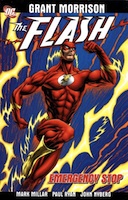
Flash Week continues at Collected Editions with my guest review of Flash: Emergency Stop. The trade covers the first half of the year-long Grant Morrison/Mark Millar run with art by Paul Ryan and covers four stories:
- Emergency Stop (Flash vs. the Suit)
- Through the Looking Glass (Flash vs. Mirror Master)
- Still Life in the Fast Lane (a focus on Jay Garrick)
- Three of a Kind: Part Three (a courtroom drama dealing with the aftermath of a Flash/Green Lantern/Green Arrow team-up)
Read the review at Collected Editions, or order the book at Amazon.
June 21, 2010
The Collected Editions blog has just started Flash Week, a whole week of reviews of Flash trade paperbacks and hardcovers, leading up to a review of Flash: Rebirth. First up: a review of The Return of Barry Allen.
Along the way, I’ll be contributing a couple of guest reviews covering the Grant Morrison/Mark Millar collections, Emergency Stop and The Human Race.
Collected Editions is a great site for news about upcoming DC Comics (and sometimes other) collections as well as reviews. The site also maintains the DC Trade Paperback Timeline. Last year they put together a Top Flash Trade Paperbacks list.
January 14, 2010
Last Monday, CBR posted a new installment of Geoff Johns Prime, their occasional question-and-answer feature with the writer.
Responding to a question about the new costumes introduced in Flash: Rebirth #5, he talked about the “Emergency Stop” story by Grant Morrison and Mark Millar and how it provided “the first inkling that the Speed Force was more than just gasoline.”
I always thought of the Speed Force as if it were this layer, kind of like the fluid in your joints that allows your bones to move together, and if you think of that as the Speed Force, it’s this fluid between the now and the time stream. It allows the two to co-exist, because the way time exists, it’s not just a line, it’s a sphere. So that fluid coats that sphere and the sphere is the Speed Force. And that sphere touches all reality and it’s full of everything, it’s full of ultimate speed, moving through reality, because time is all relative and it’s full of all scientific knowledge. It’s all knowledge of all eras.
Johns answered several other questions about the Flash, confirming that the Rogues will be heavily involved in the new series (no surprise there) and that their tailor, Paul Gambi, will return.
Another item I found interesting is that the price was a major factor in the decision to scrap the backup stories they had previously announced.
There’s more there about the Flash, plus he answers questions about Blackest Night, Earth One, Smallville and more.
May 15, 2009
Linkblogging for a Friday afternoon…
The Absorbascon examines Abra Kadabra, go-to-guy for crazy, impossible things.
Now Read This! reviews Flash: Emergency Stop.
Death and Rebirth
The Alliterates ponders why dead men (Barry & Hal) tell more tales.
Dan Didio talks death and resurrection in his latest 20 Questions feature.
Where Are They Now?
Mark Waid talks Cyberforce/Hunter-Killer.
Marc Guggenheim (“Full Throttle”) and Michael Green talk about trying to get serialized fiction onto TV…not to mention dealing with religious themes on TV.
March 10, 2009
The Victoria Advocate profiles Doug Hazlewood.
Comics In Crisis presents Flash v.2 #182 (2002), the Captain Cold Rogue Profile story, among the 10 Essential Bronze Age Comic Stories You Should Read. I’d disagree with the Bronze-Age classification (traditionally, the Bronze Age of Comics ran from the 1970s through mid 1980s, with Crisis on Infinite Earths being a good reference point for DC books), but it’s absolutely a must-read.
X-Man reviews Flash vol.2 #1 (1987), noting how different Wally West was at the age of 20 than he is today. That’s actually one of the things Wallys’ long-term fans like most about the character: that we’ve seen him grow and change naturally, rather than simply be given a personality transplant whenever a new writer shows up.
The Quantum Blog talks about TV shows canceled before their time, including the 1990-1991 Flash TV Series. (Hard to believe it’s been almost 20 years. Seriously, Quantum Leap is having a 20th Anniversary convention this month. I feel old…)
The Worlogog celebrates Weird Silver Age Tales of the Flash.
I haven’t had a chance to listen yet, but Raging Bullets Podcast #152 features Flash’s Rogues with listener guest Mike Simms.
Heritage Auctions will be selling a CGC 9.6 copy of Showcase #4, the comic that rebooted the Flash as Barry Allen, launching the Silver Age (via It’s all Just Comics)
A Journal of Zarjaz Things looks at Flash: Emergency Stop, griping that Grant Morrison’s 9-issue run is split across two trades with the second “padded” out with a 3-parter by Mark Millar. IMO, though, Morrison didn’t write a 9-issue Morrison run — he co-wrote 9 issues of a 12-issue Morrison/Millar run. It would have been less responsible for DC to print only the Morrison issues and leave out “The Black Flash,” which has arguably had more lasting impact on the Flash mythos than the other stories in these trades, good as they are. (It is silly that they left out the first two parts of “Three of a Kind,” though.)
January 20, 2009
This week, The Flash: Emergency Stop hits the shelves. The trade paperback covers half of the year-long Grant Morrison/Mark Millar run from the late 1990s, and, according to solicitations, features the conclusion of “Three of a Kind.” This three-part crossover between Green Lantern, Green Arrow, and The Flash features the second– and third-generation heroes Kyle Rayner, Connor Hawke, and Wally West. Villains Heat Wave, Sonar, and Hatchet attack a cruise liner in which Dr. Polaris is being secretly transported, only to find the three heroes have booked a vacation on the same ship.*

The segment in The Flash v.2 #135 focuses on the villains’ trial, with flashbacks to the incident. At the time, Wally West’s identity was public knowledge, though he testified in full costume. This in itself is unusual given standard courtroom dress codes (a skin-tight bright red costume isn’t exactly conservative business attire, and tends to stand out a bit). But then Green Lantern takes the witness stand:

The usage is similar to the U.S. Constitution’s 5th Amendment, which states in part that “No person…shall be compelled in any criminal case to be a witness against himself.” Two things can be gathered from these panels:
- The DC Universe had a “Federal Authority of Registered Meta-Humans” years before Marvel’s Civil War (though after the first story with the Mutant Registration Act).
- The DCU version of the United States Constitution has a Twelfth Amendment which, under some circumstances, allows witnesses to give an alias rather than a real name when testifying in court.
There’s no indication that it’s required to register, or whether it’s simply a good idea if you want legal backing. It’s not even clear whether heroes have to register under their real names. I can’t remember whether any other books made reference to this authority, but suddenly I really want to find and reread my back issues of Chase.
In the real world, the Twelfth Amendment dates back to 1803 (passed 1804) and changes the way the President and Vice-President are elected. Assuming the DCU’s US just has one more Constitutional amendment than we do, their Twelfth would be just about as old, which leads to the question: Why did they need to amend the supreme law of the land to allow masked heroes to testify 130 years before the Golden Age of super-heroes?
Thinking about it, though, DC does have super-heroes whose adventures take place in earlier eras, especially in North America. Not just heroes of the Western genre like Jonah Hex or Bat Lash, but classical super-heroes with masks, costumes and powers. Max Mercury’s origin dates back to the early 1800s, for instance, and Miss Liberty (an ancestor of Jesse Quick/Liberty Belle) fought in the American Revolution.
Might the early United States in the DC Universe have decided it was worth letting some of their more colorful national heroes remain pseudonymous even in legal proceedings? It’s certainly possible.
Whatever the circumstances of its passage, it sheds some light on the otherwise nonsensical fact that Barry Allen kept his mask on and his identity secret from his arrest all the way through his trial for manslaughter in the case of Professor Zoom’s death, dissected in great detail by Bob Ingersoll.

*It’s a little more complicated than that, of course.
September 15, 2008
Contrary to previous reports, it turns out that “The Black Flash” isn’t getting the collected edition treatment just yet. Now that DC’s December solicitations are out, they’ve officially solicited the January 21 release of The Flash: Emergency Stop. It’s confirmed at a $12.95 trade paperback covering Flash vol.2 #130-135 — only half of the Grant Morrison/Mark Millar run.
So what does that include?
- “Emergency Stop” — Flash vs. the Suit, with a time travel mystery.
- A one-shot fighting the Mirror Master.
- A one-shot focusing on Jay Garrick.
- The third part of the “Three of a Kind” crossover with Green Arrow and Green Lantern.
See also my overview of the whole run.
The surprise here isn’t that it’s only half the run. 6 issues is typical for a collection these days, and since the whole run is 12 issues, that makes it easy to cover the whole thing in two books.
The surprise is that with “Three of a Kind,” they included 1/3 of a 3-part story. At least it should flow reasonably well, since it was told with its own framing sequence, but it’s still an odd choice.
Update: “The Black Flash” will appear in Flash: The Human Race, shipping in June 2009.
September 14, 2008
The preview of DC’s December 2008 solicitations is are up at Newsarama and CBR. Here are the Flash-related books listed so far.
Update: Full solicitations are up. Read on!
The Flash #247
Written by Alan Burnett
Art by Carlo Barberi & Drew Geraci
Cover by Brian Stelfreeze
“This Was Your Life, Wally West” concludes! As Flash stands alone without his powers or family to support him, only one question remains – is this end of the Fastest Man Alive?
On sale December 24 • 32 pg, FC, $2.99 US
Notes: Surpisingly enough, the solicitation doesn’t actually say that it’s the last issue.
Team books and events appear after the cut. Read the rest of this entry »
September 2, 2008
Rumor column Lying in the Gutters seems to think that the upcoming Emergency Stop trade paperback contains the entire Morrison/Millar run on The Flash from 1997. And considering that Amazon is currently quoting a list price of $60(!), I certainly hope so! For that price — heck, even for the discounted price of $37.80 — it ought to be both complete and a hardcover!
It’s still listed as shipping in January, so with any luck we’ll get more solid information in DC’s next round of solicitations.
On a related note, the first real substantive post I made on this blog was a summary of the Morrison/Millar run. I don’t remember what price Amazon was quoting back then.
June 20, 2008
Here’s a quick update on the earlier post about the Morrison/Millar run getting the trade paperback treatment. Collected Editions reports that “The Black Flash” will be included in The Flash: Emergency Stop.
This is a good move, as it’s the story from that period that has added the most to the mythos. The Black Flash, the personification of death for speedsters, has shown up in two pivotal arcs: “Mercury Falling” in Impulse, and “Full Throttle” in Flash: The Fastest Man Alive. It was in “Full Throttle” that Inertia and the Rogues killed Bart Allen, just a short time into his career as the fourth Flash. The consequences of that event have spun into Countdown, Salvation Run, the current “Fast Money,” and the upcoming Final Crisis: Rogues’ Revenge.
Incidentally, several months ago the Black Flash made an appearance in Something Positive as the only Flash villain that Davan MacIntire likes. The presentation almost makes it look kindly as it carries a dying Flash away. (Warning: while that particular strip is “work-safe,” the webcomic and the commentary often feature adult language, situations, and offensive humor.)