August 30, 2011
Today’s guest post is by Shaun Rosado of Shauncastic!
A Sound of Thunder
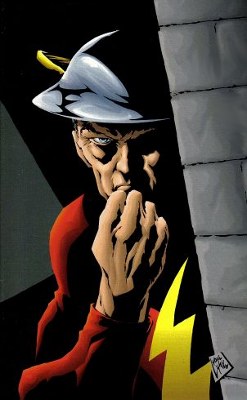
The sound of thunder, a crack of lightning and in a flash everything is different. No, I’m not talking about Flashpoint; DC Comics’ current take on a “Flash-centric” Event. I’m talking about the Flash as a character and the profound difference he’s made in comics. Ever since I was a child, I always felt a deep connection to the Flash. Perhaps it was the sense of the character’s long history, reaching all the way back to World War 2 with Jay Garrick as the original Flash. Perhaps it was the idea that when I was at my most impressionable the Flash TV show had just begun and would capture my imagination. Or perhaps it’s because the Flash is the most important character of the DC Universe.
Yeah. You read that right. I typed it. The Flash is the THE most important character of the DC Universe.
Of course, I don’t expect to get away with saying something like this without a little backup.
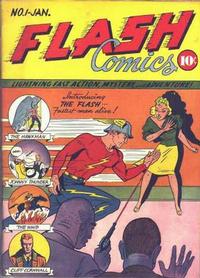
So let’s take a moment and just go over the finer points of my argument. When the Flash began way back in the 40s, he was a character that was given his own book nearly as soon as he was established. In January 1940, Flash Comics began as a variety comic that would feature new characters and give them a chance to flourish. Some of the most famous of these characters would be Johnny Thunder, Hawkman, Hawkgirl and Black Canary. This began an eerie precedence of the Flash establishing ideas and characters that would last and break out of his book time and time again. The book ran nearly the entire span of the Golden age, ending just a few months shy of the “official” end date.
But this is not a sprint and the above argument certainly does not win the Flash the title of Greatest Character Ever. This is a marathon…and as we all know, the Flash is the Fastest Man Alive. Read the rest of this entry »
March 2, 2011
Originally posted at K-Squared Ramblings.

How important is it to label fictional universes? Does it matter that Young Justice takes place on “Earth-16,” while the universe of Batman: The Brave and the Bold doesn’t have a number? Is Earth One a good label for a self-contained Superman or Batman series? If an editor writes “Earth-1″ instead of “New Earth” in Tangent: Superman’s Reign, should it overshadow discussion of the actual story? Do they need to be precisely separated, with each story identified clearly as belonging to one universe or another, or is a more general classification enough?
And once you’ve decided to catalog them, how do you label them?
A few multiverses that come to mind are DC Comics’, Marvel Comics’, and Michael Moorcock’s.
The multiverse of Moorcock’s Eternal Champion cycle is extremely fluid, with details changing whenever he wants to tell a different story. Just looking at the Elric stories, there are three or four origins for Stormbringer, and as many for the Melnibonéans and their pact with Arioch. There are several versions of the 20th-century Count Ulrich Von Bek (depending on whether you include Count Zodiac). Worlds are less like parallel lines and more like streams that can run together, mingle, and separate again (kind of like the briefly-used Hypertime as used by DC).
DC and Marvel, on the other hand, favor a discrete structure in which each universe can be precisely identified. This may have something to do with the focus on continuity as a key element of comic-book storytelling, and would explain why, for instance, Marvel has made an effort to number what seems to be every single alternate reality they’ve ever published.
Approaches to numbering:
- Sequential. DC started out like this, with Earth-1, Earth-2, Earth-3, etc.
- Random. Current DC multiverse, except for the first few we saw at the end of 52 which were based on worlds from the original DC multiverse (Earth-2, Earth-3, Earth-5 from Earth-S, Earth-10 from Earth-X). Marvel’s main continuity, Earth-616, was reportedly picked at random (though there is some disagreement on this point).
- Referential. Things like choosing Earth-S for the worlds of Shazam or Squadron Supreme, or Earth-C for Captain Carrot. Earth-97 for Tangent (which appeared in 1997) and Earth-96 for Kingdom Come (which appeared in 1996) would also fall into this category (but see the next point).
- Systematic. Taking referential labels a step further, using a consistent scheme. Marvel derives most of its designations from publication dates.
Personally, I prefer to just name them. “The Tangent Universe” or “New Frontier” or “Supremeverse” gets the idea across more directly than, say, Earth-9.
August 27, 2010
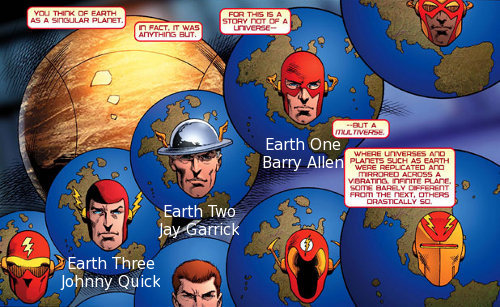
A while back (OK, a year ago — I’m trying to get my email inbox under control again), David Fulton sent in a link to this image from the 52 back-up feature, History of the DCU.

The panel appears in part three of the story, which summarizes the events of Crisis on Infinite Earths and explains the original Multiverse. I’ve labeled the Flashes I recognize, but I believe the rest are new creations. The mask in the upper right with the goggles reminds me a little of the Crime Society Johnny Quick (who would not make his first appearance until the end of 52). The full face mask directly below Barry Allen reminds me a bit of the suit in the JLI Elseworlds Annual.
So why create new Flashes just for one-time cameos instead of using existing obscure characters? There actually weren’t that many alternate realities explored before Crisis — at least, not realities that were similar to the mainstream Earth-1/Earth-2 dynamic with DC’s major heroes. Once you got as far as Earth-4, they were dealing with the Charlton heroes, or the Quality heroes, or the Fawcett heroes, worlds that didn’t have a Flash.
They could have pulled in some examples from Grant Morrison’s “Second Crisis” story in Animal Man, or from some of the settings retroactively added to the pre-Crisis multiverse like Kingdom Come or the Tangent Comics Flash, but they may have wanted to stick with “real” characters who were actually around at the time of COIE. That leaves the Zoo Crew’s Fastback or the Justa Lotta Animals’ Crash, but they were going for a serious tone with this story. A talking turtle with super-speed might have spoiled the mood!
April 6, 2010

Where else would you need Morrison school supplies?
Edit: It gets better. There’s a comic store in the same shopping center.
December 7, 2009
I went back and looked at the comments on the Earth One announcement at The Source. Big mistake. There’s an argument over whether it’s the same as Earth-1 in the 52 Multiverse, what Earth-1, Earth-2, Earth-0, etc. all are in this universe or the previous DC Multiverse, etc.
In short, the title alone drags the new, streamlined books into the realm of continuity-heavy fanboy debates.
In general, I don’t like numbering alternate realities. It can be useful for cataloging, but it’s much clearer to refer to “the Smallville version,” “Mainstream DC,” “Ultimate Marvel” or “Tangent Universe” instead of tossing around terms like “Earth-616″ and “Universe Designate Zero.”
And isn’t the point of this new line to make things less confusing?
DC needs a banner they can put on these books, so that readers can look for “XYZ Superman Volume 1″ on the shelf. But “Earth One” is already causing confusion, just hours after it was announced.
May 21, 2009
CBR has posted a write-up of the DC Nation panel at Bristol Comics Expo last weekend, and Dan Didio has (as usual) some interesting things to say about the Flash.
All modern concepts of The Flash stem from the Silver Age Barry Allen version of him, and ‘The Flash: Rebirth’ does not negate the all of the stories that have gone before, it merely brings back the star character of the franchise in order to revitalize and expand the Flash universe, using the core concept as the foundation.
Well, sure, it doesn’t negate them…except for the stories that have been negated. For example, anything that involves Barry’s parents being alive during his career as the Flash, like the Identity Crisis tie-in, “The Secret of Barry Allen.” Hmm, I wonder who wrote that one?
Undoing Crisis on Infinite Earths

He also explains that since the “pillars of ‘Crisis on Infinite Earths’” — the deaths of the Flash and Supergirl, and elimination of the multiverse — had long since started falling, they might as well knock them all over. I’m not sure I’d consider those “pillars.” Things that happened, sure, but the key purpose of COIE was to combine DC’s multiple universes’ worth of characters into a single, cohesive history — and that still stands. There may be alternate realities, alternate timelines, hypertime, a multiverse, whatever you want to call it — but they’re all variations on a theme.
There’s still a main DC Universe which is home to all the Golden Age DC characters, all the Silver Age DC characters, all the characters DC bought from Fawcett, Quality, Charlton and other companies, even the Milestone and Archie/Red Circle characters that they just licensed last year. They’re all part of “The DC Universe,” which itself has become a brand name.
Just adding a multiverse that contains worlds for the Tangent characters, popular Elseworlds concepts, and new alternate realities? That doesn’t undo the Crisis. Really undoing it would mean splitting off groups of characters into separate universes, and at this point DC couldn’t do that without a much more substantial reboot than they did with Zero Hour or Infinite Crisis.
Waiting for the Trade
One last note: Didio’s perspective on trade-waiting, and DC’s focus on periodicals:
We have to make it feel like you can’t wait for the trade. I hate the expression ‘wait for the trade.’ It’s the thing that upsets me the most, because it means in my opinion that what we’re creating isn’t worth reading now. ‘I can pick it up a year from now.’
It’s an interesting take on the issue. It reminds me of a remark someone else made about how if you wait for the trade, you might not remember to pick it up a year from now, whereas if you’re buying something every month, you’re a lot less likely to forget. I suppose there’s some truth to that, but I’ll say this much: when it comes to prose authors I follow, if I’m following a series or really looking forward to their new book, I’m going to either pre-order it or go straight to the local bookstore the week it comes out.
I mean, how many Harry Potter fans forgot to pick up the last book when it came out?
February 21, 2009
Mark Waid talks to Newsarma about Batman in Barcelona: Dragon’s Knight #1
Comicbook.com includes the Flash’s Rogues in their Top 10 Costume-Dependent Comic Book Characters.
Seduction of the Indifferent is starting a feature on Pied Piper covers, and the first installment highlights Flash Comics #59. A decade before the Rogue of the same name first appeared, this other villain based on the Piper of legend fought Hawkman and Hawkgirl.
Robot 6′s Grumpy Old Fan looks into “Flash of Two Worlds” and its influences on later comics as part of his “Towards A Modern Superhero Canon” series.