
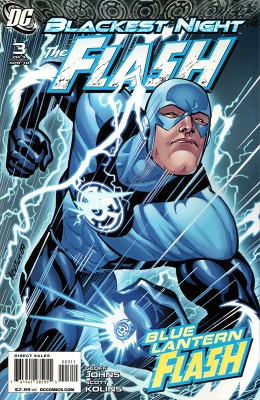
The conclusion of this miniseries — to the extent that it concludes, anyway — is more satisfying than the middle chapter. The story is more solid, and it’s visually more varied as characters with colors beyond black and blue join Blue Lantern Barry Allen onstage.
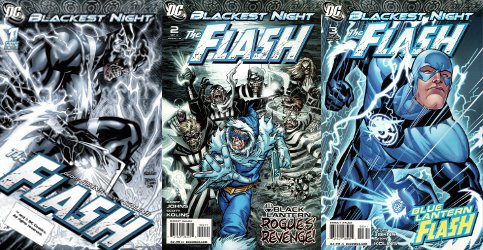
Speaking of color schemes, I noticed something interesting about the covers: they get progressively brighter. The first issue is mostly black and silver, with a dark blue logo outline. The second issue adds some color by putting Captain Cold in the center, and has a brighter logo outline. By the third issue, Blue Lantern Barry takes up the entire cover, and the logo is again a tiny bit brighter. I don’t know whether it’s intentional, but it’s certainly thematic.
The story follows three main threads: The Rogues in Iron Heights; Captain Boomerang; and the Flashes.
The Rogues’ story gets the least attention this time around. Once again it picks up right where they left off, but instead of focusing on emotional manipulation, it’s basically a dungeon crawl as they try to work out something that will shut down the Black Lantern Rogues. It does, however, give away a little more about the resolution of Flash: Rebirth
Captain Boomerang’s story is a sad one, and while moving, I’m afraid it significantly damages the character for future use. More on this in the spoiler section.
This time around the Flashes’ story works best. Barry Allen is still dealing with an unfamiliar power set, but by this time he’s gotten accustomed to it, rather than spending the entire issue learning how to use the blue ring…plus there are other speedsters around to keep the “Fastest Man Alive” theme on track. There’s also a solid resolution to one of the major story elements from last month.
Of course, since this is a side story to a larger event, it ends — or rather stops — with a big “To be continued” sign as several characters head back into the main Blackest Night story, and the big question from issue #1 is left unanswered.
Spoilers below!
.
.
.
.
Flash Family
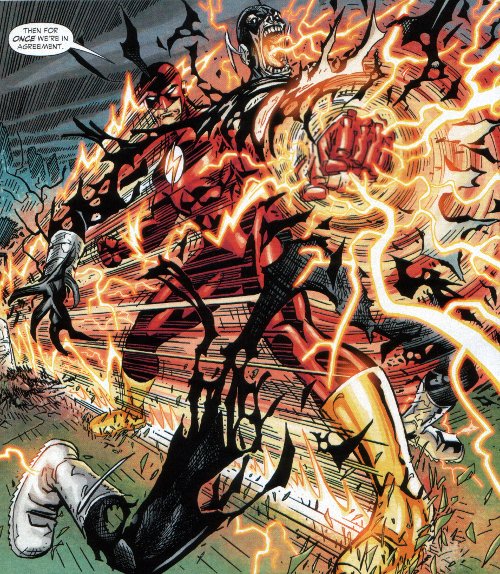
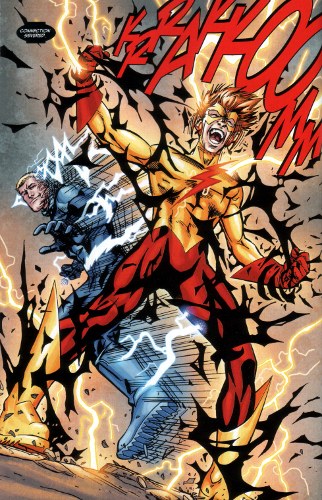 The core of the issue is the struggle by Flashes Barry Allen and Wally West to free Kid Flash Bart Allen from the influence of the Black Lantern Ring. Bart — or rather, Black Bart — continues to play the Devil’s Advocate role he played early in Flash: Rebirth, this time about the value of keeping Wally West around. At this point, the other Black Lanterns — the ones animating dead bodies rather than controlling live ones — are mere distractions.
It was satisfying to see Kid Flash’s possession resolved in the Flash miniseries, rather than left for Blackest Night itself, and it was good to finally get some solid interaction between Barry and Bart. I can barely remember them speaking to each other in Flash: Rebirth outside of “Where’s Max?” and “I don’t know.”
On the other hand, I would have appreciated the Reverse-Flash’s resurrection actually being handled in a Flash book. Too much to hope for, I suppose, since it’s probably linked to the conclusion of Blackest Night, which they wouldn’t want to spoil two months early. What we did get (showing some sort of link between Thawne’s future self and past self) didn’t even make any sense, though I’m sure it’s a clue toward something happening in the final act of the main series.
Boomerangs
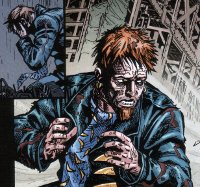 The younger Captain Boomerang, Owen Mercer, has captured the Black Lantern-animated corpse of his father “Digger” Harkness, tossed him in a pit, and is tossing down people for him to kill. Owen has bounced around a lot between villain and hero over the years, and hopes he’ll find some sort of direction by bringing his father back…and the Black Lantern has convinced him that it just needs to “feed” on enough people for him to come back. He starts with small-time super-villains whom even the Rogues would find repulsive, and works his way up to innocent bystanders. When the Rogues find out, they toss him into the pit, with predictable results.
It’s grisly. It’s chilling. It’s an effective portrait of someone lost, looking for anything to hold onto, stepping onto the wrong path and being consumed with darkness. But making him a child-killer crosses a line with the character. In the same way Dr. Light’s role in Identity Crisis and Inertia’s role in “Full Throttle” made the characters difficult to use again, this is going to be a problem for Owen — more than his death, because I’m still not convinced that any death is going to stick in a miniseries about the proverbial revolving door.
It also feels like yet another “out with the new” moment to go with the New Rogues and Zoom in Final Crisis: Rogues’ Revenge and, of course, the refocusing of the Flash franchise.
Art
 The mirror and parallel themes continue, and Scott Kolins makes good use of echoing images and layouts to highlight those themes. Some images that stood out included:
- Bart Allen’s revival (above) echoed Wally West’s dispersal of Black Lantern Eobard Thawne in issue #2.
- Similar layouts for the two scenes in which Wally and then Barry make contact with the real Bart.
- Lots of close-ups on eyes.
- The view of the Rogues as they catch up to Captain Boomerang to deal with the final zombie, similar to the shot from the end of issue #1 but showing just how much they’ve been through during the battle.
- Mirror images of Barry Allen and Captain Cold as they make almost — but not quite — the same statement about moving forward.
- The final page, with the Flashes running toward the reader and the Rogues trudging away.
I was also reminded — better than last issue, oddly enough — that while the gritty side of Kolins’ art is well-suited for hardened criminals, dark alleys, and not-exactly-zombies, he’s also good at expressing joy, as you can see in the Bart and three-Flashes scans.
Overall
Blackest Night: The Flash #3 was better than I expected, had some very satisfying moments, but left certain things — like the key question from the first chapter — frustratingly unresolved. Ultimately, I suspect it will work better for those who are reading it as part of Blackest Night than for those who are attempting to read it on its own.
See Also:
There’s already a lot of fannish rage building over the plot with Owen. I don’t quite understand why Johns went there myself.
I don’t doubt it. It’s the kind of thing that works great with your own character in your own finite story…but is just plain wasteful when applied to someone else’s character in an ongoing shared universe.
I love, love, love Barry freeing Bart from the ring – worth the issue alone, IMO, but then again, I’m quite lenient.
I enjoyed the issue. Never been that big a fan of Owen to be bothered, but I do understand why his fans are enraged.
The resurrection of Professor was very puzzling, actually I came here, hoping you know what it meant.
But when he was hanging from the ceiling, he didn’t look too alive and well LOL.
The Professor Zoom in Iron Heights was the future version of Thawne, who was already alive in Flash: Rebirth.
We still haven’t seen how he gets from Black Lantern Reverse Flash to alive-again Reverse Flash.
It’s been pointed out in forums that when he appeared in negative, he had the Brightest Day logo. I didn’t catch that the first time through, in part because the White Lantern and Black Lantern logos are so similar: an inverted triangle with lines stretching out from the top.
This is more of a Green Lantern question but how was Barry able to make ring constructs with his ring when there were no Green Lanterns around?
I enjoyed the story but it did serve to remind me how I’ll just have to get used to Wally being a supporting player.
I picked up on a lot of the parallel art noted in the review and thought it added to the story and issue.
Is the consensus that the old Rogues will survive?
I dunno why but with all the deaths in Blackest Night (Aquaman, Firestorm, The Hawks, Tempest, Damage and now Owen… something strikes me about some of them as temporary)
I’m probably Owen’s biggest fan in the world. Given this issue, I can’t say I was completely suprised. I was more disappointed in him.
After Rogue War, when we found out he was related to Bart, I went on a frenzy, and started buying everything he showed up in: Outsiders, Supergirl, Suicide Squad, everything. I’ve seen him struggle with who he is the entire time, going from bad guy rogue, to good guy outsider, to less than good guy suicide squader.
Owen was looking for some real direction. I have been waiting for Owen to choose his direction. As Bart Allen’s brother, will he be his best friend or his greatest foe? I think we got the first part of our answer…
The one thing that kinda ticked me off about what ultimately happened with Owen was this: aside from Ashley Zoloman, NO ONE in that era knows that he and Bart are related by blood. It’s something that would have made an excellent stand-alone issue for the new Flash series, and now Geoff Johns has pretty much assured us that it’s never gonna happen. Even if he comes back to life after BN, Owen is officially a murderer now. There really aren’t many ways to redeem someone who tosses children in a pit for their undead dad to eat.
Well, Ashley did write the name of Owen’s mom in her files, which I imagine other Keystone/Central City cops can access. So other people might know, including eventually Barry.
Bringing me to another question – is there anyone in the 21st century (not including Iris) that knows of Bart’s connection to the Thawne bloodline?
Max, definitely, and Carol (who bounced around in time with Bart’s mother for a while).
Probably Helen, and possibly Dr. Morlo. I’d guess Wally, Jay, Joan and Linda. He may have told Tim, Conner, or Cassie.
Well with all the speculation on what the Ressurection of Reverse-Flash Thawne etc. being thrown around and the fact that it looks like it doesn’t get explained in a Flash title of any sort. My guess is that with all the returning to life heroes after Blackest Night wraps up and Brightest Day starts… i. e. Aquaman is returning to the comics! I wouldn’t be surprised to see the new Zoom being his past and future selves merging when they both get resurrected in the same time. Just a guess but it’s probably not far off. We’ve already seen Reverse Flash as multiples of himself in Rebirth so this just kinda makes sense.
I really disliked this issue for a couple of reasons. The Owen thing felt a little forced and creepy-for-the-sake-of-creepy, which comes off for me as more an indictment of the writer than genuinely, constructively creepy. The climax with Barry and Bart bugged me more, though; it’s been over ten years since Wally got his explosive vibrations under control. Bringing that back now so that Barry becomes the only one who can save Bart feels like just another marginalization of the character to me.
I don’t recall Wally ever getting his explosive vibrations under control; when was this?
As I recall, around the time that it was established that vibrating through solids was a no-no, Waid gave him the ability to “steal” speed/inertia.
Right after the Dark Flash saga, it was established that he could (at least sometimes) manage to vibrate through things without blowing them up. They assumed he’d picked it up somehow while working with Walter. Since then, it’s been very inconsistent, so I think the rule is that he can vibrate through things without exploding them when the plot requires it.
I hated what happened to Owen as a character, though I am pretty sure he might not have been the only person in the DCU to go the pit route aka giving victims to the Black Lanterns. The other problem for me was the dead victims not rising as Black Lanterns.
I’m elated they finally took the word electricity out of The Flash intro blurb. 😛
Wait a minute… didn’t Weather Wizard internalize the powers? Why is he using the wand? Did I miss a storyline or is my memory tanking again?
They kind of went back to the wand without any explanation. Not that I mind it. The wand is an awesome visual and the newer costume really just looks odd without it. But I don’t remember them explaining it, just him showing up with it again.
.-= Devin “The Flash” Johnson’s latest blog post: Third Post! =-.
Pingback: Blackest Night Discussion – Spoliers for Blackest Night#8 « Comicbook Crossfire
I was so pissed off when I saw Owen’s name added to the Black Lantern list on Wikipedia. It was such a waste of a good character to do this to him. I havent read the BN: Flash comics in the least. But I remember picking up 2 and 3 when I was in the store. And didnt really think to read em all the way through. But still, I cant believe they did that to Owen. That’s so stupid and pointless.
I still think that Owen could have held down his own mini-series for a time. It would have been intrestring. I’m still hopefull that he’ll be resurrected someday. He still had a lot of potential left in him.