Category Archives: Reviews

Review: The Batman Season 5

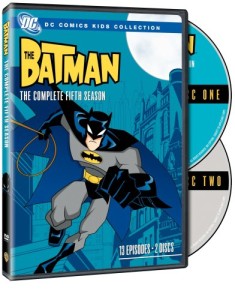
The Batman Season 5I recently watched the complete fifth season of The Batman. I’d only ever seen one episode, “A Mirror Darkly” (the one with the Flash, of course!) before, and when I decided to watch the two-parter with the Justice League, I figured I might as well watch the rest of the season.

The series follows Batman, a young Robin, and a teenaged Batgirl as they battle the usual assortment of Gotham City villains. While the 1990s Batman: The Animated Series essentially translated the comic-book versions of these characters into a style suitable for animation, The Batman has redesigned virtually everyone…and that’s the main problem I have with the show. They’ve taken the villains and dehumanized them, making them into little more than monsters.

Introducing the League

The main thread for season 5 is showing Batman as he works with the Justice League, with 8 of 13 episodes featuring guest stars. Unlike the Gotham villains, the heroes’ designs are practically lifted from the comics. It’s also a much more Silver Age League (at least compared to the animated Justice League and Justice League Unlimited from earlier this decade)*, with Hal Jordan as Green Lantern, Hawkman as a Thanagarian policeman, and Barry Allen (though his name is never mentioned on screen) as the Flash. Conspicuously absent is Wonder Woman, an oddity considering the larger role given to Batgirl in this series. That, and some of the visuals in the final episode, reminded me of Filmation’s Justice League cartoons from the 1960s.

The season opens with a two-parter pitting Batman against a mind-controlled Superman. Lex Luthor and a host of Batman villains guest star. Oddly enough, I found myself looking up the casting, even though Superman, Lex and Lois are voiced by the same actors as in the Dini/Timm cartoons. The takes on each character were enough different that I didn’t notice the voices at first.

Batman goes on to team up with Green Arrow, the Flash, Green Lantern and Hawkman over the course of the season, as they fight Count Vertigo, Mirror Master, Sinestro and the Shadow Thief. The Green Lantern tie-in, “Ring Toss,” was particularly fun, as the Penguin obtains GL’s ring. He figures out the basics pretty quickly, even though he doesn’t have the experience — or willpower — to use it to its full potential.

The Flash

According to the producers, the Flash in this series is Barry Allen, though his real name is never mentioned onscreen and his personality is somewhere between the Timmverse Flash and Impulse.
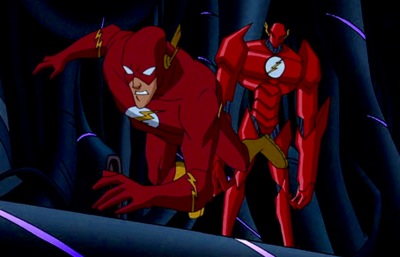
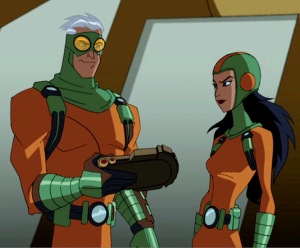
The Scarlet Speedster teams up with Batman and Robin in “A Mirror Darkly” (on the first disc of the set). Mirror Master has come to Gotham City seeking components for a weapon (of course), and uses mirror duplicates of heroes — including both Batman and the Flash — to help him steal them. I like the portrayal of Mirror Master as a smug know-it-all mad scientist, and the redesigned costume works fine for me. He’s been given a sidekick/assistant named Smoke, and thankfully the show’s staff resist the urge to point out the pun in the name (though I keep thinking of the episode, erroneously, as “Smoke and Mirrors” because of it).

Mirror Master’s plan proves to be one of those totally bizarre schemes that would ordinarily seem out of place in a Batman story, but feels right at home in a classic Flash story with new pseudo-scientific feats appearing on every page.

On a related note, I could swear I remember an episode of Batman: The Animated Series that also featured a showdown in a room-sized orrery at a planetarium, but I just can’t place it.

Finale

In a sense, there are two series finales. “The End of the Batman” has Batman and Robin going up against Wrath and Scorn, opposite numbers who have dedicated themselves to protecting criminals and wiping out the Batman. They bring in half a dozen Batman villains in on the scheme, one which will not only make them all rich, but end the threat of the Batman for good.

Then the two-part “Lost Heroes” brings the Justice League thread to the foreground, as all the heroes who have guest starred over the season show up just long enough to be abducted, leaving Batman and Green Arrow to track them down. The heroes must battle robots that have stolen their powers, then head off another alien invasion. Robin and Batgirl aren’t left out of the action either, and their reactions to meeting the League — and seeing its headquarters — are priceless.

(This story also has the oddest portrayal of Hugo Strange that I’ve seen, but then I’m mainly used to the version from Legends of the Dark Knight, so I’m not sure what “standard” is. Now that I think about it, he looks like a cross between Dr. Scratchensniff and Ralph the Guard, and now I can’t unsee it.)

*I realize I’m probably going to compare almost any animated DC show to the DC Animated Universe for quite a while. Even though I grew up on Superfriends in the early 1980s, it was the 1992 Batman series that really resonated with me and my friends in high school. It was a show that actually managed to present complex characters and storylines without talking down to their audience. It featured the best portrayal of Two-Face until this year’s The Dark Knight. The direct-to-video Batman: Sub-Zero was a better Mr. Freeze movie than Batman and Robin, which came out the same year. And it introduced Harley Quinn. How can you argue with that?

Review: Flash #247: “Incubation” (Final Issue)

Flash #247

Well, if Wally West’s series had to end — again — at least he got a decent send-off. Flash #247 concludes Alan Burnett’s four-part “This Was Your Life, Wally West”. This story wraps up threads from the current run of the series, looks back on Wally’s entire super-hero career, firmly establishes his roots in the Justice League and Titans, and sets up a few beats that can be picked up for future stories with the characters.

It picks up immediately after the previous issue’s cliffhanger, resolving the threat to Linda before rushing headlong into battle with the Queen Bee. This month does feature another flashback, this time to the West family’s time on the planet Savoth, but it’s only two pages. It ends with a conclusion that’s not quite an ending, but a place to stop. DC isn’t burning any bridges here the way they did with “Full Throttle” and the end of Bart’s series.

It’s also much better than “Finish Line,” the four-parter that wrapped up Wally’s series the last time it was canceled, from Flash #227–230. It was better written, better researched, and actually made an effort to tie together the rest of the series. The only thing “Finish Line” has over “This Was Your Life, Wally West” is consistent art.

While the first issue of the arc was penciled entirely by Paco Diaz, and the second and third were penciled entirely by Carlo Barberi, this issue was done by committee. Barberi gets the cover spot, but is joined by J. Calafiore and Andre Coelho. I’m not familiar with either of their work, so I couldn’t tell who did which pages, but the shifts in style were jarring. Normally changes in artist don’t bother me, especially if their styles are similar or if the change is done for thematic effect. (An example in The Flash would be Race Against Time, in which each issue used one art team for Wally’s storyline and another for John Fox’s.)

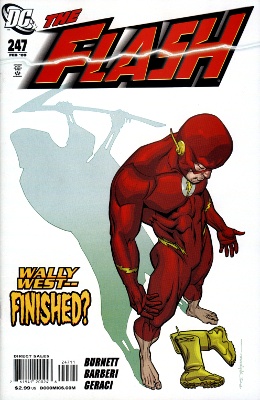
Brian Stelfreze’s cover, on the other hand, has got to be one of the best Flash covers since the relaunch. (I’d also include issues #243 and #246, both by Freddie Williams II) The starkness of it, with the plain white background, the shadow of the grim reaper, and the Flash standing barefoot with his boots off, says everything that needs to be said about what he’s up against. Honestly, I think it would work better without the “Wally West — Finished?” caption, or even the title logo.

Spoilers after the cut: Continue reading

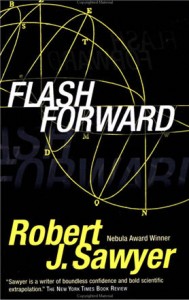
Review: Flashforward

This has nothing to do with The Flash except the title, but I’ve been a fan of Robert J. Sawyer’s novels for several years and figured this site’s audience might still appreciate the review.

Flashforward has been in the entertainment news quite a bit the last few weeks with casting for the TV series pilot (more about that later). Strangely enough for a story that’s all about time and the role of the observer, I started reading the novel the day before the first casting news hit.

The novel looks at what happens when, at the moment a scientific experiment begins, everyone on the planet blacks out for two minutes. For those two minutes, everyone sees through the eyes of their future selves, two decades down the line. The world is transformed: first by the millions of accidents caused as drivers, pilots and surgeons lost control of their vehicles and instruments, and second by the survivors’ knowledge of the future.

What follows is an exploration of the nature of time, destiny and free will. Is this a glimpse of the future as it will be, or as it may be? Did the experiment cause the event, or was it a coincidence? Is foreknowledge a blessing or a curse?

Dilemmas

Flashforward is at its best when it focuses on characters’ dilemmas. While it sounds like the TV series will feature a wider cast, the original novel centers on the personal lives of researchers at CERN, particularly the two scientists who designed the experiment: Lloyd Simcoe, a 45-year-old Canadian who is shocked to learn that his impending marriage is doomed to collapse, and Theo Procopides, a 27-year-old Greek who learns that he will be dead by the time the visions come to pass. Lloyd wrestles with his responsibility for the event and whether it’s worth going through with a marriage he knows won’t last. Theo is consumed with preemptively solving his own murder.

Continue reading

Review: Stan Lee’s Lightspeed

I recently decided to try out Netflix’s instant streaming service by watching Stan Lee’s Lightspeed, the made-for-TV movie about a government agent turned super-speedster. It’s been on my queue for a while, and I figured I’d free up the slot for something else.

Ultimately, I was really impressed — with the service. The image and sound were very clear, even with the window playing fullscreen. I’m annoyed that it’s Windows– and Internet Explorer–only. Aside from that, the only thing I really missed was fine control over fast-forward and rewind.

The movie itself? Cheesy. And what’s worse, dull. I took a break halfway through and wasn’t sure I really cared about coming back to finish it. Heatstroke was better — and I mean that.

The structure’s fine. It starts with the villain, a man with snake-like skin called Python, and a firefight between the villain’s gang, the people in a building, and a SWAT-team–like group called the Ghost Squad. Then it flashes back to the villain’s origin, then jumps forward to the aftermath of the battle and weaves the hero’s origin into the tale of Python’s master scheme. Like many classic stories, the hero’s and villain’s origins are linked.

The effects are decent, if no more exciting than those that appeared on The Flash a decade and a half earlier. Though they do spend more time in daylight. The suit is goofy, but they at least hang a lampshade on its goofiness: he picks it up at a sporting goods store to help protect himself from windburn.

But the movie just isn’t compelling at all.

I started taking notes during the film, but they quickly turned into snarky commentary. So rather than writing a full review, I’m attaching them below the cut. There could be spoilers, so beware.

Continue reading

Review: Flash #246: “Infection”

We’re moving into the home stretch, with the second-to-last issue of the current Flash series. Part 3 of “This Was Your Life, Wally West” is written by Alan Burnett with art by Carlo Barberi.

The book was originally solicited with a more story-related cover by Brian Stelfreeze. Normally I prefer covers that have something to do with the story over iconic covers, but I have to say this is one seriously impressive cover by Freddie Williams II.

Carlo Barberi’s art continues to work surprisingly well with the serious tone of the book (I’d previously known his work only from Impulse), and the cast list is combined with the issue’s splash page.

The threats of the Queen Bee and power loss take a back seat to a more personal story: Wally West faces the possibility that he might lose the love of his life, Linda Park West. Much of the first half of the issue is a look back at Wally and Linda’s relationship, starting with their first meeting as reporter and story subject at the end of the “Porcupine Man” saga (Flash v.2 #24–28), working through their tumultuous courtship, interrupted wedding, all the way through to the worldwide memory wipe between Blitz and Ignition.

The flashback is well-integrated with the main line of the story, as it brings up several elements that factor into the second half of the issue as the Queen Bee case takes center stage again.

Oddly, I noticed my local comic store didn’t have any copies of this issue on the shelf. I meant to ask, but forgot, whether they had reduced their order, whether they’d sold more than usual, or whether they simply hadn’t finished putting everything on the shelf. (They were still sorting through customers’ pull lists at the point I got there.)

Spoilers after the cut: Continue reading

Review: Soon I Will Be Invincible

Austin Grossman’s novel Soon I Will Be Invincible is a fun romp through every super-hero cliché ever invented over the history of the genre. Time-travel, cyborgs, telepaths, aliens, evil geniuses, legacy heroes, secret identities, heroes going bad, villains turning good — everything. It’s an affectionate, tongue-in-cheek parody of the tights-and-flights set.

The book is narrated in alternate chapters by Dr. Impossible, a mad scientist who has held the world in his grasp a dozen times, only to be defeated by his arch-nemesis CoreFire — whom he inadvertently created — and by Fatale (as in “Femme”), a small-time cyborg hero who has just been invited to join the world’s premiere super-team, the Champions.

The book opens with Dr. Impossible still in prison, a situation that’s taken care of within the first few chapters. The world’s greatest hero CoreFire is missing, and the Champions, disbanded for nearly a decade after the death of one of their own, have re-gathered to find him. Their number one suspect: Dr. Impossible. Once he escapes, it becomes a race between him and the heroes: will he build his next doomsday device before they capture him? And where is CoreFire?

Dr. Impossible’s megalomaniacal nature (he suffers from “Malign Hypercognition Disorder,” the clinical diagnosis given most evil geniuses) suffuses every sentence as he dwells on his tortured past and schemes to take over the world. By the end of the book, he’s monologued his entire origin, down to the day his eighth grade guidance counselor told him he was a genius, and taken us on a tour of the underworld from its greatest peak to its most pathetic.

Fatale, despite being a high-tech super-soldier who can never live a normal life, comes off as the closest the book has to an ordinary person. She’s still an outsider in the upper echelons, and her loneliness is a constant presence in her chapters. She knows her new colleagues mainly from television, from news footage of their battles and from their celebrity endorsements. (One fundraises for Amnesty International. Another has her own line of beauty products.) While much of Dr. Impossible’s narration consists of flashbacks in which he tells the reader what he already knows, Fatale is entrenched firmly in the present, learning as she goes and relaying her experiences straight to the reader.

The Champions form a sort of dysfunctional Justice League (or is that redundant these days?), with CoreFire, Damsel and Blackwolf as the Superman, Wonder Woman and Batman equivalents. Except in this version, Wonder Woman and Batman are a divorced ex-couple, trying to work together. And Superman’s a bit of a jerk. (But then again…) The team is rounded out by man-tiger Feral, ageless Faerie warrior Elphin (who still has a mission to perform for Titania), magician Mr. Mystic (mainly in the Mandrake/Zatara mold, but with elements of Dr. Strange), teen pop idol Rainbow Triumph, and two newcomers: Fatale herself and Lily, a powerhouse from a distant, blighted future who once fought on the other side of the law. (The book’s website has a database of heroes and villains that doesn’t seem particularly spoilery at first glance.)

The book has its requisite battles, but for the most part it’s about what heroes and villains do in between the fighting: the endless investigations that go nowhere. Bickering at team meetings. Rivalries and affairs. Clandestine meetings in dive bars and abandoned buildings. Hunting for the components of a doomsday weapon. The same concerns as anyone else.

One disadvantage the book has is that it points out just why super-heroes tend to work best in a visual medium: the costumes. I only had strong images of a few of the characters, and most of them were taken from other comics. I never did figure out just what Damsel was supposed to look like, so I pictured her as Payback from True Believers. Fatale was somewhat like Liri Lee, a member of the Linear Men whose name I can’t recall (Thanks, West!). CoreFire, I saw as a cross between Red Star (in his red-and-yellow outfit) and Firestorm. Without pictures, the costumes are more or less pointless, and the only reason they’re included is tradition. Small wonder that colorful tights only really came in when heroic fiction made the jump from the pulps to the comics pages.

Although Dr. Impossible does make a case for why, despite Edna Mode’s warning in The Incredibles, a villain might want a cape. It makes for a much more dramatic entrance.