Tag Archives: Golden Age

Flash and the Mechanical Brain

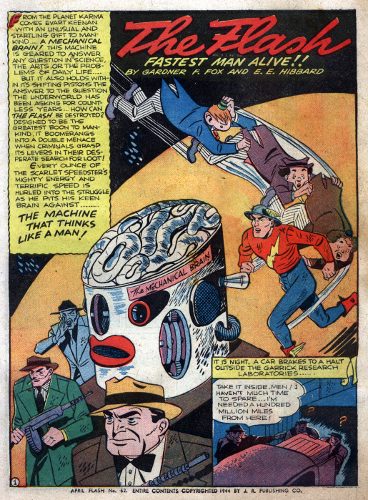
A recent post at Crimson Lightning with a boxy golden-age robot reminded me of this design from Flash Comics #52, “The Machine that Thinks Like a Man.”

The Mechanical Brain

The “mechanical brain” was basically a computer, but of course back in the 1940s, computers were mostly stuck in the realm of science-fiction (except for the occasional warehouse-sized monstrosity with less computing power than a modern calculator). It was built by scientific genius Evart Keenan, a recurring character who left Earth for the alien planet Karma so that his inventions wouldn’t call into the wrong hands. Oddly enough, his first appearance leads directly into the first appearance of the Thinker!

Beyond the Speed of Sound

For those who have been wondering whether the original Flash, Jay Garrick, could exceed the speed of sound back in the Golden Age of comics…

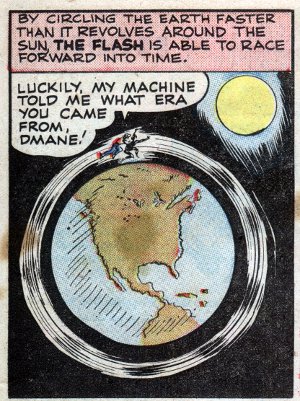
The Golden Age Flash circles the Earth

Yes he could.

The speed of sound is roughly 340 meters per second (varying with humidity, altitude, etc.)

Earth revolves around the sun at roughly 30 kilometers per second.

So in that panel he was running at least 88 times as fast as the Flash: Rebirth promo claims was his top speed before he met Barry Allen.

Source: Flash Comics Miniature Edition (promo book taped to boxes of Wheaties in 1946), in which the Flash goes up against the one-off “Criminal From Tomorrow!” Dmane. And yes, that looks like the same stunt Superman pulled in the 1978 movie with Christopher Reeve.

I seem to remember that Jay reached the same levels of insanely impractical speeds that Barry did on a regular basis — this was just the first place I thought to look, since I remembered the time travel element.

The Fifth Most Expensive Comic

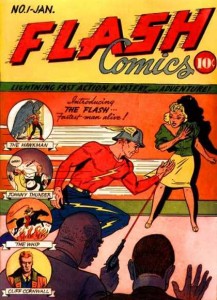
Friday Night Lists is running a list of the 15 Most Expensive Comic Books, and a copy of Flash Comics #1 — specifically the Mile High pedigree copy rated CGC NM+ 9.6 — ranks at #5, valued at an estimated $274,000.

As recently as 2006, it was estimated at “only” 250,000. That’s still a bit out of my price range, though. I think I’ll stick with my $35 copy of The Golden Age Flash Archives Vol. 1 for now.

The post also says that the “milestone issue is currently ranked as the eighth most valuable comic book of all.” I’m not entirely sure how that fits with the ranking at #5 in the list.

Flash Comics Make $553,583 in Auction

ComicsPriceGuide reports on a recent auction of comic books and original art at Heritage Auctions, which realized nearly $4 million.

“Also offered in this auction were the Mile High copies of Flash Comics #2-24 and #60,” Jaster said, “some of the most hotly desired books from the Gold Age of Comics. We offered the remainder of the run in a previous auction, and were proud to bring these beauties to the collecting public. Residing at the very top of the CGC Census, these exceptional books inspired spirited bidding. All told, the impressive run offered in this auction brought a whopping $553,583.”

A brief explanation: The Mile High Collection was a huge lot of comics going back to the 1940s, collected over decades by Edgar Church. His heirs sold the whole lot in 1977 to Chuck Rozanski of Mile High Comics. Because there were so many, and because Church had kept them in virtually pristine condition, the find had a huge impact on the Golden-Age collectors’ market.

As for the books in this auction, Flash Comics #2–24 cover the earliest years of the series, from 1940–1941. The Flash and Hawkman stories are included in The Golden Age Flash Archives Vol. 1–2 and The Golden Age Hawkman Archives (just one volume). I don’t know of anything special about the contents of Flash Comics #60, so its appeal is probably just the fact that there are so few high-grade copies in existence.

Naming Flash Eras

I’ve been trying to work out how I can best break down appearance lists with the repeated Flash relaunches. Assuming that Flash: Rebirth sticks, I can categorize them this way:

  • Golden Age: Jay’s series, 1940–1951
  • Silver/Bronze Age: Barry’s series, 1956–1986
  • Legacy: Wally’s series, 1987–2006
  • One Year Later: Bart’s series, Wally’s relaunch, and Flash: Rebirth, 2006-2009
  • Post-Rebirth: Whatever we end up with starting next year.

I originally used the term “Modern Apperances” for 1987+, but with Infinite Crisis marking a major relaunch, I clearly needed to rename it. I picked “Crisis Era” on the idea that it was bounded by Crisis on Infinite Earths and Infinite Crisis. But with DC overusing the term “Crisis” lately, it doesn’t seem to fit that era anymore. I think “Legacy” has a better sound to it, and since DC did a lot of legacy characters in the 1990s (some with greater success than others), it fits.

As for the period from Infinite Crisis through Flash: Rebirth, I’m thinking “Musical Chairs Era” might be the most accurate, but I’m going to stick with “One Year Later” for now.

Flash Companion Preview: Lost Gold

The following is an excerpt from the upcoming book, The Flash Companion. The full article appears in the first section of the book. It is printed here with permission of the book’s main author, Keith Dallas.

The Flash Companion is scheduled for a July 23 release.

Lost Gold: The Unpublished Golden Age Flash Stories

By John Wells

The abrupt cancellation of Flash Comics left Julius Schwartz with no chance to burn off the inventory of completed material he’d assembled for future issues. Instead, each page was stamped “Written Off 9-30-49,” filed away and ultimately marked for destruction in the late 1960s. Unpublished samples of all five features in Flash Comics survived to the present. Most remarkably, there were five Flash stories — three preserved in their entirety! They are:

“Journey Into Danger”: A criminal discovers a formula capable of accelerating speed and motion — but not the means of controlling it. In an effort to force Jay Garrick to give up his own formula for slowing down energy, the Farmer unleashes his speed solution on an unsuspecting Keystone City and the Flash himself (published in The Flash #205: April, 1971).

“The Tale of the Three Tokens”: A stranger gives common objects to Jay and two other men that prove instrumental in saving each of their lives during the Thinker’s attempt to use a stolen time machine (published in The Flash #214: April, 1972).

“Strange Confession”: After the Flash’s third encounter with the Thorn, her “sister” Rose confesses to Jay Garrick that she and the villainess are one and the same. Her evil personality kidnaps Joan Williams in retaliation, and the Flash ultimately asks Green Lantern to transport Rose to the curative Transformation Island at the suggestion of Wonder Woman (pages 11 and 12 published in Superman’s Girl Friend, Lois Lane #113: Sept.-Oct., 1971. Later published in its entirety in Robin Snyder’s fanzine The Comics [Vol. 6] #10: Oct., 1995.).

Continue reading