
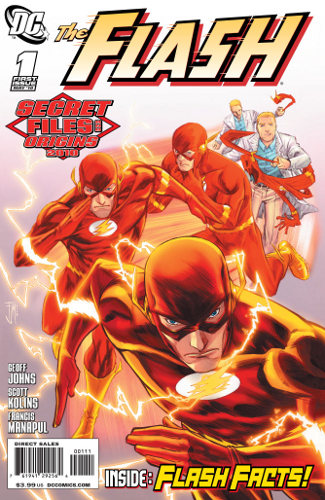
More precisely, the book is Flash: Secret Files and Origins 2010 #1. (I’m always faintly amused at the tendency of comic book publishers to slap a big “#1” on the front of an obviously one-shot issue.) Like most of DC’s Secret Files books, this is made up of a lead story and a series of profile pages.
Lead Story
“Running to the Past” by Geoff Johns and Scott Kolins was a fairly standard Flash story. It doesn’t really stand out as particularly good or bad, but it serves as an introduction to Barry Allen, his primary motivation (the retconned-in death of his mother), and the sometimes lonely life of a speedster.
There are some nice moments, like the sequence of panels early on in which Barry hits a light switch, pours himself a glass of water, and then the light comes on (though if you think about it, that only makes sense if the water is sped up too).
Oddly, while the whole story is drawn by Scott Kolins, the epilogue featuring the Rogues looks vastly different. It really highlights something I’ve mentioned before, which is how well-suited his art is to the Rogues.
It is a Barry Allen story, first and foremost, though the rest of the “good guy” speedsters show up briefly. I didn’t really expect anything beyond that, but the solicitation text suggested that Wally West and Bart Allen might be more involved, and I’m sure there are people out there for whom that will be a factor in whether they pick up the book. Perhaps DC planned bigger roles or a second story, back when they still planned a series of backup stories featuring Wally and a Kid Flash book featuring Bart, but if so, it didn’t make it to the finished product.

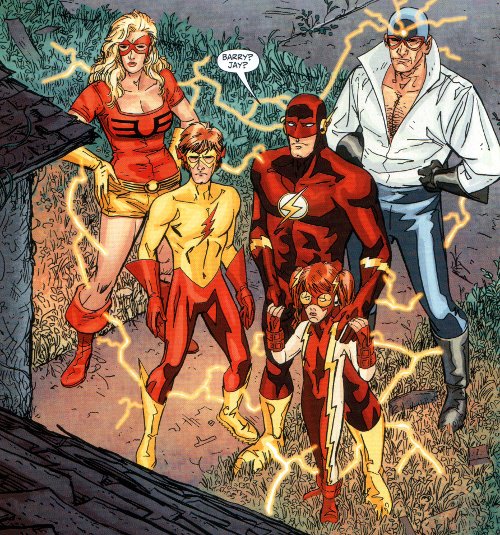
Jesse Quick’s costume gets a slight variation here, which I think is a good move. Kolins draws her with running shorts instead of the leotard that Ethan Van Sciver drew in Flash: Rebirth #6. Admittedly, there’s a long tradition of circus-influenced costumes in super-hero designs. (Just look at Max Mercury’s collar!) Jesse’s outfit is slightly different in the profile page (not pictured here) — her mask is black there, and the neckline is a bit higher as well, even though both are drawn by Kolins.
There’s a really awkwardly-placed ad near the end of the story. At the end of one page, Captain Cold pulls back a curtain to reveal… a comic-strip-style Colgate ad, followed by a second page of the Colgate ad, followed by…a giant picture of Robin and Wonder Girl kissing — wait, what’s that doing in the old Rogue hide-out? Oh, that’s still part of the toothpaste ad!
The final page will probably put off fans of Wally West, as it serves as a reminder (in 2-inch-high letters taking up the entire page) that as far as DC is concerned, “The Flash” has been missing since 1986.
Profile Pages
The second half of the book is made up of profiles covering the following characters (plus two cities and an object):
- Flash (Barry Allen)
- Iris Allen
- Keystone City and Central City
- CCPD Crime Lab, including: Darryl Frye, James Forrest, David Singh, Barry Allen, Kristen Kramer
- The Speed Force, including Flash/Jay Garrick, Flash/Wally West, Kid Flash/Bart Allen, Max Mercury, Jesse Quick, John Fox, Impulse/Irey West, Jai West
- The Cosmic Treadmill
- Captain Cold
- Heatwave
- Mirror Master (Evan McCullogh)
- Weather Wizard
- Trickster (Axel Walker)
- Gorilla Grodd
- Abra Kadabra
- Doctor Alchemy
- Professor Zoom, the Reverse Flash
- Captain Boomerang
Yes, it seems that “The Speed Force” is officially a team name, now. Here’s hoping I don’t get a C&D letter on trademark infringement for this blog. 😀
Most of the characters’ write-ups include not just their history, but hints to future stories. For instance, Abra Kadabra is said to have more enemies in other time periods, the Weather Wizard’s profile brings up the question of just who the wand was being built for, and John Fox “is lost in time, the reasons unknown.” (Fox was last seen comfortably settled in the 853rd Century during DC One Million, in a different costume. Presumably Johns’ plans are to use him at an earlier point in his personal timeline.)
A few profile items bothered me as a long-term reader, particularly:
- Max Mercury’s origins are said to be “shrouded in mystery,” even though Mark Waid told his origin during Terminal Velocity and we’ve seen several stories of his various aliases throughout the last 200 years.
- Wally West’s special talent with the speed force is generating his costume. Apparently that’s more important than the fact that he can lend and steal speed — or maybe Geoff Johns wants to get rid of that ability.
For some reason these changes bother me, but others, like giving Albert Desmond (Dr. Alchemy) a background in the Central City crime lab, or redefining Central City as a town obsessed with speed, don’t bother me at all. I think it’s because making Desmond a colleague of Barry’s is adding something, while erasing Max’s origin or dropping Wally’s extended powers down the memory hole is removing something.
Of course, new readers won’t notice anything odd in the first place.
The profiles are all drawn by either Francis Manapul or Scott Kolins. Manapul takes Barry and Iris and the non-Rogue villains, while Kolins takes the extended speedster family and the Rogues proper. Their art really benefits from the larger canvas made possible by the new layout. Instead of a basic split page with one column for art and one for text, the art takes up the entire page, with the text appearing in floating boxes. On the downside, many pages use multiple boxes for the name, stats, and history, which makes it a little harder to follow, especially on the group pages.
One character’s identity and history are blacked out, presumably to avoid spoiling the end of Blackest Night. This might have been a little more useful if this book hadn’t shipped two weeks late, since Blackest Night #8 arrived in stores last week. Oh, well!
Overall
Readers new to The Flash, or those who sat out Flash: Rebirth but plan to return, will probably find the book very helpful. The story establishes the current version of the lead character, and the profiles cover the setting, supporting cast, and major established villains.
Readers already familiar with the Flash may be less satisfied. The art is great, especially on the profiles, but there’s not much story and very little new information. If you like sifting through, looking for hints about future stories, or if you just want to refer back to the current baseline, it may be worth it.
RE: Max’s origins – I’m trying to be positive here and thinking that they didn’t simply explain it here to save space.
But I will be mighty pissed if they retcon nearly everything from Impulse; ie. Helen, the Mercury Falling arc, etc.
Heh, that ad annoyed me too — comics have got to do a better job of ad placement. They really take you out of the story at times.
I have already complained about misspelling Heat Wave’s name elsewhere, but shall do it here too. Because it’s a really bush-league mistake.
The Heat Wave/Heatwave difference doesn’t bother me anymore. I just treat it like Wally’s disappearing/reappearing eyes.
I mean, compared to the way Cary Bates would just make up entirely new names for the Rogues when he couldn’t remember them, removing a space is kind of small change! 😀
Ha. Cary did that? Really? What are some examples? We talking real names or costumed aliases?
Off the top of my head, Joe Scudder instead of Sam Scudder (later reconciled as Samuel Joseph Scudder). Heat Wave has been both Mick Rory and Rory Calhoun. Usually one part of the name was consistent, but I think he came up with a completely different name for Pied Piper at one point during the 300s. I keep meaning to go through Piper’s appearances and identify when each name showed up.
The Rory Calhoun thing was Waid, in a Who’s Who entry. Bates also came up with ‘Roscoe Neyle’, which was also retconned into a middle name (worst middle name ever).
Piper had the names ‘Thomas Peterson’ and ‘Henry Darrow’, but I think they were established as aliases from the beginning (however, Boomerang does call him ‘Henry’, so either Bates made another error or Piper told the Rogues fake names too).
Anyway, I expect more from modern comics and editors. I give Bates and co a pass because comics were pretty slapdash back in the ’60s and ’70s, but we expect better from today’s comics.
Believe it or not, this was sold out at my LCS yesterday! They had to do a reorder so I guess I will get Flash #1 before I get SF&O.
I thought the main story was a nice quick little story. Didn’t really serve a purpose other than to catch new readers up to speed (heh), about Barry’s new status quo. We know he loved and misses his mother from Rebirth, this just goes to drive that point home.
I really liked the clock views though, and how everything happened in the span of a minute or 2.
It’s also interesting how the characters don’t really know why they’re at Barry’s old house, but the Speed Force drew them there. I think that’s definitely something Johns is going to work with.
Can anyone tell me the status of Hunter Zoloman? He may not be officially a Rogue but I didn’t see a page on him. Also I just got Rogue War all original issues for $10, I’m looking forward to reading it.
Hunter’s in Iron Heights, still in a wheelchair. When last seen, he was trying to persuade Professor Zoom (in an adjoining cell) to team up with him.
Thanks for that breakdown. I agree with many of your assessments. I don’t think this series will appeal to me, so I will be skipping it, for sure.
If I hear about something cool, I may revisit, but here’s some money I can keep in my pockets. Why would I want to pay for a book that ignores or retcons the rich history that makes me so fond of these characters?
Let the Flash future move forwward, for the next generation. This particular old fogey will be looking to the past for his Flash fixes.
On the one hand, it doesn’t bother me that the Rogues don’t consider Wally to be the real Flash–they were very specifically Barry’s villains, and they never focused around Wally in the same way. On the other hand, it’s hard for me to envision what the hell could be behind that glass that would make any sense.
For some reason I’m suddenly thinking of the Trickster’s plans from the Justice League Unlimited episode, “Flash and Substance.”
Or maybe, in keeping with Mirror Master, the Disco of Death?
I’m actually on the other side regarding the lead story: it did more to make this version of Barry work for me than all of Rebirth, which had to waste time pulling the levers of an overcomplicated plot. Barry remembering his mother, then seeing her fade away struck me as an especially poignant way to reflect the horror of Thawne’s timeline change, and Barry’s confession that he sought her killer only because “he had to know” who and why and how rang true. The line got across both Barry’s scientific attitude and his guilt about the detachment that attitude sometimes requires.
As to the profiles, the Kadabra profile’s suggestions of future enemies is interesting, but it looks like the Waid story in which we learned about Citizen Abra’s future world is tossed now. It’s also nice to see the lead story and the Mirror Master profile belatedly remembering that Scudder, not Snart, was traditionally the biggest name among the Rogues.
Johns has a curious tendency to build his plots on the legacies of the dead: Scudder here, Owen Mercer’s doomed and damning quest, McCullough’s origin revolving around the discovery of his parents after he’s killed one of them, and the Weather Wizard’s relationship to his dead brother. Blackest Night is the ultimate example, but the motif encompasses things like the death of Pa Kent in Johns’s Superman stories, Hal Jordan’s driving memories of his father’s death in Hal’s childhood, the “Rebirth” subtitles of his minis and, on a personal level for the writer, his creation of Courtney Whitmore. It’s interesting to track the motif in his work, anyway.
I remain unconvinced that we need Barry back, though. The Secret Files didn’t change that, and the preview pages of Flash #1 we’ve seen don’t, to my eyes, read any differently if you replace Barry and Iris with Wally and Linda.
I still don’t understand:
1) Why Iris is young.
2) Why Barry and Iris don’t seem to care about their kids. They have kids!!
1) Youth sells.
2) Kids who are dead…
Kids who are dead IN THE FUTURE. They won’t be born for another millennium for Pete’s sake!
IT’S THE FUTURE! AND THEY CAN TIME TRAVEL! They could bring them back to the present at this point, even, because it’s fairly obvious that the past is a mutable as silly putty at this point anyway.
The artwork is good, (much beter than the bad anatomical Liefield-like mistakes in Rebirth!) but here’s the problem; Johns has run out of things to write about the Flash.
Why bring Barry back just to diminish (I’ll call it “fucking with” at the risk of revealing my frustration!) his well-established character! That, to me, explains all the retcon changes. The possiblity that Johns wants to be “serious” about his craft and explore his own Oedipal issues in the Flash, only makes me want to put the Speedster down for a while. WHat’s with the obvious disparity between Mother and Father in young Barry’s eyes? Why doesn’t Johns even mention his father; Dr. Henry Allen except in a minor, passing comment? Ie: “Who Killed her?” – “Her husband from the looks of it. Guy’s going away for life.” And that’s the extent of the mention! That Barry feels anything at all for his wrongly accused father is not even hinted at! He may add this dimension of Barry’s relationship with his father later if he wants, and may claim it was his plan all along, but because he neglected to mention it now it will only seem like retroactive damage control.
I’m very close to saying that I’ve had enough with all of it; the ridiculous delays between eagerly awaited issues only to be bitterly dissapointed, the stupid retcon shuffling and re-shuffling of characters on a whim, the lack of economy in the overall pace/rythm of the last 3-4 arcs! (Maybe even stretching back when Bart was the Flash for a while!) But I have faith that a hero will rise and save us from the drudgery of BAD COMICS! It’s bad enough society sees us fanboys/fangirls in an awkward, askew light! Must we also have to suffer these assaults to our intelligence from our supposed allies?
This was so meh to me.
The art was solid overall but definitely looked a little rushed in certain spaces. I’ve always loved Scott Kolins’ work, and generally like anything he does. Although I have to add that his Barry at times looked exactly like Wally from back in the old series.
Speaking of Wally his costume is growing on me. Although I still think the JLU style symbol seems off, I like the cowl, the reintroduction of the “Batman eyes” look and the darker scarlet color scheme. I still miss Bart’s old boots and slightly more distinct costume though. The design alone gave him more personality than he ever has had in the version that Ethan Van Sciver took upon himself to redesign and simplify. Yeah it might be simpler and easier to draw but it looks like Wally-lite. Ridiculously bland.
The writing is the real problem for me though. I never remembered Johns’ writing being so heavy-handed and over the top back when he was writing Wally. The whole slow thing when he was a kid, the retroactive insertion of tragedy, the abandoned childhood home, I mean come on. “In Case The Flash Returns Break Glass”? Really? COME ON!(I’m doing my best Gob impression right now). And how come Barry never seems to be missing his dad. I mean he was screwed over pretty bad in the end too and he doesn’t get a single panel. Not even just a family picture with all of them pictured and being happy. If you are going to take the time to bother throwing all this cheesecake stuff in the book, then at least take the effort to do it right.
Henry Allen gets no respect.
The profiles have been my favorite parts of all the older Flash Secret Files and Origins but this one just doesn’t feel up to snuff. Every single one reads like the writers are completely disinterested in what they are writing and gloss over and flat out omit important details. The Speed Force? Why can’t they just be the similarly powered guys and gals that team up every now and then? Could you imagine them as an actual super team? What would be the point of anyone else? It’s just lame and unnecessary.
In fact this whole thing just feels completely unnecessary. They are jumping through all these hoops, retconning this, and that, just to try and make Barry relevant. Even though I love Wally and would rather have him stayed the Flash, I would have had no problem with a newer younger Flash taking over. Heck I’m one of the few people who supported Bart’s run and bought every issue and both the trades. Sure it wasn’t done in the best way, but the idea was sound. Move forward. The Flash of all characters should be the last one backtracking.
Scott Kollins gave Bart his old boots back though in the main story (Don’t remember the splash at the end and I don’t have the book w/me right now).
That makes me think that EVS’s redo of Bart’s costume is going to be changing with each artist. Maybe Francis will give us a difinitive Bart now.
And I have a theory on the Flash villains not treating Wally with equality as The Flash: Wasn’t Barry always cut and dry with them? I mean, to him, they are bad guys and should be treated as such.
With Wally, yeah, they’re bad guys, but he knows Cold has a morality streak in him, so he’s not so gung-ho about taking them down. At least, that’s how it’s seemed to be in the past few years to me.
Look closer. Bart’s boots in the main story and throughout the rest of it may not be like EVS’ design exactly, but they don’t look anything like they did before EVS redesigned them.
There are some nice moments, like the sequence of panels early on in which Barry hits a light switch, pours himself a glass of water, and then the light comes on (though if you think about it, that only makes sense if the water is sped up too).
In fact, the whole story takes place in a minute, with the Rogues epilogue starting a minute after. I thought that was neat.
Great review Larry. I won’t repeat the stuff I wrote on my blog (link above, most likely) but I was, like many of the good folk here, a tad underwhelmed with this issue.
I’m just so bored waiting for the main even, when Barry becomes a super-speed Lily Rush.
The toothpaste ad never bothered me, I’ve seen it a few times so it doesn’t really register.
I’m glad you liked the review, but…who’s Larry?
Whoops, sorry Kelson – I think Larry is the person under you on the DCMBs from whose post I clicked here. Btrain knackered!
.-= Martin Gray’s latest blog post: Spider-Man: Fever #1 review =-.
I agree with the issue being bland, The paneling and the art being completely solid, and being tired of ret-cons. I found it particularly interesting that in Bart’s powers and abilities section that they failed to bring up his energy duplicate power that was given to him. They do continue to short-hand a lot of the speedsters. I know there is so much space on the panel, but I think they do deserve a lot more respect. Johns is a good writer, but he lacks a lot of nerding knowledge that made his predecessors great. He needs to know his character’s rich past before tackling them. Johns ignored Wally’s triumphs with coming back from the speed force, not only in Rebirth, but Blackest Night as well. I know this is because Barry is the front man now, but come on, give Wally his do. Along with all the other great cast members of this book.
I am quite weary of the turtle on Jai’s shirt on the splash page with all the speedsters. I am growing irritated on the daughter always inheriting the father’s powers and the son becoming an evil doer. Why can’t the son ever just inherit the powers and ride alongside his father? I know it happens, but it is so seldom. I liked Jai and Iris. I was hoping for more from them, not some cop-out to re-create a villian.
I thought all the time talk throughout the issue was interesting. I do think the foreshadowing was done kinda lame though. Could they at least attempt to show some effort in trying to get readers to want to read this book? It was almost like looking at a checklist of upcoming events. Time traveling was always a mechanic of Barry’s and I am glad that they are bringing it back with him. The mechanic is a time honored Flash staple.
All in all, I was not swept off of my feet. I will keep with the series to see where it goes and hope it does get better. (It was like Johns made Barry the Blue Lantern to give us a clue on what actions we need to take as fans of this character. Hope) I am a Flash fan. I respect each man who has held the mantle, but I am not convinced Barry needs to be back. I am also convinced Johns isn’t either. He put so much more effort in his Wally run. Kolins seems to even be protesting by drawing Barry like he did Wally in costume.
I will wait and see what happens. I just hope, “All will be well.”
I think the turtle on Jai’s shirt might be a slight reference to the turtle Wally’s son in The Kingdom had tattooed on his chest.