Today’s guest post is by Tony Laplume.
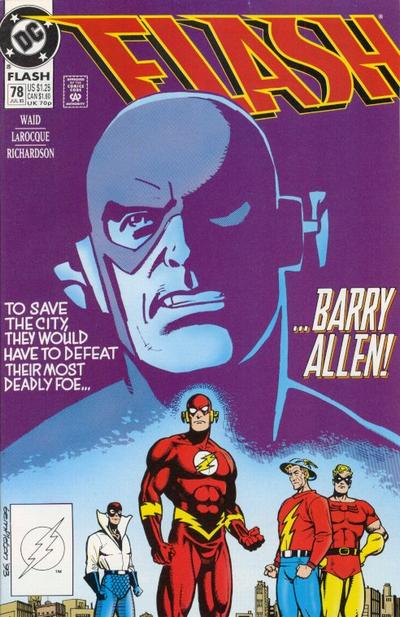
I first encountered Max Mercury in 1993’s The Flash #78. This was part of Mark Waid’s “The Return of Barry Allen” arc, which did not actually feature Barry Allen, but rather Wally West’s first encounter with the Reverse Flash. Barry was the Silver Age Flash and Wally’s mentor, but he’d been gone since his death in Crisis on Infinite Earths. The arc was all about Wally finally moving past his feelings of inadequacy and embracing his own legacy. It was a seminal moment in Waid’s long run on the series, setting the stage for many other stories, including the introduction of the Speed Force, from which every DC speedster draws their ability.
Max Mercury was just another speedster in the arc. Along with Jay Garrick, the Golden Age Flash, and Johnny Quick, Max was representative of an earlier generation. He was a character Waid cobbled together from another Golden Age speedster, Quicksilver, renamed to avoid confusion with his Marvel counterpart. Memorably, Max was referred to as the Zen Master of Speed. I guess this was his first true mark of distinction for me, the fact that he was identified as an expert on the topic that defined the series. He was all but the Yoda of Flash lore.
Of course, Max fares poorly against Professor Zoom, the Reverse Flash, in the arc, although some solace can be found in the fact that he does little better than Jay Garrick or Johnny Quick. It’s Wally’s fight to win. Max is just there to inspire new confidence in him. By the end of the arc, Max disappears back to wherever he came from in the first place. Waid moves on as well, allowing Wally to enjoy being the Flash for a change, until the appearance of Bart Allen, whom Wally soon enough dubs Impulse, the new and future Kid Flash.
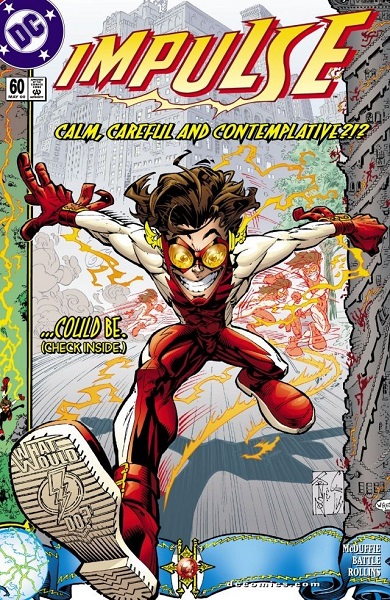
Bart quickly gains his own series, Impulse, also written by Waid, and resurfacing for the occasion is Max Mercury, who is given the unenviable task of helping the excitable youth discovery maturity. It’s Max in the role glimpsed during “The Return of Barry Allen,” the consummate mentor, who may be better instructing than actually doing. We discover Max’s true history, how he became a speedster in the nineteenth century and made several leaps through time, eventually depositing him in the present, an experienced and wise old man, allowed the white hair most superheroes never know. Bart’s own tenuous experience with time is something he can appreciate, if not Bart himself, who constantly exasperates Max, but this is fine, because he has a soft spot for family.
Max is a perfect personification of the kind of family Waid brought to the Flash franchise. At a time when comics were beginning to appreciate the working benefits of legacy, famously within the pages of James Robinson’s Starman, Waid started to understand the interconnectedness of a family of loners. Aside from the famous “Flash of Two Worlds” story in The Flash #123 in which Jay Garrick and Barry Allen meet (thereby initiating the era of the multiverse), the generations of scarlet speedsters had about as much to do with each other as Alan Scott and Hal Jordan’s Green Lanterns. True, Wally was the original Kid Flash and as such had an extensive history working alongside Barry, but Barry was gone by the time Wally took on the full cowl for himself, and it wasn’t until Waid that a writer finally addressed what kind of impact that had on his life.
In fact, as “Return of Barry Allen” proves, he didn’t stop there. Waid brought Jay back into the fold, and then Johnny Quick with his unique formula and daughter Jesse, who was also Quick. Max was something different, representative of the lineage but a character without a print background, and thus a part of Waid’s own emerging narrative. Waid didn’t always concentrate on this part of his own emerging legacy, at least not at first, not even following “Terminal Velocity,” which completed Wally’s journey toward awareness of the Speed Force. Subsequent arcs like “Dead Heat,” “Race Against Time,” and “Chain Lightning” continued the tradition and united the speedsters as never before or since.
It wasn’t until Impulse that Max could truly shine, guiding Bart along and deepening the sense of family. In the course of this series, Max reunited with a daughter he never had a chance to know because of his time hops. Every speedster needs grounding, seemed to be Waid’s message. Wally found his in exploring the depths of the Speed Force, while Bart and Max found each other as unlikely equals, even if both were reluctant to admit it. Max could sometimes come off as gruff, but it was a front, much as Wally’s life prior to “Return of Barry Allen” hid his longing to move past his mentor’s shadow. The man who began as a mystery and pegged as the expert not only became exposed as one of the biggest victims of the previously unknown Speed Force but one of its biggest beneficiaries as well.
Max Mercury will always fascinate me. He’s the manifestation of everything that made Mark Waid’s Flash great, even if he remains a fairly obscure element of it. While everyone else clamors to see Wally West again, I wish Max could make a comeback. If there’s anyone in that strange family who still has a story to tell, it’s him.
Tony Laplume regularly writes about superheroes at Comics Reader. Cover via Comics.org