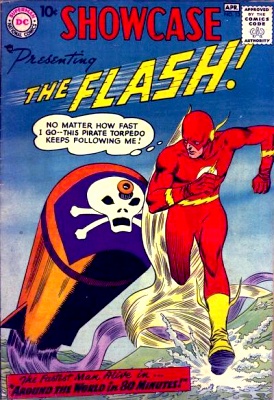
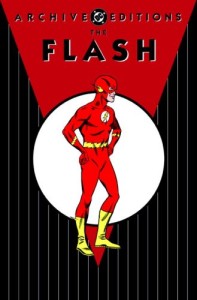
Today’s Final Crisis #2 marks an event that many Flash fans have been anticipating* for years: the return of Barry Allen, the Silver Age Flash.
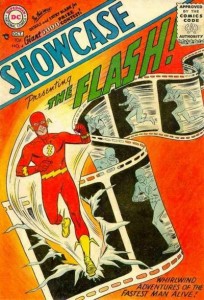 Barry made his debut in the 1956 comic book, Showcase #4. In the early 1950s, super-heroes had faded from popularity, and most of their series had been either canceled or converted to another genre. (For example: the Justice Society’s book, All-Star, became All-Star Western.) DC Comics decided to try reviving the genre, and started by redesigning the Flash. They gave him a new origin and identity, a sleeker costume, and a more sci-fi flavor to the stories, and published him in their try-out title.
The Flash was a success, and after three more appearances in Showcase, they gave him his own series in 1959. Revamps of Green Lantern, the Atom and other heroes soon followed. In fact, the Flash is often credited with launching the Silver Age of comics. (The other hero most often cited is J’onn J’onzz, the Martian Manhunter. Ironically, he was just killed in Final Crisis #1.)
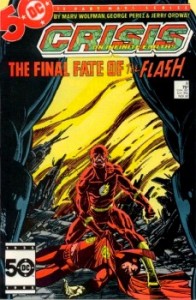 After 30 years, though, DC decided it was time for another relaunch. Sales on the book were flagging, and DC was preparing Crisis on Infinite Earths, an event which would make sweeping changes to its entire line. In essence they were launching a new age of DC comics. The death of the Flash symbolically represented the end of the Silver Age.** Barry met his end in Crisis on Infinite Earths #8 (1985), and his former sidekick Wally West carried on his legacy as the Flash of a new era.
Over the next 23 years, Barry Allen was part of a small group of comic book characters whose deaths seemed permanent. He showed up occasionally in time travel stories, and was placed in various afterlives — including a tribute story at Marvel and the concept that gives this site its name: the speed force, a Valhalla for speedsters. And of course there was the 1993 storyline, “The Return of Barry Allen,” in which he appeared to be back…only to eventually be revealed as an impostor.
But eventually, even Jason Todd and Bucky Barnes returned from the grave.
Speculation started with the build-up to Infinite Crisis. It became clear that Wally was going to follow his mentor into comic-book limbo, and fans started trying to figure out who would take over. Would it be Barry’s teenage grandson Bart, the current Kid Flash? A rejuvenated Jay Garrick? Would Barry return? Would several Flashes somehow be fused into one? Ultimately, DC transformed Bart into an adult and gave him a shot at the lightning.
One year later, the Justice League/Justice Society/Legion of Super-Heroes crossover, “The Lightning Saga” was working up toward resurrecting someone. Signs pointed to either Lightning Lad or a Flash, and when the news hit that Bart’s series was ending, fan speculation again went to Barry. This time, it was Wally who returned.
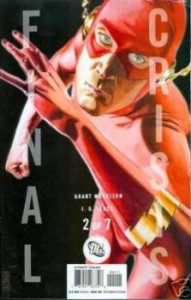 Another year later, with Final Crisis looming and continuing discontent with the relaunch, fans started to see clues that, once again, hinted at a possible return for Barry. Among those clues was a poster that appeared at the New York Comic Con that looked a lot like Barry — and was painted by J.G. Jones, the artist on Final Crisis. Then there was the summary for Final Crisis #2 and its “spectacular return from the dead.”
Then on April 30, DC Universe #0 hit the stores. The book served as a lead-in to multiple storylines, all tied together by an unseen narrator who starts the issue at one with the universe. As the story progresses, he begins to remember more of his life and his connection to various heroes, and the narration boxes slowly change from black to red. By the last few pages, they’ve picked up a lightning bolt. The final splash page shows a large, white moon against a red sky, a bolt of lightning cutting diagonally in front of it. The same day, the New York Daily News ran the story of the Flash’s return.
With Barry’s return confirmed in subsequent interviews, it was only a matter of figuring out when he would appear on-panel. When the “next issue” blurb for Final Crisis #2 showed that Flash painting and mentioned “the return of a long lost hero,” the answer was clear.
Of course, many questions remain. How long will Barry be back? Permanently, or just for the duration of Final Crisis? If he stays, will he take over the lead spot in The Flash? And what does that mean for the current Scarlet Speedster?