Category Archives: Reviews

Review: Justice League Heroes: The Flash

Today’s guest post is by liquidcross of The Indigo Tribe.

Let’s take a look back (a flashback, if you will) at a video game that fell under many fans’ radar: a sidescrolling beat-’em-up for the Game Boy Advance starring the Flash. Designed as a side story to the 2006 Justice League Heroes console game, the aptly-named Justice League Heroes: The Flash features the scarlet speedster zipping around the globe as he takes down the forces of evil. Unlike many licensed games, the end result is pretty damned good, so let’s examine why JLH:F is a hidden gem.
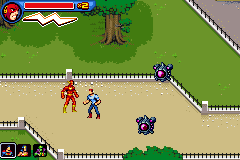
At its core, JLH:F is a 2D brawler reminiscent of the Streets of Rage series. You’ve got the usual punches and kicks to dispatch your foes, but since you’re the friggin’ Flash, you’ve also got his superspeed. (Note: It’s never explicitly stated within the game which Flash this is, as everyone just refers to him as "Flash." However, the developers at WayForward Technologies have stated that it’s the Wally West incarnation). The use of superspeed in the game actually works quite well; the "A" button will dash you to the closest enemy, allowing you get in some swift combo attacks ("B" is your attack button). The "R" trigger will kick you into Flash Speed mode, and everything will appear to slow down…except for you. This is what life is like from the Flash’s perspective, and you can use it to thrash opponents before they even have a chance to react! To keep things fair, though, you’ve got a Speed Force meter right below your lifebar; when it’s depleted, you can’t use Flash Speed mode until it recharges. (Fighting enemies and finding certain powerups will recharge the Speed Force meter.) Finally, if you’re in a real pinch, you can call in other Justice League members to help clear the screen: Superman, Wonder Woman, the Martian Manhunter, Black Canary, or Green Arrow will jump in if you hit the "L" trigger. Their assistance can only be called upon a limited number of times, but you can find powerups that’ll let you summon your fellow Leaguers more often.
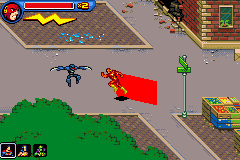
As you progress through the game, you’ll earn new moves (like a whirlwind attack), explore new areas, and face the inevitable bosses. Most of them are classic Justice League villains like Circe, but there’s a few Flash-centric baddies in there such as Gorilla Grodd and my personal favorite, Zoom. Another Flash "villain" appears in JLH:F, but not as a stage boss. Want to find out who? Trying using Flash Speed mode right after you lose your last life.

While JLH:F is a portable game, the graphics are top-notch. WayForward have mastered the art of high quality 2D graphics, and their other games like Shantae, Contra 4, and Batman: The Brave and the Bold are shining examples of their craft. JLH:F is no different; the sprites may be tiny, but they’re filled with detail and fluidly animated. Last but not least, let’s take a look at the game’s audio and extras. The background music’s pretty good, and the sound effects are standard beat-’em-up fare. JLH:F is peppered with voice clips, and that really makes it feel like you’re playing an arcade title. Some of the clips might get annoying after a while, but still, it adds to the overall charm of the game. As far as extras are concerned, you can unlock the game’s cutscenes, background information, preproduction art, and more.

Overall, JLH:F is a very good game, but there are two minor flaws. One is the aforementioned focus on Justice League villains. For a Flash game, it would’ve been nice to see a game filled with the hero’s infamous Rogues. Where the hell are Captain Cold and Mirror Master?! The other downpoint is the poor quality cutscene art. I understand that WayForward probably didn’t want to hire a professional comic book artist just to do a few tiny panels here and there, but the art they did use is subpar. Even worse are some of the coloring errors, like the one seen below:
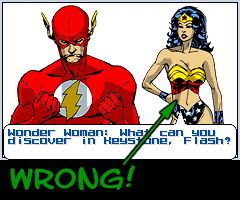
I don’t recall Wonder Woman sporting a bare midriff in the comics; this ain’t an early 1990s Image book. That’s supposed to be armor plate! I know it seems like a minor concern, but it’s a rather glaring (and annoying) error.

Fortunately, these flaws have no effect on the gameplay, and that’s all that really matters. The game engine is rock-solid, and the Flash plays just like he should, dashing around dealing out ass-kickings at superspeed. JLH:F is a great street-brawlin’ game that’ll bring back fond arcade memories for anyone who sank tons of quarters into Final Fight and its brethren. The Game Boy Advance may have been rapidly swept away by the Nintendo DS, but games like JLH:F prove that the GBA still had some life left in it towards the end. For Flash and beat-’em-up fans alike, Justice League Heroes: The Flash belongs in your library. Start diggin’ around on eBay…
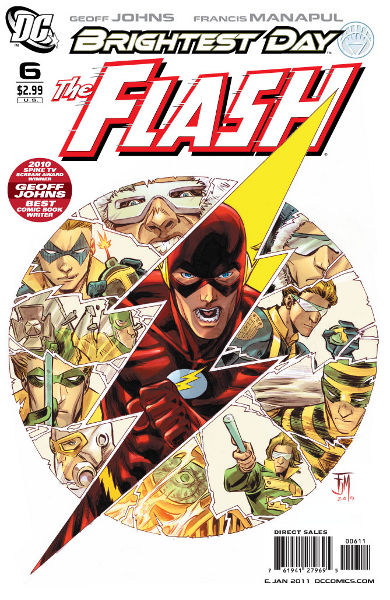

Review: The Flash #6

Written by Geoff Johns
Art by Francis Manapul

The long-awaited conclusion of “The Dastardly Death of the Rogues” is here! And while it doesn’t exactly end with a bang, it does race to a satisfying finish. Mysteries are revealed, conflicts are resolved, and events that seemed unrelated turn out to be connected, with teases for upcoming events.

It’s been a fun story, one I really didn’t expect going into this series. I do think it could have been told just as effectively in less time — maybe 4 parts instead of 6. This storytelling style isn’t going to lose much when DC drops the page count from 22 to 20 next year.

Francis Manapul’s artwork is amazing, as always. I really can’t add more to what I’ve already said about it, so I’ll focus on the story, and since this is the conclusion, it’ll be hard to say much without spoilers…

Continue reading

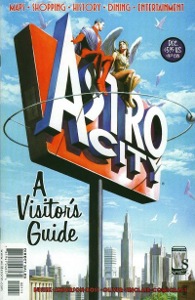
Read This Too: Astro City

Today, a group of comics bloggers have gotten together to recommend lesser-known gems of the comics world. Comics are more than Brightest Day and Heroic Age, and you just might want to…read this too!

Astro City. Written by Kurt Busiek; art by Brent Anderson; covers by Alex Ross. Published by WildStorm Comics.
A big part of the appeal for many comics fans is the shared universe. Spider-Man, Daredevil and the Fantastic Four all share the same New York. Flash and Green Lantern can fight each other’s villains. There’s a sense that, beyond what you’ve read, there’s more…a bigger world, one where things matter beyond a single story.

Astro City takes that feeling and creates a whole shared super-hero universe in a single book. Instead of following one character or team, the anthology focuses on a different hero, villain, or civilian in each story. The stories are usually about the human element, focusing more on character than on super-villain beat-downs.

Many (but not all) of the heroes are based on classic characters or familiar archetypes. Samaritan is Superman down to the blue hair. The First Family is very much like the Fantastic Four. Others are original, or far enough removed from their sources that I can’t place them.

The first volume, Life in the Big City, features:

  • A day in the life of Samaritan, who is so busy rescuing people that he can’t slow down to enjoy flying.
  • A newspaper editor tells about his first published story as a cub reporter, when he witnessed a team of heroes turning back an interdimensional invasion in the caverns beneath the city.
  • A small-time crook accidentally discovers the hero Jack-in-the-Box’s identity, and tries to figure out what he can do with the knowledge.
  • A woman who grew up in a neighborhood fraught with supernatural dangers finds herself confronted with the very different, scientific dangers that threaten downtown.
  • A neighborhood recluse turns out to be an alien spy, scouting out Earth as a potential invasion target. His decision rests on the discovery that one of his neighbors is secretly a super-hero.
  • Heroes Samaritan and Winged Victory try to go on a date, but their professional lives keep getting in the way.

You don’t have to start there, though. With very few exceptions, Astro City stories can be read in any order. Most of the stories only take one or two issues, and are collected in Life in the Big City, Family Album, and Local Heroes. There have been a few longer ones: Confession and The Tarnished Angel each take up an entire volume, and the longest story, The Dark Age, will be collected in two volumes.

Some of my favorites include:

  • Confession re-imagines Batman and Robin with a supernatural twist.
  • In Family Album, Jack-in-the-Box meets his future son…or rather, three different possible versions of his future son, all traumatized by his death. The encounters force him to rethink the life he leads as he and his wife try to start a family.
  • Also in Family Album, A man is troubled by vivid dreams of a woman he’s never met, and eventually learns that she was his wife before the reality-altering Crisis event erased her from existence. This 16-page story from 1998 is still my favorite take on the genre created by Crisis on Infinite Earths.
  • In Local Heroes, a lawyer gets in over his head when he successfully uses the doppelganger defense.
  • In the upcoming Shining Stars collection, sworn enemies Samaritan and Infidel meet once a year for a cordial dinner, while a living “Beautie” doll with super-powers seeks out her origins.

Astro City took a long break earlier this decade, and has been on a series-of-miniseries schedule for the last few years. With The Dark Age finished just a few months ago, Kurt Busiek and Brent Anderson have been planning to relaunch the series as an ongoing monthly again, but the recently-announced shuttering of WildStorm may throw a bit of a wrench into those plans (or it may just launch with a DC logo on it instead).

Oh, one more thing: Flash fans might be interested in the Astro City: Silver Agent two-parter that wrapped this month (and will be included in Shining Stars). He’s not a speedster, but you’ll see what I mean. More about this in an upcoming post…

But That’s Not All!

Interested in reading more? Good! I’ve also reviewed The Unwritten at K-Squared Ramblings, and there are a lot of other bloggers participating in today’s event. Check out the lesser-known titles reviewed in these other blogs and read these, too!

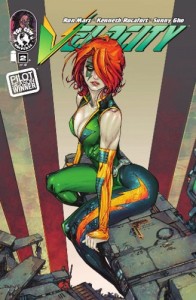
Review: Velocity #2 — “Decoys” Part 2

Velocity #2 of 4
Written by Ron Marz
Art and cover by Kenneth Rocafort
5-page preview at CBR.

It’s been a while since the first issue of this miniseries, but the second issue jumps straight into the action as if no time had passed. The members of Cyberforce have all been infected with a virus that will kill them within an hour, and Velocity is the only one fast enough to save them. Of course, she’s been infected too — it’s only her super-speed metabolism keeping her conscious. The clock is ticking. Literally. Every page shows a countdown timer, starting at 58:07 and finishing at…well, why spoil the surprise?

Like the first issue, this continues to be extremely accessible. I’m a Top Cow neophyte, and had no problems following the book even as it twisted through other parts of the Top Cow universe. I was mildly confused when the Hunter/Killer organization showed up, but the heroine’s inner monologue covered the basics in a couple of short narration boxes a page or two later, and a text page in the back describes it in more detail.

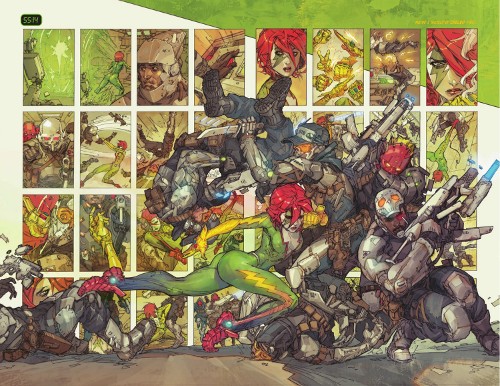
Kenneth Rocafort’s art continues to be a major draw, both in the stylized art itself, and in the creative panel layouts. Two double-page splashes manage to show off completely different ways of showing super-speed. The first (shown below), features a staccato 4×4 grid across each page overlaid with a giant close-up of one moment in a fight. The other is a great example of the classic wide shot of a room with multiple images of a speedster doing different activities all across the panel.

Don’t miss an artistic in-joke: one scene takes place out in the deserts of the American Southwest. There’s a bird visible in the foreground: a roadrunner.

SPOILERS BELOW!

Continue reading

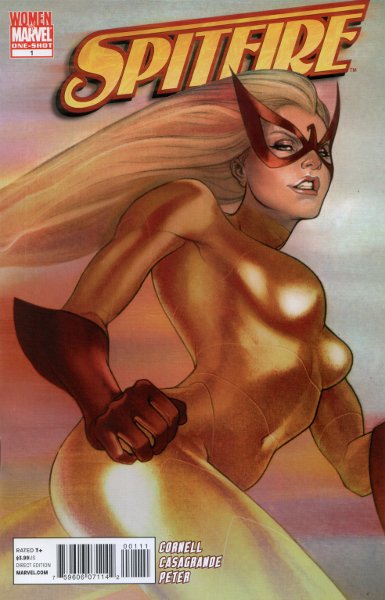
Review: Spitfire #1 – “Living in the Ruins”

Written by Paul Cornell
Art by Elena Casagrande
Cover by Jenny Frison
5-page preview at Marvel.com

Marvel Comics’ Spitfire one-shot, released last week, looks like a speedster story from the cover…but it’s really a vampire story. Once I realized that, I found the second read much more enjoyable.

The Basics

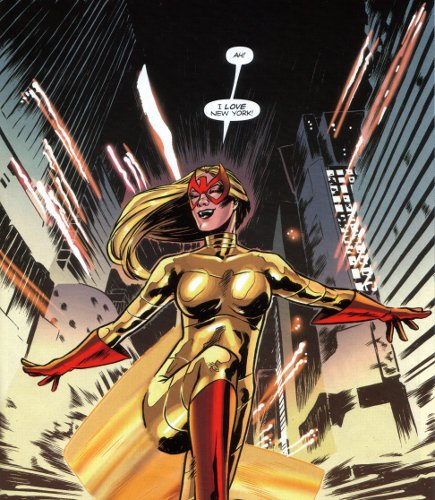
Spitfire is Lady Jaqueline “Jac” Falsworth, a World-War II–era speedster who got her powers from the combination of a vampire bite and a blood transfusion from the original Human Torch. After she lived out a normal lifetime, a second transfusion restored her youth and activated vampire traits, like fangs and, most importantly for this story, immortality. She works for British intelligence service MI:13, along with vampire slayer Blade, whom she is dating.

The plot involves Spitfire and Blade pursuing a suspected spy — who is also a vampire — to New York. Through the course of their pursuit, Spitfire has to confront the similarities between their quarry and what she herself has become. Will immortality leave her jaded and empty, like it has so many of the vampires she’s met? Will she become what they hunt?

New Readers? Really?

As someone who doesn’t follow Marvel Comics very closely, and hadn’t even heard of the character until a few days ago, I appreciated the text page at the beginning. It’s a bit dense, but it covers Spitfire’s origin, her history with vampires and fighting Nazis, her recruitment by MI:13, and her relationship with Blade. It’s also easily skippable by readers who are familiar with the character.

The cover is labeled “Women of Marvel,” which seems to be some sort of event like DC’s ill-titled “Girlfrenzy” set of one-shots during the 1990s. Most of what I can find online has to do with a series of variant covers for established books like Captain America, Iron Man, and the Avengers, so I’m not sure what other books are involved.

So How Is It?

Mild spoilers after the cut. Continue reading

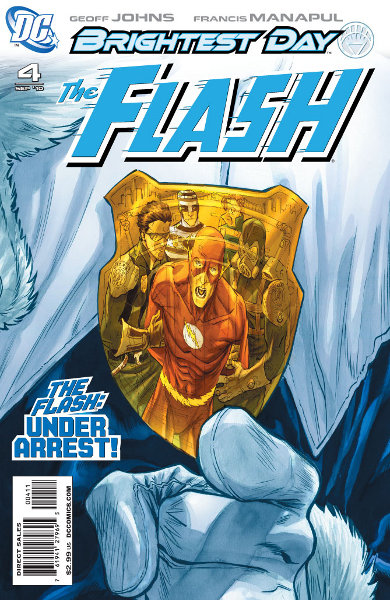
Review: The Flash #4

I’ve been really enjoying the ongoing Flash series despite the frustration and disappointment of Flash: Rebirth. It’s as if “The Dastardly Death of the Rogues” is being written by Geoff Johns, and Flash: Rebirth was written by the mirror Geoff. Or in a multiverse context, the Geoff Johns of Earth-3.

Also surprising: Johns seems to have remembered an old saying about writing comic books: Every issue is somebody’s first. A few deftly placed lines of dialogue spell out the key details of the story so far: Boomerang’s status and new abilities, who the Renegades are, what file is missing and why, etc. Considering this is part 4 of a 6-part story, I suspect most writers today wouldn’t have bothered.

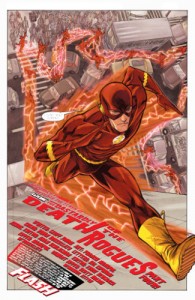
Francis Manapul’s artwork continues to be the highlight of this book. The Flash stands or falls (runs or stumbles?) on pacing and the reader’s perception of speed, and Manapul delivers. This time around, the stand-out panels are splash pages in an effort to rescue pilots from a damaged helicopter. (One nice easter egg: in the background of that double-page spread, we see the bridge that Wally West rebuilt back in “Crossfire.”)

I’m neutral on the “Flash Facts” pages, though if they’re going to keep using them to spotlight the villains, I like the way they link the real tech with the comic-book tech. Last month it was “How Boomerangs Work” and “How Captain Boomerang’s Boomerangs Work.” This month it’s mirrors and Mirror Master’s mirrors.

Some of the luster is beginning to fade, though. The structure is starting to feel formulaic: Barry Allen keeps fighting the Renegades, and every battle gets cut short one way or another. Every issue has a major super-speed feat, which individually manages to be extremely cool, but gets repetitive four issues on.

I think the main thing that disappointed me about this issue was the revelation behind the murder mystery. Sure, it’s one of the few explanations that fits Barry Allen’s character, but it also violates the expectations set up in the first half of the story. To say any more, I’ll have to break into….

SPOILERS!

Continue reading