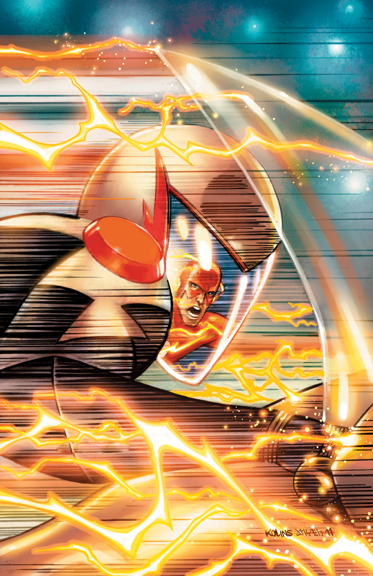
What kinds of changes are in store for the DC Universe during Flashpoint? Teasers we’ve seen so far show a world with no Earth-based Green Lantern, a very different Superman, and a Wonder Woman and Aquaman who are world leaders rather than superheroes. DC will be publishing no less than sixteen miniseries exploring this altered world, enough for an entire line of comics…which brings to mind another thought:
What might DC comics look like if they’d been publishing this alternate history all along?
It wouldn’t be the first time someone’s explored an alternate publishing history. The Marvel/DC mash-up Amalgam Comics were all labeled #1, but included editor’s notes and letters columns referring back to earlier imaginary comics.
More interestingly, Bob Rozakis published a series of articles in TwoMorrows’ Alter Ego and Back Issue magazines in which he imagined an alternate history of DC Comics, the company.
All-American Comics
Up until the mid-1940s, DC Comics was really two companies: One was DC proper, owned by Harry Donenfield. The other was All-American Comics, owned by Max Gaines, which published under the DC label. The big three characters at DC were Superman, Batman and Robin, starring in World’s Finest. The big three at All American were Wonder Woman, Green Lantern (Alan Scott) and the Flash (Jay Garrick), starring in Comic Cavalcade. (This is also why Johnny Quick exists: DC published the Flash, but didn’t actually own the character, so they wanted a speedster they owned outright.) In 1945, after a dispute led to several issues of All-American books being published under their own banner, DC bought out the entire line. A few years later, most of the All-American characters fell off the radar (with the notable exception of Wonder Woman), but DC kept publishing Superman and Batman.
By 1956, DC decided to try re-imagining some of the older characters, starting with the Flash. The result: the Silver Age explosion, including new versions of Flash (Barry Allen), Green Lantern (Hal Jordan), the Atom (Ray Palmer), etc.
What If…
For an Elseworlds story, Bob Rozakis imagined an alternate world in which instead of DC buying All-American, All-American bought DC. Flash and Green Lantern survived the end of the Golden Age, but Batman and Superman disappeared until they were re-imagined for the Silver Age.
DC rejected the story, but the ideas stuck in Rozakis’ head, and he eventually expanded them into a full alternate history — and not just an alternate story history, but an alternate publishing history, down to the way the alternate publisher might have treated his writers and artists.
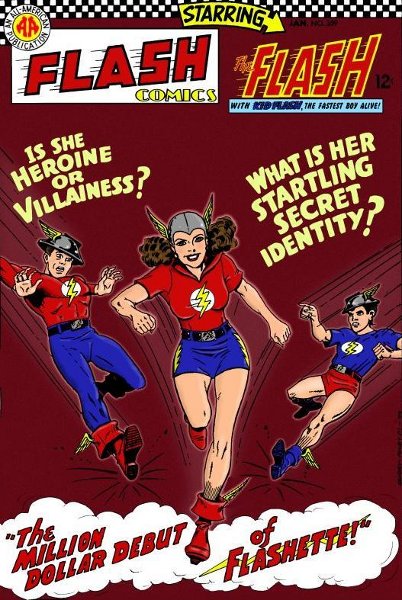
Of course, part of the fun in this sort of alternate history is looking at not just what might be different, but what might be similar. So Green Lantern and the Flash not only took on the prominence of Superman and Batman, but many of the same story elements. Green Lantern introduced Kid Lantern stories instead of Superboy, and Girl Lantern instead of Supergirl. Instead of Batgirl, the Flash family expanded to include Flashette. Artist Larry Guidry provided cover art inspired by the introductions of their counterparts in the real publishing timeline.
On his blog, Rozakis lists the full set of articles:
The series appeared in ALTER EGO #s 76, 78-81, 83, 85 and 87, with a bonus chapter scheduled for #93 or #94, depending on space. [Edit: I don’t see it listed on the TOC for either book.] The second half is in BACK ISSUE #s 28 – 36, except #31.