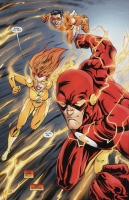
Showcase: The Top #4

Comics Should be Good has been running a Top 50 Countdown of the “most notable issue numbers in comic book history,” with the top issue #1, the top issue #2, the top issue #3, etc. They’ve been revealing the numbers in a more-or-less random order, and wrapped up the series today with #4. Their choice: Showcase #4, the 1956 comic in which DC Comics decided to try revitalizing super-heroes with a revamped Flash, and launched the Silver Age of Comics.

Why Do I Buy Certain Comics?

The Weekly Crisis recently invited 5 comics bloggers to write about why they buy the comics that they do, then turned it over to ask the readership the same question. This is an extended version of my response to that post.

For most of my comics-reading life, I’ve followed characters. I’d pick up The New Teen Titans and stick with it. I’d follow that to Flash (and that to Justice League Europe), Hawk and Dove, Deathstroke, Nightwing, etc.

Sometimes I would pick up a new book for the concept. I’d take a look at, say, Darkstars in the early 1990s, and think, “Hey, that sounds cool!” Or Planetary back in 1999, or Welcome to Tranquility last fall (yeah, in trades).

I’ve also tended to stick with the universe I know best — DC — and stand-alone titles. The Marvel books I’ve read tend to be either creator-owned (Groo the Wanderer when it was published at Epic), licensed (Transformers when I was younger), or off in their own little corner (Alias, The Twelve). Same with WildStorm — while I eventually tracked down some Stormwatch and Authority trades, mostly I read Planetary, which was off doing its own thing.

For a long time, I read most of the big events at DC. Partly it was because everyone was in them (and I was reading a lot more super-heroes back then), and partly it was because, if Big Changes were afoot, I wanted to see what happened. Though I drew the line at tie-in issues of series I didn’t read, unless they specifically crossed over with a book I was reading. (The one exception: DC One Million. I read almost all of those tie-ins because I wanted to see what DC did with the ideas.) Eventually I got tired of the endless crossovers of the 1990s, and stopped. Until Infinite Crisis, which looked interesting, but annoyed me even more in the end.

These days, I find myself following writers. Astonishing X-Men was far from my first comic, but it was my first X-Men comic — not counting the crossover with New Teen Titans back in the 1980s — and I picked it up because it was Joss Whedon. I’ll check out almost anything mystical written by Bill Willingham. Neil Gaiman’s name got me to pick up his Eternals miniseries, and you can bet I’ll pick up his Batman story next year. And I’m beginning to get to that point with Jay Faerber — Noble Causes, Firebirds and Dynamo 5 are hard to beat, and I resisted picking up Gemini, but finally gave in.

Like some of the respondents, I also have trouble letting go. I kept reading various incarnations of Titans for over a decade (everything from “Titans Hunt” to Infinite Crisis, minus the Jurgens series) even though I no longer really liked the book — just occasional stories. I kept hoping it would get better, but after being bitten over and over, I finally wised up and walked away.

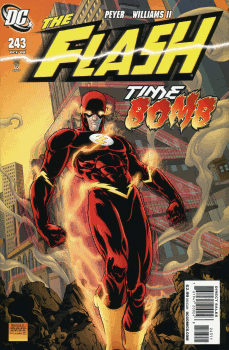
I’ve gotten much better at only reading the stuff I actually like lately (Countdown to Final Crisis excepted; it was research material). I dropped Fell after a few issues because, as good as it was, it just disturbed the heck out of me. I gave Shadowpact and Jack of Fables a shot, but neither really grabbed me the way Fables did. I even came close to dropping Flash with the 2006 relaunch, though I decided to give it a chance. Once I picked it up, I stuck with it because the writers were clearly learning on the job (and you could see that they were learning from issue to issue), and then actually liked the next writer’s arc — not where it went, but how it was presented.

Looking at books I’ve started reading recently: Continue reading

Super Stupor on Resurrection and Legacies

Cartoonist R.K. Milholland of Something Positive has been working on an occasional strip called Super Stupor since December, applying his usual twisted humor to the everyday lives of super-heroes and villains. At this year’s Comic-Con, he was selling a short Super Stupor comic book in which villains attack a super-hero convention.

Before the battle, the book has glimpses of the convention itself, including a “Heroic Deaths Q&A” session featuring Death himself as a panelist:

A fan asks Death whether bringing heroes back from the dead is insulting to their legacies.  Death...is sarcastic.

It seemed topical.

Super Stupor features adult language, adult content, and a very sick, twisted and offensive sense of humor. If any of that offends you, or is likely to get you in trouble, you probably shouldn’t look at it.

If you’re okay with that sort of thing, there’s an interesting commentary on the “Women in Refrigerators” cliche in the archive.

XS in Legion of Three Worlds

CBR has an interview with Geoff Johns on Final Crisis: Legion of Three Worlds, and hints at certain… flashy elements to the story.

“If people liked Bart Allen, they should probably read the book. XS is in it.”

And while he wouldn’t come right out and say whether or not the five-issue miniseries absolutely, positively marked the return of the speedster formerly known as The Flash, Johns teased, “Obviously, one of the big things in ‘Lightning Saga’ that we still haven’t addressed is the lightning rod and what that’s all about. That will be a central focus of the series.”

An image caption also indicates that XS (Jenni Ognats, Bart’s cousin and Barry’s granddaughter) will appear in Flash: Rebirth. While that’s entirely possible, given the apparent scope of the story — and I think it would be great to have the entire Allen/West clan involved — I have to wonder whether the caption writer was misreading an ambiguous paragraph early in the article, which explained XS’ ties to Barry Allen, then added that “The popular character will be showcased… [in] The Flash: Rebirth.

Word Balloon interviews EVS on Flash: Rebirth

The latest Word Balloon podcast interviews artist Ethan Van Sciver on his role in Flash: Rebirth. Newsarama has posted selected quotes, including this:

I’ve been talking about bring Barry back for years. He’s been dead for 23 years I think we’ve paid sufficient homage to the greatness of the original Crisis…you know there’s still great stories to tell about this character let’s bring him back NOW. He’s a crime scene investigator, and we can tell stories in a pg-13 way that couldn’t be done in the silver age.

People are going to focus on Barry Allen being back …but really what Flash Rebirth is about is restoring the entire Flash mythos. We want to realign everything up again, have it all make sense, and make it more palatable for every Flash fan. The Flash mythos is only partly understood now…There’s going to be a big map that explains concepts that people already kind of have an inkling about, will be totally explained therein.

I’m going to have to listen to this later.

Final Crisis Theory of Impenetrability

Three issues into Final Crisis, there’s a large contingent of people who feel that the book is “impenetrable,” and that it requires an encyclopedic knowledge of the DC Universe in order to understand it. I disagree. In fact, I think up to a point, knowledge of DC actually makes it harder to understand it.

From what I’ve read, the biggest complaints seem to be coming from people who know quite a bit about the DC universe and are annoyed that they don’t know the background on, say, Frankenstein (as he fits into the DCU), or Anthro, or Libra, etc. On the other hand, people who aren’t totally immersed in DC history assume they’re not going to recognize everyone, and are more willing to go with the flow.

Certainly, the book is steeped in the DC Universe. But for the most part, the characters’ back-stories don’t seem to be necessary to understand what’s going on in this story.

Example 1: The prologue in the first issue was set in pre-history, in which Metron of the New Gods filled the Prometheus role and gave fire to humans. A cavemen battle featured DC characters Anthro and Vandal Savage. A lot of people complained that if they hadn’t recognized the characters, they’d be lost. Well, no, not really — they’d just see a battle among cavemen, which gets the main idea across quite nicely.

Example 2: Frankenstein and S.H.A.D.E. figure prominently in the opening scenes of issue three. If you haven’t read Seven Soldiers: Frankenstein, you might wonder what the heck Frankenstein’s monster is doing working for an F.B.I.-like agency. On the other hand, the scene would still work if it were a random F.B.I. or S.H.A.D.E. agent. The back-story on the character isn’t necessary to understand his role here.

Oddly, I haven’t seen anyone complaining (yet) that they needed to pick up a Cave Carson showcase in order to understand the scene in which they discover a petroglyph.

I believe it was Bruce Timm who explained that on the Justice League cartoon, they made an effort to use existing characters from DC’s stable whenever possible. In one episode they needed a sniper. They could have just had a random sniper, but they looked through DC’s roster and decided to use Deadshot. Was Deadshot’s background necessary to understand the resulting episode? Not at all.

In a lot of these cases, what readers are missing isn’t a critical piece of the story — it’s bonus material. And again, it’s the people who have a solid but not thorough knowledge of DC who feel left out, because they know, say, JLA backward and forward, but not Kamandi, or they’ve memorized everything Geoff Johns has ever written, but didn’t read Seven Soldiers. So they feel like they should know the back-story.

As an experiment, I handed the first issue to my wife, whose familiarity with the DC Universe mainly comes from the animated Justice League. She had some questions, certainly, but she was able to understand most of what was going on.

Working up the scale, you eventually get to the readers who do recognize almost everything, and then the key issue becomes: what attitude do they take toward the parts they don’t know? Are they frustrating? Or are they puzzles to solve?

As for myself, admittedly I do have a strong grounding in the DCU, having read a lot of their comics over the past two decades. But there were still characters I didn’t recognize, like Dan Turpin and Sonny Sumo. Heck, I missed the fact that the evil caveman in the prologue was Vandal Savage, which enhances a later scene (when Libra mentions that the world has been waiting a long time for Vandal Savage to make good on his threats to conquer it*). Even so, these gaps in my DC knowledge didn’t prevent me from figuring out what was going on, because I thought, oh, these must be new characters. Picking up the details through sites like Final Crisis Annotations certainly enhanced the experience, but I didn’t feel that my initial reading had suffered at all.

So in short, here’s my theory (well, really it’s just a hypothesis) on how readers react to Final Crisis:

  • Minimal DC knowledge: Accepts gaps in knowledge, goes with what they do know and what’s on the page, and follows the book.
  • Medium DC knowledge: Gaps in knowledge are infuriating, feels the book is impenetrable.
  • Extensive DC knowledge: Follows the book, then gets involved in discussions afterward to see what they missed.

*I prefer the take given by some story I can’t remember, in which Vandal Savage says, “From time to time, I have chosen to rule the world.” It makes him more menacing, to think that for the most part he isn’t really trying, and when he has put the effort in, he’s succeeded.