Now that Barry Allen has returned, there’s sure to be a surge in interest in stories starring the Silver-Age Flash. Unfortunately, the series ended a decade before the trend of re-releasing comics in trade paperback form came into fashion. This leaves only a handful of Barry Allen stories collected in books, and most of those from the early 1960s.
Books featuring Barry’s adventures are currently limited to two Showcases, four Archives, a Greatest Stories collection and the Crisis on Multiple Earths series.
Showcase Presents: The Flash
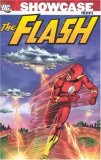 The easiest and cheapest way to pick up classic Barry Allen stories is through the two volumes of Showcase Presents: The Flash. These are black-and-white paperbacks on newsprint, but include roughly 500 pages in each book for under $20. The idea is to put the content out as cheaply as possible for people who want to read it. So far, these books cover 1956–1963.
The first volume covers the Flash’s initial appearances in Showcase up through issue #119, and features the first appearances of most of the classic Rogues Gallery. The second, released last week, collects issues #120-140, and includes such classics as “The Flash of Two Worlds.”
Showcase Presents: The Flash at Amazon
Showcase Presents: The Flash at Mile High Comics
The Flash Archives
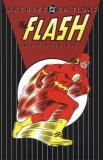 For the higher-end collector, DC’s Archive Editions include four volumes of Flash Archives. These are hardcover, color books on glossy paper, around 200–250 pages apiece, retailing for $50. (Though if you shop around, you can usually find them for closer to $30.) The Archives are designed to last as part of a personal library. The Silver Age Flash Archives cover 1956–1962.
DC has been cutting back on its archive program in recent years, and it’s not clear whether they will release any more volumes of the Flash Archives. These four could be it.
The Flash Archives at Amazon
The Flash Archives at Mile High Comics
The Greatest Stories Ever Told
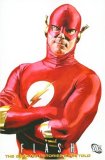 Rather than sequential collections, this book collects the high points of the Flash’s entire run. There are actually two versions, one released in 1991 and out of print, and one released in 2007, with different content.
The 2007 trade paperback, Flash: The Greatest Stories Ever Told, is easier to find, and features five Barry Allen stories including “Flash of Two Worlds,” (Barry crosses to Earth-2 and meets Jay) “One Bridegroom Too Many” (Barry and Iris marry), “The Gauntlet of Super-Villains” (the first major Rogues Gallery story) and the 80-page crossover, “Beyond the Super-Speed Barrier.” (It also features two Jay Garrick stories and a Wally West story.) My other blog has a detailed breakdown of the contents.
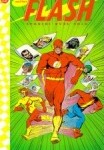 Harder to find is the 1991 hardcover, The Greatest Flash Stories Ever Told. This was a longer book, and featured 12 Barry Allen stories — all but one of them different from the 2007 book. (Only two stories appear in both editions: the Golden-Age “Stone-Age Menace” and the late Silver-Age “The Flash — Fact or Fiction?”) There’s also a paperback version. If you can track this down at a reasonable price, it’s worth picking up.
Superman vs. the Flash
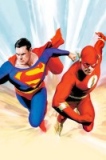 This TPB covers all of the major races between Superman and the Flash. It includes four races with Barry Allen including the original in Superman #199, the rematch in Flash #175, and two longer races from World’s Finest #198–199 and DC Comics Presents #1–2.
The Life Story of the Flash
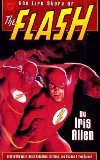 Mark Waid’s 1997 biography of Barry Allen, done in the form of an in-universe book written by Barry’s widow, Iris. It covers the high points of his career, putting a different spin on some events. This is available in both hardcover and trade paperback.
Flash & Green Lantern: The Brave & the Bold
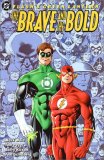 This collects the 1999 miniseries by Mark Waid, Tom Peyer, and Barry Kitson. The stories focus on the friendship between Barry Allen and Green Lantern Hal Jordan over the course of their super-hero careers. It’s also a follow-up to the Waid/Augustyn/Kitson JLA: Year One.
Crisis on Multiple Earths
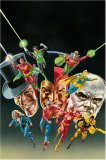 During the 1960s and 1970s, cross-overs between the Justice League of America and the Justice Society of America became an annual event. They started with “Crisis on Earth-One” and “Crisis on Earth-Two,” setting the phrasing that would eventually become Crisis on Infinite Earths. DC has four trade paperbacks under the Crisis on Multiple Earths banner that feature these JLA/JSA team-ups.
There are also two volumes of Crisis on Multiple Earths: The Team-Ups, which feature individual characters from Earth-1 and Earth-2 working together. These include several meetings between Barry Allen and Jay Garrick, such as “Flash of Two Worlds,” “Double Danger on Earth,” and “Vengeance of the Immortal Villain.”
Crisis on Multiple Earths at Amazon
Crisis on Multiple Earths at Mile High Comics
Crisis on Multiple Earths: The Team-Ups at Mile High Comics
Other Series
(Added July 1)
Naturally, the Flash appears in various other collections from the Silver and Bronze ages, especially Justice League of America. JLA trades include the Crisis on Multiple Earths series, three (so far) Showcase Presents volumes and nine Archive editions covering most of the 1960s.
Showcase Presents: Justice League of America at Amazon
Showcase Presents: Justice League of America at Mile High Comics
Justice League of America at the Trade Paperback List
Back Issues
As mentioned above, the 1970s and onward (the Bronze Age) are almost completely unrepresented in collections. Fortunately, the Internet has made it easier than ever to track down back issues. Sites like eBay and Mile High Comics make it easy to track down what you can’t find at a local comic store or a convention.
A number of stories from the 1960s have been reprinted in later issues of The Flash and in smaller reprint collections from the 1970s, as you can see in this list of Silver-Age Flash Reprints (work in progress). Sure, you won’t find them at Barnes & Noble or Borders, but if you find yourself looking for something from the mid-1960s, it may be easier to find a 1970s reprint in decent condition.

 Teen Titans: Titans of Tomorrow
 Countdown Presents: The Search for Ray Palmer