More WWC Flash Hints

Saturday’s Wizard World Chicago panel, DCU: Crisis, added a few more tidbits of Flash news to the many hints from the DC Nation panel on Friday.

Newsarama’s report

Didio looked at Ethan Van Sciver, teasing about his involvement. EVS deadpanned, “Yeah, good stuff. I wish Geoff were here.” Didio followed up, “Which Flash would you talk about?” Van Sciver shot back, “Why not all of them?” Didio pretended to be incredulous “In the same book?” Van Sciver drove it home with, “Why not?”

Rumors of a Van Sciver/Johns Flash series were already floating around. But all Flashes? They might have to come up with a team name at this rate! (Blog @ Newsarama points out the reason Geoff Johns missed the panel: He was close friends with Michael Turner, and left the con for Los Angeles when he learned of the artist’s passing.)

CBR’s write-up adds:

DiDio didn’t want to comment on a rumor that Peyer and Williams would leave “The Flash” and a the series would be restarted with a new #1…

Well, we already know that Peyer and Williams are off the book. And it certainly looks like a relaunch of some sort is in the cards. But another #1?

Personally, I think if the series relaunches with Barry Allen, it would make more sense to pick up with #351 — right where his series left off. If Wally keeps the central spot, it should stay with his numbering. If it’s going to be a combined Flash book, I’d like to see them take a cue from Spider-Man and pick up where the numbering would be if the series had never been renumbered.

Let’s suppose that “This Was Your Life, Wally West” is a 4-parter, which would make it finish the same month as the end of Final Crisis. That would take the series to #247. So we’d have 350 issues of Jay’s and Barry’s series, plus 247 issues of Wally’s, plus 13 of Bart’s, bringing it to 610 issues total, with a relaunch picking up at #611. Or if you include All-Flash #1, Flash v.2 #0, and Flash v.2 #1,000,000, all of which fit into the normal monthly schedule, it would pick up with #614. Okay, so neither of those has the magic of a #500, but very few comic books have reached numbers this high.

Michael Turner Passes Away

Newsarama is reporting that artist Michael Turner has passed away at the age of 37, after an 8-year battle with chondrosarcoma. The founder of Aspen Comics is probably best known for his creator-owned book, Fathom, and his work at Top Cow in the 1990s — and to DC readers for his Identity Crisis covers and re-introducing the Kara Zor-El Supergirl.

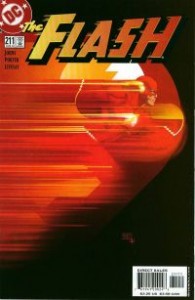
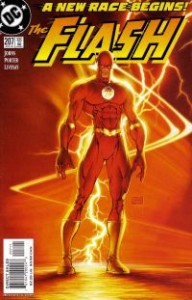
Turner did a series of high-profile covers for The Flash in 2004 (Flash v.2 #207–211), at least three of which have been reproduced as posters and T-shirts.

Strangely enough, when I went into my local comic store this morning, I noticed a large Fathom poster at the back. It’s probably been sitting there for the last five times I’ve been in, but for some reason it caught my eye today.

Aspen has asked that anyone wishing to make a charitable donation in Michael Turner’s name should send it to either the American Cancer Society or The Make-A-Wish Foundation.

Flash Hints from Wizard World Chicago

CBR has been live-blogging the DC Nation panel at Wizard World Chicago, and reports these comments regarding the Flash. Update: Newsarama’s coverage is up, with a few more bits. I’ve tried to merge them together more-or-less in order.

“Barry Allen’s back,” a fan yelled. DiDio polled the audience to see what Flash they liked best. Jay Garrick and Bart Allen didn’t win, but Barry Allen and Wally West were both favorites.

“Flash came back and Martian Manhunter died, doesn’t that balance the scales?” [Dan] Didio said.

This is interesting phrasing, given how balance is such a central theme to Final Crisis.

– With Barry Allen back, does DC have a better plan for what to do with Barry than “what you had for Wally?”

Van Sciver: “Oh of course.”

DiDio: “Wally will be around. He’s part of the Titans team right now, and he’ll be part of that team for the foreseeable future.”

On the plus side, that again suggests that Wally West will live through Final Crisis despite Barry Allen’s return. On the minus side… who knows what they consider “foreseeable” at this point. (And they have misled us on future Flash plans before.) And it’s The Titans.

It would certainly fit with rumors that Wally may stay in the Titans while Barry rejoins the Justice League. Though it doesn’t preclude Wally staying in Justice League of America while Barry joins James Robinson’s Justice League cast with Hal, Ollie, Ray and company.

Will they bring back Bart Allen? “You have read the first issue of ‘Legion of Three Worlds,’ right?” Didio asked, and Johns hid his head in his hands.

“I haven’t read it,” [Bob] Wayne said. “It hasn’t come out.”

At that point, [Geoff] Johns put his head down and shook it, then leaned toward the microphone in front of him and said, “You’ll read it now.”

“No plans at this time,” Didio came back. “How did I cover, Geoff?”

Hmm, perhaps the carrot-dangling has officially passed from grandfather to grandson… 🙂 (This part was mashed together from both write-ups.)

Seriously, fans have been speculating as to “who was in the lightning rod” since Justice League of America #10 wrapped up The Lightning Saga a year ago. It was made clear that the Wests’ return was unintentional, but strongly implied that the Legion did manage to bring someone back. Barry? Bart? Someone else? Barry’s return in Final Crisis seems to eliminate him as a possibility, so Bart’s a strong candidate. (Looks like I’ll be adding another miniseries to my pull list this summer.)

– Any more Elseworlds? DiDio: “As a matter of fact, we have a couple in production right now… We have one story coming out from Cary Bates.”

Aside from this being big news, since they’ve been avoiding the Elseworlds name, there’s a possible Flash connection…since Cary Bates wrote Barry’s series for the better part of 15 years. Could this be a similar project to the Teen Titans Lost Annual?

– Wally’s twins? DiDio: “Montessori School,” he joked. Van Sciver: “They’re going where Nightwing’s going.”

Okaaay… I’m going to guess these were both joke answers.

– After writing Rogues Revenge, does Geoff Johns have anything else with the Flash? Johns: “Ummm… I don’t know!”

Update: There’s more Flash news from Saturday’s DCU: Crisis panel.

Final Crisis: Altered Balance

In responding to Comic Treadmill’s review of Final Crisis #1, I realized that a common thread links many of the criticisms various people have leveled at the series: a change in balance between plot, continuity, and theme. I’ll try to keep this as spoiler-free as I can.

Plot-Driven Events

We’ve gotten used to event books where the most important elements are plot and continuity, almost to extreme. Books like The OMAC Project, Day of Vengeance and Rann-Thanagar War were accused of being bullet-point series, where the writers seemed to be going down a checklist of items that had to happen. Villains United differed by emphasizing characterization, and proved to be the stand-out among the four Infinite Crisis lead-ins.

Looking back at Infinite Crisis: what was the theme? Early on there seemed to be a concept of “Okay, the world’s fundamentally broken. Do you fix it or start over?” — but that went by the wayside as it turned into villain threatens the universe and heroes must stop him. If anything, perhaps the value of perseverance?

Focus on Theme

With Final Crisis, people have complained about the “filler” — the caveman battle in issue #1, the Japanese super-hero team at the night club in issue #2, etc. — and about continuity. Either there’s too much continuity, because it uses obscure characters, or there’s not enough, because it conflicts with Countdown and Death of the New Gods (which didn’t quite line up themselves).

I think what Grant Morrison is doing is writing a story where theme is more important than plot. What happens, or how it happens, isn’t as important as why it happens. And so far, the “why” is all about humanity’s capacity for corruption. From taking the prehistoric gift of fire and turning it into a weapon of war, to taking the modern-day gifts of super-powers and turning them into a tool for popularity, we see how humans can misuse their potential. Similarly, there’s the detail of the community center becoming a strip club. The corrupting influence of Darkseid and his minions fits right in.

Balance

There’s also the “Evil won” concept, where Libra mentions that the balance has shifted between good and evil. Morrison has previously treated the fact that the good guys (almost) always win as part of the nature of the DCU. In JLA #9, the Key took advantage of this to set up a scenario such that the Justice League winning would further his own plans. More prominently, in JLA: Earth 2, the League tried to travel to the Crime Syndicate’s world and correct as many injustices as they could in a limited time period. Because the nature of that universe was opposite — there, evil always won — none of the League’s victories could last. Kurt Busiek later picked up on this for his “Syndicate Rules” arc. The key setup for Final Crisis seems to be that the rules have changed, and until they’re changed back, evil will always have the upper hand. This explains why, as one reviewer put it, heroes are getting taken out like teenagers in a slasher movie.

Clearly, for the story to not be totally depressing and destroy the DCU, part of the story will have to be about redressing that balance.

For the record: I’m not a giant Grant Morrison fan. I enjoyed his run on JLA, DC One Million, his Flash run, and Seven Soldiers. I’ve read the first trade (or perhaps two) of The Invisibles and maybe two issues of Animal Man, and none of Doom Patrol. Seaguy left me utterly confused, but I think I need to re-read it now. I don’t think I’ve read any of his Marvel work, or Image, or anything he did before breaking into the US market.

Welcome Back, Barry Allen!

Today’s Final Crisis #2 marks an event that many Flash fans have been anticipating* for years: the return of Barry Allen, the Silver Age Flash.
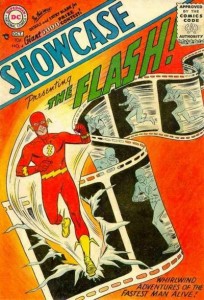
Barry made his debut in the 1956 comic book, Showcase #4. In the early 1950s, super-heroes had faded from popularity, and most of their series had been either canceled or converted to another genre. (For example: the Justice Society’s book, All-Star, became All-Star Western.) DC Comics decided to try reviving the genre, and started by redesigning the Flash. They gave him a new origin and identity, a sleeker costume, and a more sci-fi flavor to the stories, and published him in their try-out title.

The Flash was a success, and after three more appearances in Showcase, they gave him his own series in 1959. Revamps of Green Lantern, the Atom and other heroes soon followed. In fact, the Flash is often credited with launching the Silver Age of comics. (The other hero most often cited is J’onn J’onzz, the Martian Manhunter. Ironically, he was just killed in Final Crisis #1.)
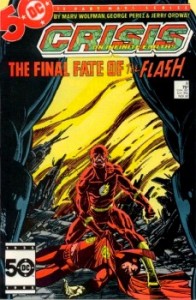
After 30 years, though, DC decided it was time for another relaunch. Sales on the book were flagging, and DC was preparing Crisis on Infinite Earths, an event which would make sweeping changes to its entire line. In essence they were launching a new age of DC comics. The death of the Flash symbolically represented the end of the Silver Age.** Barry met his end in Crisis on Infinite Earths #8 (1985), and his former sidekick Wally West carried on his legacy as the Flash of a new era.

Over the next 23 years, Barry Allen was part of a small group of comic book characters whose deaths seemed permanent. He showed up occasionally in time travel stories, and was placed in various afterlives — including a tribute story at Marvel and the concept that gives this site its name: the speed force, a Valhalla for speedsters. And of course there was the 1993 storyline, “The Return of Barry Allen,” in which he appeared to be back…only to eventually be revealed as an impostor.

But eventually, even Jason Todd and Bucky Barnes returned from the grave.

Speculation started with the build-up to Infinite Crisis. It became clear that Wally was going to follow his mentor into comic-book limbo, and fans started trying to figure out who would take over. Would it be Barry’s teenage grandson Bart, the current Kid Flash? A rejuvenated Jay Garrick? Would Barry return? Would several Flashes somehow be fused into one? Ultimately, DC transformed Bart into an adult and gave him a shot at the lightning.

One year later, the Justice League/Justice Society/Legion of Super-Heroes crossover, “The Lightning Saga” was working up toward resurrecting someone. Signs pointed to either Lightning Lad or a Flash, and when the news hit that Bart’s series was ending, fan speculation again went to Barry. This time, it was Wally who returned.
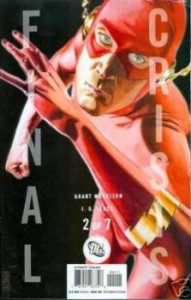
Another year later, with Final Crisis looming and continuing discontent with the relaunch, fans started to see clues that, once again, hinted at a possible return for Barry. Among those clues was a poster that appeared at the New York Comic Con that looked a lot like Barry — and was painted by J.G. Jones, the artist on Final Crisis. Then there was the summary for Final Crisis #2 and its “spectacular return from the dead.”

Then on April 30, DC Universe #0 hit the stores. The book served as a lead-in to multiple storylines, all tied together by an unseen narrator who starts the issue at one with the universe. As the story progresses, he begins to remember more of his life and his connection to various heroes, and the narration boxes slowly change from black to red. By the last few pages, they’ve picked up a lightning bolt. The final splash page shows a large, white moon against a red sky, a bolt of lightning cutting diagonally in front of it. The same day, the New York Daily News ran the story of the Flash’s return.

With Barry’s return confirmed in subsequent interviews, it was only a matter of figuring out when he would appear on-panel. When the “next issue” blurb for Final Crisis #2 showed that Flash painting and mentioned “the return of a long lost hero,” the answer was clear.

Of course, many questions remain. How long will Barry be back? Permanently, or just for the duration of Final Crisis? If he stays, will he take over the lead spot in The Flash? And what does that mean for the current Scarlet Speedster?

* And, to be fair, others have been dreading it, given the way DC seems to like killing off “redundant” characters these days. Those fears gained new fuel last year when DC killed Bart literally in the same moment that Wally returned (Justice League of America #10, Flash: The Fastest Man Alive #13, and All-Flash #1).

**The 1970s and early 1980s are often referred to as the Bronze Age, but the difference is mainly in the tone of the storytelling.