Earth-Whatever

I went back and looked at the comments on the Earth One announcement at The Source. Big mistake. There’s an argument over whether it’s the same as Earth-1 in the 52 Multiverse, what Earth-1, Earth-2, Earth-0, etc. all are in this universe or the previous DC Multiverse, etc.

In short, the title alone drags the new, streamlined books into the realm of continuity-heavy fanboy debates.

In general, I don’t like numbering alternate realities. It can be useful for cataloging, but it’s much clearer to refer to “the Smallville version,” “Mainstream DC,” “Ultimate Marvel” or “Tangent Universe” instead of tossing around terms like “Earth-616” and “Universe Designate Zero.”

And isn’t the point of this new line to make things less confusing?

DC needs a banner they can put on these books, so that readers can look for “XYZ Superman Volume 1” on the shelf. But “Earth One” is already causing confusion, just hours after it was announced.

Thoughts on Earth One

This morning, DC announced the first two volumes in Earth One, a new series of original graphic novels set in a new continuity. The first two books will be Superman: Earth One by J. Michael Straczynski and Shane Davis, and Batman: Earth One by Geoff Johns and Gary Frank.

It’s being discussed all over the place, so I’ll just state my initial thoughts.

The Positives

First, I love the idea of a series of OGNs. There’s a huge potential audience out there in bookstores, and while collected editions help meet that audience, there are drawbacks — particularly pacing (when read serially) and the fact that waiting for the trade means missing out on the fan conversation. It works for prose novels, it works for Scott Pilgrim, it works for manga (even if it was originally serialized in Japan, it may as well be OGNs as far as the American audience is concerned), and it’s good to see DC taking the concept seriously.

Second, an Ultimate-style reboot of the DC Universe is a good idea. 80 years of continuity, multiple “soft” reboots, heroes who have been replaced, then come back, major events based on short stories from 25 years ago…the modern DC Universe is a complicated place. A project that reaches out to a new audience is a good opportunity to streamline things without messing with the monthly continuity.

Third, I like the Batman redesign.

The Negatives

It makes sense to start with Superman and Batman, because these are two characters that everyone is familiar with, even those who don’t read comics. But they’re starting with the origin stories. Who doesn’t know Superman’s origin? Or Batman’s? With any other character, I’d say it would be worth starting with an origin, but with these two, it might be better to jump in at the deep end and fill in the backstory as they go along.

If they keep the series going, it won’t be a problem, but I can see it being a problem for the first volumes. It reminds me of the choice for the movie of The Golden Compass to rip out the ending and move it to the start of the second movie. It definitely hurt the first movie, and probably contributed to the fact that there won’t be a second movie.

It also makes me worry that, like so many rebooted series, they’ll eventually turn to retelling older stories instead of telling new ones.

The Earth One branding seems…a little obtuse. It means nothing to the new audience, and judging by comments I’ve seen, it’s already confusing the existing DC audience. [Edit: expanded a bit more in that link.]

Uncertainty

I can’t reach the AICN interview, but CBR’s article quotes Geoff Johns as saying that the plan is for two novels a year. Two total? Or two per character? If these take off, two per character would be a much better approach, especially if they expand it to Wonder Woman, Green Lantern, Flash, and beyond.

Quick Thoughts: Weekly Twitter for 2009-12-06

  • Somehow I don’t think this guy is taking the Renaissance Faire entirely seriously.
  • Odd: I saw the typo “Batman: Unsenn” and my brain decided it was a misspelling of Unsinn, German for Nonsense, rather than Unseen.
  • Wow, these sales figures for DC are depressing.
  • FlashForward continues to take 2 steps forward, 1 step back. Ah, well. Better than the other way around.
  • Blackest Night: Flash – @GeoffJohns0 says: “Zombie gorillas are hard to beat, but next issue has something even better.”
  • Remember that Muppets Bohemian Rhapsody video? They’re official at @MuppetsStudio #FollowFriday
  • Ack! Just saw someone use “pre-Crisis” to refer to pre-INFINITE Crisis! I need a lawn ASAP so I can start yelling at kids to stay off it!
  • Archive binges were a lot easier when webcomics hadn’t been around so long…
  • FlashForward TV schedule explained.

Powered by Twitter Tools

Speed Reading: Prime, LEGO, Reborn

Some weekend linkblogging…

Interviews

CBR is readying a new installment of its Geoff Johns Prime Q&A column. If you have a question for the Flash: Rebirth and Blackest Night writer, you can submit it through Monday at 5:00 PM PST.

CHIU-stream is holding a contest for original art by Francis Manapul, and will be interviewing the upcoming Flash artist on December 10.

Art Finds

Crimson Lightning is back from its Nanowrimo-imposed hiatus with a Foxtrot Flash Find.

Ulises Farinas draws a LEGO Blackest Night (via Robot6). Brickest night?

Augustine at Comic Bloc found a probable Flash reference in Ultimate Spider-Man.

Commentary

Also at Comic Bloc, a discussion on the origin of Wednesday as new comics day.

I haven’t decided yet whether to put together a list of Blackest Night: The Flash #1 reviews. If I do, it’ll probably just be major sites and those that I follow, plus anything I stumble across. Searching does take time, even with Google Alerts.

Geoff Johns: Already the Longest Run on Flash Since 2005

Something just occurred to me: Between Flash: Rebirth and Blackest Night: The Flash, DC has scheduled 9 Flash comics in a row by the same writer. This hasn’t happened since 2005, when Geoff Johns finished his previous run on The Flash. We’re looking at the most creatively-consistent period the Flash has had in four years, even though we haven’t seen a single issue of the regular series!

The Flash has historically had very stable writing teams. The Golden Age was mostly Gardner Fox; the Silver age mostly John Broome. Robert Kanigher contributed to both. The Bronze Age was almost entirely Cary Bates. William Messner-Loebs did several years in the late 1980s, Mark Waid had the 1990s sewn up, and Geoff Johns took the first half of the 2000s.

But since 2005, the longest run had been just 8 issues by Danny Bilson and Paul DeMeo.

It’s nice to finally have some stability back for the Flash. Even if we didn’t already know Geoff Johns would be sticking around for the new series, it already feels like a minor miracle.

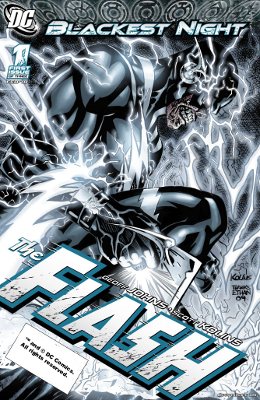
Review: Blackest Night: The Flash #1

Blackest Night: The Flash #1 (Standard)

Blackest Night: The Flash: #1 shows how to start a Flash miniseries: by hitting the ground running. Literally. While Geoff Johns took a slow burn approach for Flash: Rebirth, this time he starts in media res, with the Flash racing around the world to let everyone know what Earth is up against: the dead are rising from their graves, possessed by Black Lantern rings.

The one-page opening sequence, followed by a dramatic double-page splash of the Flash running, serves another purpose: filling in readers who might not be familiar with the main Blackest Night miniseries. As someone who hasn’t been following the main event directly, I found this page extremely helpful. Similarly, I imagine the two-page recap of Flash: Rebirth would probably help anyone approaching this miniseries from the Blackest Night perspective get “up to speed” with the current status of the Flash.

Once the recaps are out of the way, the issue alternates between high-speed Flash vs. Black Lantern action and interludes of the Rogues as they prepare to face their dead comrades. It’s effective pacing, providing both contrast and a sense of weight to an issue that, despite the battles, is still mostly setup (more about that later).

Rogue Artist

I’ve probably said it before, but Scott Kolins’ art is a perfect fit for the grizzled Rogues. He proves equally well-suited to the undead Black Lanterns. Kolins also does a great job of conveying motion and stillness — important, since that contrast is one of the issue’s major themes. On the downside, there are places where his art comes off as too rough. A one-panel appearance of the Titans stands out as an example.

Connected

The story is surprisingly connected to Flash: Rebirth, following through on several elements established in that miniseries but not (at least as far as issue #5) resolved. It seems that Blackest Night: The Flash will be exploring the fallout from Rebirth‘s changes, paving the way (one hopes) for more stand-alone stories in the new Flash ongoing that launches next year.

Even so, this issue feels less like setup and more like an actual story than the five issues of Flash: Rebirth that we’ve seen so far.

Okay. It’s spoiler time. If you don’t want to know specifics, stop reading now. Otherwise, keep reading after the cut.

Continue reading