January 11, 2012

Wayback Wednesday: Origins are Only as Complicated as You Want

Category: Opinion — By Kelson

It’s easy for us as fans to look at a character concept and decide that it’s too complicated for new readers. But that’s because we’re fans, and as fans, we like to include every detail instead of focusing on the most critical ones needed to bring someone up to speed. (And it’s not just comics fans, either. I once asked a family friend what Les Miserables was about, and she spent at least twenty minutes describing the plot of the three-hour stage version. And consider this tribute to “excrutiatingly detailed” movie plot summaries on Wikipedia.) I don’t know if it’s our attention to detail, or our love of storytelling, but it’s just so easy to pile things on that a new reader doesn’t really need to worry about until a story warrants it.

You can make a lot of these “complicated” origins awfully simple. Even Wally West.

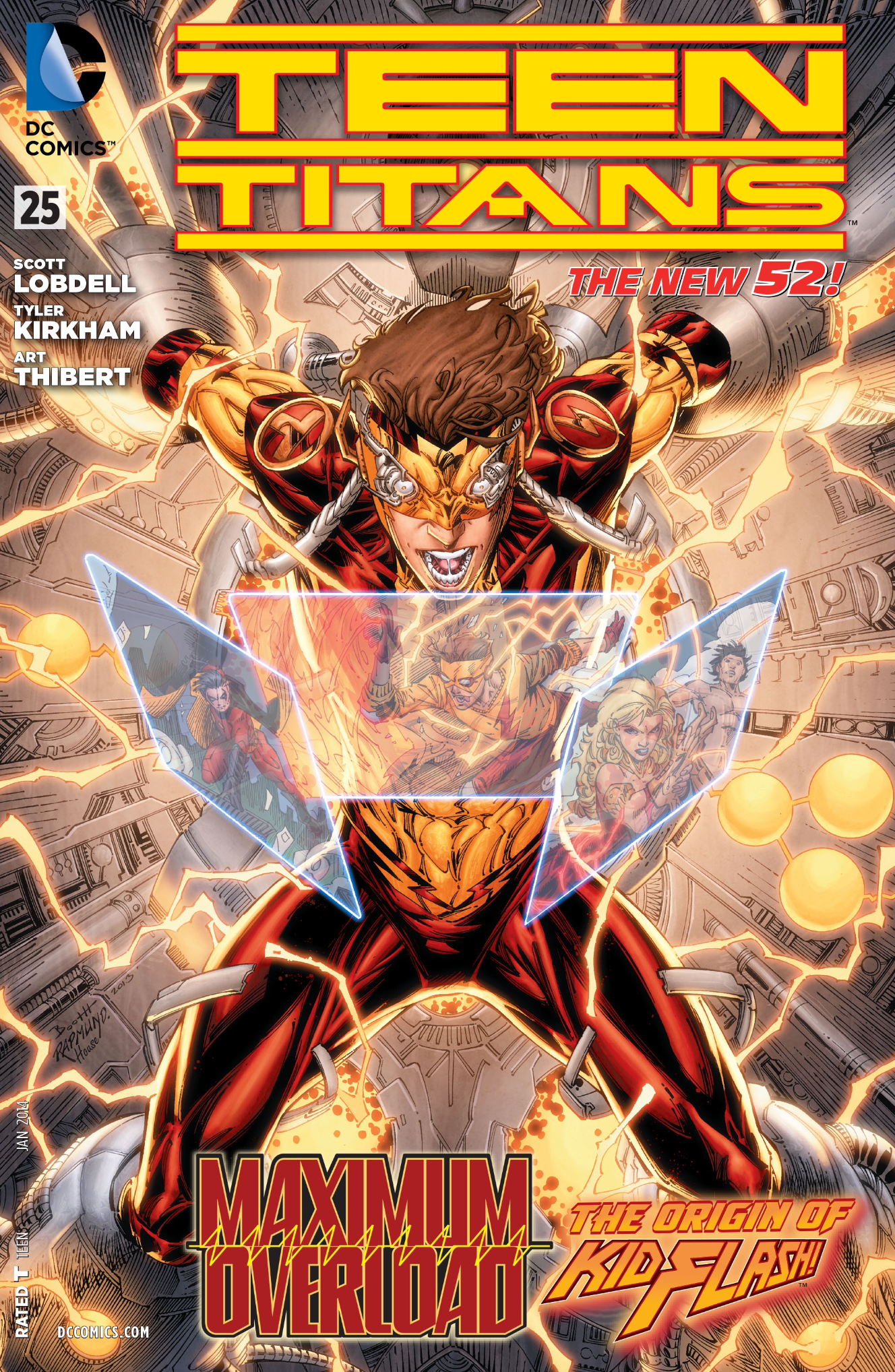
And yes, even Bart Allen.

Read the original article to see how.

December 29, 2010

Comic Critics on the Origin of the Flash

Category: Flash History — By Kelson

The webcomic Comic Critics presents its take on Grant Morrison-style minimalist origin retellings of various super-heroes, including the Flash.
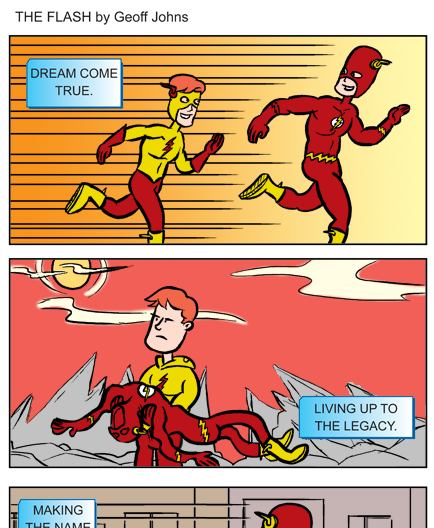
Head over to Comic Critics to read the conclusion (and the rest of the origins).

As for the Flash one: Harsh, but so, so true.

May 18, 2010

Elementary Flash

Category: Fun — By Kelson

Comics Alliance has posted a Periodic Table of Super-Powers, detailing not just powers but origins as well.
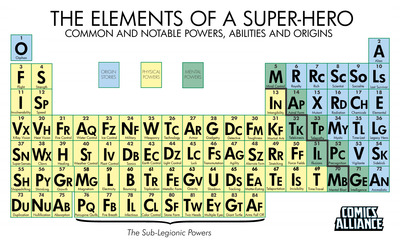
Click through to the original article, where they link to a full-sized table that you can actually read.

Let’s see if we can come up with the “chemical” formula for the Flashes:

Jay Garrick:
SpInTScCh
Speed, Intangibility, Time Travel; Scientist struck by Chemicals

Barry Allen:
SpInTDcScCh
Speed, Intangibility, Time Travel, Detective; Scientist struck by Chemicals

Wally West:
SpInTChSkLg

Speed, Intangibility (sometimes), Time Travel; Chemicals, former Sidekick, Legacy hero

Bart Allen:
SpInTXTlLg

Speed, Intangibility, Time Travel; Mutant (closest I could come up with to inherited powers), Time-lost, Legacy hero.

Arguably you could include H=healing (super-metabolism) & Is=invisibility (they can move too fast to be seen), or Sn=super-senses (seeing things more quickly, or moving so fast that radiation is red– or blue-shifted into the visible spectrum), etc.

Who wants to try the Rogues?

April 23, 2010

Dead Parents and Super-Hero Origins

Category: Opinion — By Kelson

One last WonderCon post!

At the Comic Arts Conference panel on super-hero origins, James Robinson and Steve Englehart agreed that one of the key elements to a good origin is that it includes the hero’s motivation and a hook that readers can relate to. Robinson cited the Silver-Age Flash as missing that compelling motivation: Okay, he put on a costume to fight crime, but why? Why keep going?

Robinson also talked about why so many heroes have dead parents in their past: the fear of losing a parent is something that any reader can relate to. In fact, when someone asked later in the panel how one could create a good origin, Englehart flippantly replied, “Kill their parents?”

Later in the discussion, the moderator asked about retelling origins. Robinson said he was always wary of destroying what was already there, and preferred to try to add new detail around what already works. He cited Geoff Johns’ revised origin for Barry Allen, in which his mother is killed and his father framed for it, as a successful example.

Personally I disagree. It drastically alters the character’s history, and raises questions of why his history hasn’t changed in other ways, but most importantly, it introduces a cliche that wasn’t present in the original version of the story. If you’re going to revise a story, it seems better to remove overused elements than add them.

The same weekend, the New York Times published an article on the role of parents in young-adult fiction: traditionally, the role of a hero’s parents in classic literature was to die, or at least get out of the way, forcing the protagonist into his journey of self-discovery: the orphan’s “triumphant rise.” (via Neil Gaiman)

Yeah, writers have been using this trope for a long time.

September 18, 2009

Extinguishing a Speedster’s Smokes

Category: Flash History — By Kelson

Comic Coverage posted a humorous look at the role smoking had in the Golden-Age Flash’s origin. Jay Garrick was working late, took a cigarette break, and knocked over a beaker of “hard water.” Interestingly, later retellings of his origin downplayed and finally deleted the cigarette.

First, here are the original 1940 panels from Flash Comics #1 (copied from Comic Coverage), showing grad student Jay Garrick taking time out for a smoke:

Jay Garrick pauses for a smoke

Four decades later, in 1986, Secret Origins #9 would retell his origin. Mindful of the details, but also concerned about modern sensibilities about health, writer Roy Thomas kept the cigarette break, but added Jay thinking, “I know I should give up these things…”

Jay really wants to quit

A decade later, the cigarette had disappeared completely. Flash Secret Files #1 (1997) featured a condensed retelling of all three (at the time) Flashes’ origins, and this time, Jay simply succumbed to the hour and nodded off, dropping the beaker.

Jay falls asleep on the job

(Via Crimson Lightning)

Originally posted at K-Squared Ramblings.

April 16, 2009

Origins: Only as Complicated as You Want Them To Be

Category: Opinion — By Kelson

Secret Origins Annual 2Back in February, DC’s Executive Editor Dan Didio stated that one of the reasons they are bringing back Barry Allen as the primary Flash is because “you can’t tell the origin of Wally West without Barry Allen.” I have to agree with Comics Should Be Good that this isn’t a valid reason. It doesn’t take that much more time to explain Barry’s involvement in Wally West’s origin.

I had the same problem with complaints that Bart Allen’s origin was too complicated.

The origins are only complicated because we, as fans, want to include every little detail.

Up to Speed

When it comes down to it, all you really need to explain the Flash — any Flash — is that he’s really, really fast, and he helps people (as Marc Guggenheim pointed out in his brief run on Flash: The Fastest Man Alive).

Flash v.1 #309How about an origin? For Jay Garrick, Barry Allen and Wally West, the key element is: “A laboratory accident gave him super-speed.” You can get a little more specific if you like, say, “Gained super-speed after being struck by lightning and splashed with chemicals.” As for Bart Allen? “Inherited super-speed from his grandfather” — kind of like Zatanna, who inherited her magic from her parents, but I don’t think I’ve ever heard anyone complain that her origin is too complicated.

Sure, you can go into all the time-travel and accelerated aging for Bart, but you don’t need that for the sales pitch. It might help explain his personality during his years as Impulse, but even then, all you have to add is, “He was raised in virtual reality and has no concept of danger.”

Of course, if you’re going to tell a 7-part, 150-page epic Secret Origin story, I think there’s plenty room to cover a mentorship with a classic hero.

Mentors

Flash v.2 #62Now, if you’re going to do a Wally West story that really focuses on the fact that Barry Allen was his idol, his uncle, and his mentor, then yeah, you need to explain that relationship. But for the typical Flash vs. some Rogue story, the reader doesn’t need that level of detail. It’s enough to know that he trained under the previous Flash and later succeeded him. Kind of like how Hal Jordan trained under another Green Lantern (Sinestro), and succeeded a third Green Lantern (Abin Sur). Not only does the training under Sinestro seem to factor into most retellings of Hal’s origin, but the history between Hal and Sinestro seems to be extremely important to the current Green Lantern mythology.

Green Lantern #33And yet I’ve never heard anyone claim that since you need to know Sinestro in order to know Hal Jordan’s origin, you might as well focus the Green Lantern series on Sinestro.

Or, for that matter, that since you need to know Obi-Wan Kenobi in order to understand how Luke Skywalker became a Jedi, then you really ought to focus on Obi-Wan instead of Luke. (Though given the current focus of the Star Wars franchise on the prequel era, perhaps that’s not the best example.)

Conclusion

So, is Barry Allen important to Wally West’s origin? Absolutely, no question about it. Does it make his origin more complicated? A little. Does it mean that DC can’t tell compelling, comprehensible stories about Wally West as the Flash? Of course not. Admittedly DC hasn’t been telling the best Flash stories possible lately, but having Barry in Wally’s background certainly didn’t stop them from telling good stories over the previous 20 years.

This is not to say that DC shouldn’t tell stories with Barry Allen instead of Wally West. Just that if they want to claim that it’s somehow necessary or better to focus on Barry, this particular rationale doesn’t hold up.

(Thanks to comics.org for the cover scans.)