Bolt From Above

Found in a movie theater lobby this weekend:

Large shiny golden 3D cardboard lightning bolt sticking up out of the floor.

I’m pretty sure it’s a subtle (in the sense of not having any words on it that I could see, not in the sense of being difficult to miss) ad for the upcoming Disney CGI cartoon, Bolt, but I couldn’t pass up a picture of a giant golden lightning bolt frozen in the lobby. My wife joked that it needed the caption, “Zeus was here.”

Speed Reading: Flash on TV, “Definitive” Characters, MK vs DC and more

Fellow Flash blog Crimson Lightning has returned to a regular update schedule, including the latest in its series reviewing each episode of the 1990 Flash TV Series: “Fast Forward.”

Newsarama’s Grumpy Old Fan contemplates what “the most definitive” version of a character means.

More Mortal Kombat vs DCU trailers, including video of Flash vs. Scorpion. Something must be funky about the player CBR uses, because this is the second time they’ve posted video clips on MKvDC that I couldn’t get to play. YMMV.

This Week in Geek interviews Brea Grant (via @breagrant)

And speeking of geeks, check out the 56 Geeks Project (via Once Upon a Geek)

This Week (Nov 5): Justice Society

Sorry it’s late — with following election results last night, I totally lost track of the fact that I hadn’t written this up. This week we have:

Justice Society of America #20

Written by Geoff Johns and Alex Ross; Pencil art and variant cover by Dale Eaglesham; Cover by Alex Ross

It’s the Justice Society of America vs. the Justice Society Infinity of Earth-2 with the fate of Power Girl at the center of it all! Meanwhile, Starman struggles with his returned sanity as he embarks on his true mission in our time period – one that will have vital consequences for the Crisis of the 31st century!

New Teen Titans Archives vol.4 (hardcover)

Written by Marv Wolfman; Art and Cover by George Pérez and Romeo Tanghal

The 1980s adventures continue in this final Archive edition, collecting NEW TEEN TITANS #21-27 and NEW TEEN TITANS ANNUAL #1! Don’t miss the Titans’ struggle against the hordes of Brother Blood, Starfire’s confrontation with her evil sister and more!

Teen Titans: Year One (trade paperback)

Written by Amy Wolfram; Art by Karl Kerschl and Serge LaPointe; Cover by Karl Kerschl

The early days of the Teen Titans are chronicled in this title collecting the 6-issue miniseries!

Sorry about the lack of covers — I’m in a rush.

Speed Reading: Kolins, Johns, Morrison

IGN is running an interview, the Geoff Johns Marathon, in which the writer talks about just about everything he’s working on, including Flash: Rebirth (via trmnlvlctyyy at Comic Bloc). Among other things, he writes:

Right now I’m looking at the Flash with Rebirth, and I want to see how I can make this mythology even bigger. It’s already huge. The Flash has an awesome base, so cracking it open even more has been an incredible challenge.

and

The Flash has always been my favorite character since I was a kid. And it’s fun to get back to writing Wally West. I wrote him for five years. To get back to him and then write Barry Allen. Like I said earlier, I get to take what I’ve learned over the last several years writing comics and apply it to the Flash. Because I started writing the Flash almost when I started writing comics, and now I get to look at everything I’ve done to this point and see how I can apply that onto my original work on the character. I want to continue to elevate my writing, and hopefully I’ll achieve that.

Newsarama interviews artist Scott Kolins on Faces of Evil: Grundy, which reunites him with Flash and Final Crisis: Rogues’ Revenge collaborator Geoff Johns.

Finally, MTV’s Splash Page wonders why Grant Morrison can’t talk about a Flash movie, given the number of NDAs he’s signed in connection with various film projects. [Edit: Since the original page has vanished, I’m attaching a quote from the Google cache so you can have a little context. Thanks, Rockin’ Rich.]

“Yeah, that’s the kind of thing I can’t talk about,” Morrison said. “Yes, I have talked to them. I’m deeply involved in those discussions. I know what’s going down with all of that, and it’s actually really exciting. But beyond that, I can’t say anything. I wish I could tell you. I’m sure announcements will probably be made at some point, but I can’t say anything.”

Creative Consistency

Edit: This has been restructured and rewritten a bit to make the post come off a bit less personally, since that wasn’t the intention.

Groovy Superhero is running a series on The World’s Fastest Cancellation, looking at the way the series has been relaunched over and over since Geoff Johns 2005. The Flash has had a remarkably consistent writing credit over the years, until Geoff Johns left the book in 2005 to do Infinite Crisis.

Wally Before Geoff

One thing the author of that series said got me thinking about the series’ creative history: In part one, he or she writes about the book after Geoff Johns left it:

The Flash…was relegated to the status he had endured throughout most of the ’90s: a “who needs work?” book, being tossed around from creator to creator

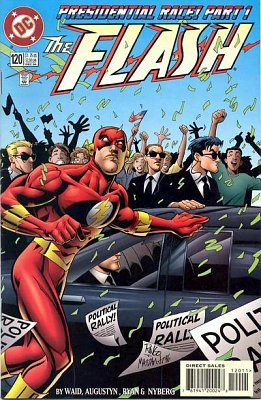
Tossed around from creator to creator? True of the last three years, but certainly not true of the 1990s. William Messner-Loebs wrote the book for four years from 1988–1992. Mark Waid* took over in 1992 and stayed on until 2000 (Brian Augustyn joining him officially halfway through after several years as editor and an uncredited co-writer), with a one-year break during which he wrote JLA: Year One and Grant Morrison and Mark Millar filled in. In fact, if you count the Morrison/Millar run as a main creative team, there’s a grand total of only five issues by fill-in writers** from #1 to #225 (the end of Geoff Johns’ run), covering 1987–2005.

Long-Term Consistency

If you go further back, Gardner Fox wrote most of the Golden Age books, with Robert Kanigher coming in near the end. John Broome wrote most of the Silver Age, with Fox and Kanigher. There was a transition period in the late 1960s, and then Cary Bates wrote nearly every issue from the early 1970s through 1985.

Three main writers from 1940-1970. One from 1970-1985. Five writers or writing teams from 1987-2005. (I’m lumping the Waid/Augustyn and Waid solo runs together. Same with the Morrison/Millar and Millar solo books.)

Now let’s look at the book after Geoff Johns left in 2005:
4 issues by Joey Cavalieri
8 by Danny Bilson & Paul De Meo
5 by Marc Guggenheim
7 by Mark Waid
6 by Tom Peyer
4 by Alan Burnett
2 one-shots

Six writing teams in three years, and a couple of one-offs.

Flash or Thrash?

Following Johns’ final issue, it’s clear they had already decided to axe the book, since all that remained was one stand-alone story that had been sitting on the shelf and the 4-part “Finish Line,” which was clearly intended (like the current “This Was Your Life, Wally West”) to wrap up the series.

Then DC proceeded to throw lead characters, creative teams, and creative directions at the wall haphazardly, hoping something would stick. How could anything gain traction with that much churn?

In my opinion, given that DC is already committed to relaunching the series with Flash: Rebirth, the best thing DC could do to build the book back up would be to keep Geoff Johns on after the miniseries, and give him at least a year to establish the series tone, direction, and at least one long-term arc. Then make sure that whoever follows him is sufficiently high-profile not to scare readers off, and won’t simply throw everything out and start over.

Notes

*By part 5, he explains that “Waid’s main contributions to the Flash mythos were to introduce Wall and Wife Linda’s twins.” Now, I would assume that he meant Waid’s contributions this time around, but given the remark in part 1 about the series being a dumping ground of random writers in the 1990s, I have to wonder whether the writer in question is simply not familiar with Waid’s eight-year run, or that it established the Wally/Linda relationship, introduced the Speed Force, built up a family of speedsters, spun off an Impulse/Max Mercury book, and really established the Flash as once again being a major player after 60-odd issues of the B-list.

**Those fill-ins would be:
#29: Len Strazewski (1989)
#151: Joe Casey (1999)
#160: Brian Augustyn solo, not sure you can properly call it a fill-in. (2000)
#161: Pat McGreal (2000)
#163: Pat McGreal (2000)