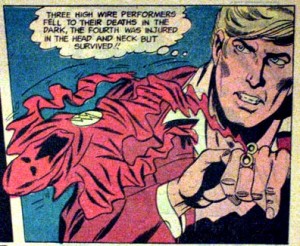
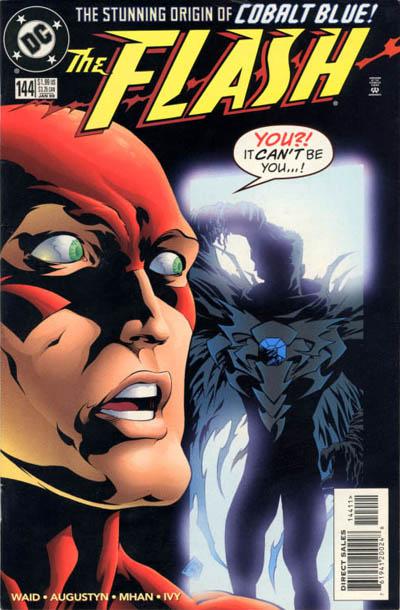
As it turns out, the Flash was right. The man removing his mask in the prologue to “Chain Lightning” wasn’t who Wally thought he was at first. But Cobalt Blue certainly looked like the classic Scarlet Speedster! (Flash v.2 #144, 1999).
Interestingly enough, the series returned to the cover concept less than a year later during the Dark Flash saga, reversing the lighting, the angle…and who was doing unmasking. (Flash v.2 #154, 1999) Read the rest of this entry »
Welcome to the second entry in our breakdown of Flash stories from the late 1970s and early 1980s, leading up to the July 20th release of “The Trial of the Flash”!

UP TO SPEED: Last week we looked at Flash #270 and the introduction of the mysterious Clown, who seemed to have gotten the best of Barry Allen. We also witnessed the birth of Dr. Nephron’s prisoner rehabilitation program, a female fan out to “ensnare” our hero, a jilted Iris Allen, and a heroin smuggling operation based in Barry’s crime lab!
This week, we’ll review the events of issue 271.
Read the rest of this entry »

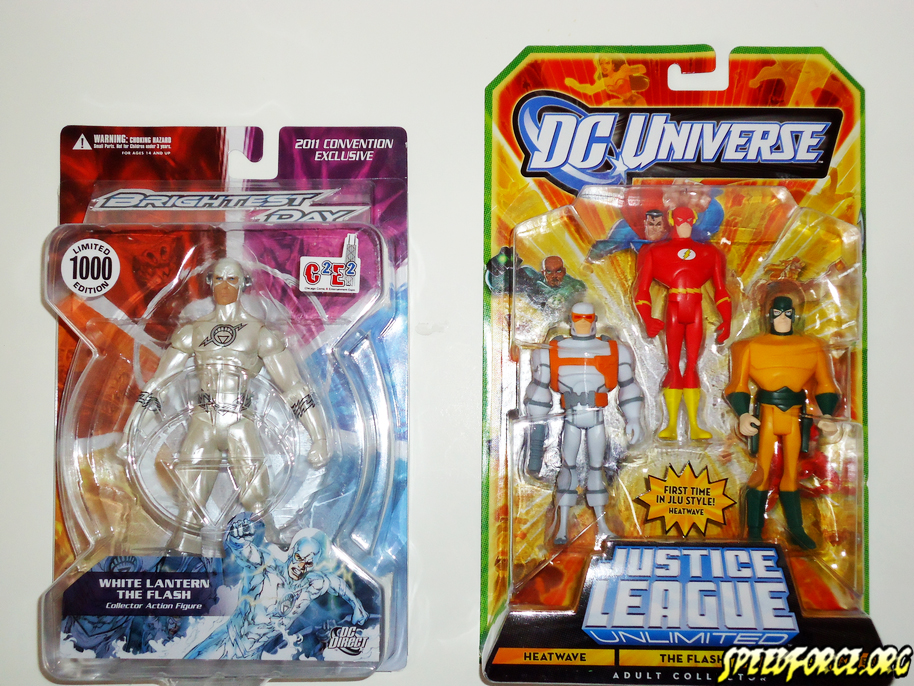
So last weekend Chicago’s biggest comic book convention, C2E2 was held. Which just so happens to be the the first leg on the Mattycollector.com Collector Appreciation Tour 2011. This is the first place they would be selling the Heatwave, Flash and Mirror Master set, amongst other JLU goodies. Now normally I would be sitting back looking at the trickle of toy news online and thinking about how much the figures are going to cost me on evilBay the next day. This time however I had an ace in the hole; a reader of Speed Force who frequently posts comments under the name Fastest, Mark Maslauskas. Mark was going to the convention and was kind enough to offer to pick up a set for me. Can you believe it? Absolutely awesome.
Read the rest of this entry »
More importantly, the more DC has to promote the next Flash #1, the less it has [available] to devote to (let’s just say) hyping a new Icon series. If DC would put some of its series on hiatus, as opposed to cancelling one volume so a new one can begin a few months later, it would acknowledge the reality of cancellation-proof series and let more attention linger on the stragglers. Who knows — given time, maybe some of them could become cancellation-proof too.
– Robot 6′s Tom Bondurant in his Grumpy Old Fan column.
As he points out, The Flash is one of DC’s “foundational” series, which have been in almost continuous publication since the Silver Age. We all know it’s coming back.

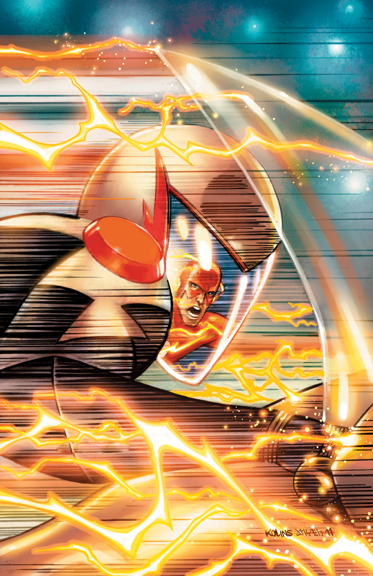
DC has released seven covers over at The Source today, including this Scott Kolins piece for the upcoming Flash #11, due at the end of April.
On a related note, Flash #10 is scheduled for April 13, featuring the Francis Manapul cover originally set for #9 and a Yildiray Cinar variant.
I spent the weekend moving to a new city, so posting’s a bit light. Here’s the round-up of last week’s linkblogging.
First, the Flashy links:
And the rest.
ComiXology now has the first two issues of The Flash vol.3 available as digital comics for their online reader or iOs/Android apps. (Sadly, the joke about having Flash on the iPad has been completely played out by now.) Better yet: The first issue is available for free!
The online version works fairly well, except for trying a bit too hard to imitate the printed comic look. (Please, we don’t need those gradients imitating the curved paper near the spine — especially on double-page spreads!) The phone app has a few problems adapting the art to the smaller screen size. I will say that this issue (at least the part I skimmed — it’s a busy day!) works better when viewed landscape than portrait.
Keep in mind: if you’re browsing the ComiXology store for these, they’re currently sorted under “T” for The Flash.
» The Flash: Rebirth
» The Flash vol.3
(via Francis Manapul’s Twitter.)
Welcome to the first installment in our analysis of the soon-to-be-reprinted “Trial of the Flash”, and related Flash storylines!

Arguably the most praised and vilified pre-Crisis Flash tale, the Trial story was written by Cary Bates, began in 1983 and ran through the title’s cancellation in 1985. With seeds in stories from as far back as 1979, the Trial was essentially the collision of years of Flash plot threads. These stories are some of the earliest examples of long-form, soap-opera style writing in DC Comics.
Read the rest of this entry »

What kinds of changes are in store for the DC Universe during Flashpoint? Teasers we’ve seen so far show a world with no Earth-based Green Lantern, a very different Superman, and a Wonder Woman and Aquaman who are world leaders rather than superheroes. DC will be publishing no less than sixteen miniseries exploring this altered world, enough for an entire line of comics…which brings to mind another thought:
What might DC comics look like if they’d been publishing this alternate history all along?
It wouldn’t be the first time someone’s explored an alternate publishing history. The Marvel/DC mash-up Amalgam Comics were all labeled #1, but included editor’s notes and letters columns referring back to earlier imaginary comics.
More interestingly, Bob Rozakis published a series of articles in TwoMorrows’ Alter Ego and Back Issue magazines in which he imagined an alternate history of DC Comics, the company.
All-American Comics
Up until the mid-1940s, DC Comics was really two companies: One was DC proper, owned by Harry Donenfield. The other was All-American Comics, owned by Max Gaines, which published under the DC label. The big three characters at DC were Superman, Batman and Robin, starring in World’s Finest. The big three at All American were Wonder Woman, Green Lantern (Alan Scott) and the Flash (Jay Garrick), starring in Comic Cavalcade. (This is also why Johnny Quick exists: DC published the Flash, but didn’t actually own the character, so they wanted a speedster they owned outright.) In 1945, after a dispute led to several issues of All-American books being published under their own banner, DC bought out the entire line. A few years later, most of the All-American characters fell off the radar (with the notable exception of Wonder Woman), but DC kept publishing Superman and Batman.
By 1956, DC decided to try re-imagining some of the older characters, starting with the Flash. The result: the Silver Age explosion, including new versions of Flash (Barry Allen), Green Lantern (Hal Jordan), the Atom (Ray Palmer), etc.
What If…
For an Elseworlds story, Bob Rozakis imagined an alternate world in which instead of DC buying All-American, All-American bought DC. Flash and Green Lantern survived the end of the Golden Age, but Batman and Superman disappeared until they were re-imagined for the Silver Age.
DC rejected the story, but the ideas stuck in Rozakis’ head, and he eventually expanded them into a full alternate history — and not just an alternate story history, but an alternate publishing history, down to the way the alternate publisher might have treated his writers and artists.
Of course, part of the fun in this sort of alternate history is looking at not just what might be different, but what might be similar. So Green Lantern and the Flash not only took on the prominence of Superman and Batman, but many of the same story elements. Green Lantern introduced Kid Lantern stories instead of Superboy, and Girl Lantern instead of Supergirl. Instead of Batgirl, the Flash family expanded to include Flashette. Artist Larry Guidry provided cover art inspired by the introductions of their counterparts in the real publishing timeline.
On his blog, Rozakis lists the full set of articles:
The series appeared in ALTER EGO #s 76, 78-81, 83, 85 and 87, with a bonus chapter scheduled for #93 or #94, depending on space. [Edit: I don't see it listed on the TOC for either book.] The second half is in BACK ISSUE #s 28 – 36, except #31.
It used to be a joke, “As long as you keep buying late books, we’ll keep making ’em.” It’s not a joke anymore: you stopped buying ’em. We need to get our schedule under control.
– Dan Didio at DC Nation, C2E2 (as reported by CBR).