How Soon is Too Soon to Judge a Serialized Story?

Flash: Rebirth #1Following up on my Lightning in a Bottle/Flash: Rebirth comparison, one of the issues I found myself flip-flopping on was how early you could fairly judge an incomplete story. In addition to my frustrations with Flash: Rebirth, I’ve picked up at least 8 other first issues over the last three months. Times (and storage space) being what they are, I’m taking a hard look at what I’m buying, including the new books.

To the Question

The UnwrittenSo, at what point is it fair to write off an incomplete story?

The UnknownOn one hand, I’m the kind of person who hates to leave a book unfinished. Even if I don’t like it much, I’ll generally slog through it (as I did with A Game of Thrones). So if I’d picked these miniseries up as complete editions rather than individual chapters, I’d probably read all of them through to the end.

But I’m not buying them as trade paperbacks or as hardcovers. I’m buying them one chapter at a time, and while I’m happy to let details unfold over time, if I’m just not interested, what’s the point in spending an additional $12+ to get the rest of a story I don’t want to read?

Making the Cut

Mysterius the UnfathomableAll those new books I’ve picked up in the last few months are at #2 or #3 now, and I’ve realized that’s my threshold these days. If I really don’t like a first issue, I’ll stop there, but if I’m sort of lukewarm toward it, I’ll usually give it a second chance. That worked out well with, for instance, Ignition City and Mysterius the Unfathomable. In both cases I wasn’t quite sure about the series at the end of issue #1, but issue #2 sealed the deal.

Ignition City #1So, The Unwritten and The Unknown, both of which grabbed me in the first issue? Already on my list. Final Crisis: Escape and Unthinkable, both of which had me just intrigued enough to pick up a second issue? Gone after issue #2. Still not sure about Final Crisis: Dance, which I think I’ll give one more issue. If not…it’s on the chopping block.

And yet…

Epiphany

The IllusionistA few weeks ago I watched The Illusionist. I won’t say much about the plot, because it’s better without spoilers, but…I hated the first hour of the movie. Just couldn’t stand it. The two leads were just acting so stupid and self-destructive that I couldn’t sympathize with anyone except the police inspector, and even that was probably in part because he was effectively narrating the story.

If it had been a two-part TV miniseries, I wouldn’t have bothered with part two.

But I stuck through with it, and the tone changed significantly in the second half…and then the ending was so good that it completely made up for everything that had bothered me about the beginning.

So I have to wonder, what might I be missing by dropping a book two issues into a 5– or 6-issue story?

Any thoughts? When do you decide to stick with or drop a miniseries?

This Week (July 1): Neon Light!

To the best of my knowledge, the Flash doesn’t appear in any comics this week, with the possible exception of the trade paperback of Amazons Attack.

On the other hand, there’s this spiffy neon sign…

The Flash Mini Neon Sign

Decorate your home or store with this exciting, affordable neon sign featuring The Flash’s classic lightning strike logo!

The adjustable base unit can sit on a tabletop or be mounted to a wall.
Powered by a plug-in, UL-adapter, the sign itself measures approximately 8″ wide x 9″ high and has a base measuring approximately 5.5” in diameter. Packaged in a 4-color box.

$89.99 US.

Looking Back at Velocity

Velocity #1This weekend I read the 3-issue Velocity miniseries from 1995, by Kurt Busiek and Anthony Chun. I’m not terribly familiar with the character, having read only the Pilot Season one-shot from 2007. I haven’t read any Cyberforce or anything else she’s appeared in, since I basically ignored Image back in the 1990s. (I was a DC snob at the time, and only made exceptions for Groo the Wanderer and the occasional licensed book.)

What struck me right away was that this was not the character I remembered from Pilot Season. This Velocity was shy, timid, and always followed her first instinct: to run away. I was also annoyed by the male/female protector/protected dynamic that started out with Heatwave (no relation) and shifted to Savage Dragon in issue #2. It’s one thing if your lead is the protector, but if your lead is the protected and supposed to be the hero?

I kept reading, though, and realized that this miniseries was about how Velocity grows up and becomes the capable hero I read in about in the Pilot Season book.

She’s put in a situation where she can’t just run away, and can’t rely on other people to shield her. She’s cornered, and has to turn and fight. Near the end of issue #2 she begins taking her fate into her own hands. By the end of the story, she leads her pursuer to a battleground more suited to her and defeats him on her own. More importantly, learns that she can.

Compared to the Flash

The emphasis on running away reminded me of Flash: Rebirth, which has made a point of characterizing Barry Allen’s life (unfairly, but he is depressed right now) as a series of choices from which he ran away. Both miniseries are about taking a character who is not ready to be a hero (Barry with his not-quite acknowledged death wish, Carin with her inability to overcome fear) and moving them to where they need to be in order to become better heroes. Continue reading

Speed Reading: Secret ID, Impulse Alumni, and More

At CBR, Geoff Johns wants your questions! Submit questions for the next Q&A by Monday, June 29.

Scans_Daily demonstrates how Barry Allen kept his secret identity. Or, rather, didn’t.

Comic Bloc has Noah Van Sciver’s comedic recap of Flash: Rebirth #3.

An old post turned up on my other blog a few days ago, reminding me of those “world’s fastest man” commercials for MovieTickets.com. Remember those, with the superhero who had wings on his head, a round symbol on his chest, yellow boots, and a lightning motif (but the website was still faster)? Okay, so the costume was blue, but still…

Beyond the Flash

I’ve written a guest review of Perhapanauts: First Blood at Collected Editions. Perhapanauts, an adventure series about strange creatures like Bigfoot, chupacabras etc. created by Impulse alumni Todd Dezago and Craig Rousseau.

Robot 6 reports on Katelyn Rae Rochelle, first winner of the Ringo Scholarship. The Ringo is named after the late Mike Wieringo, who co-created Impulse during his run as Flash artist.

Lots of sites have linked to this guide to comic book message boards. Seems pretty accurate for the boards I visit from time to time. The DC Message Boards really are that scary, and Newsarama is only marginally better.

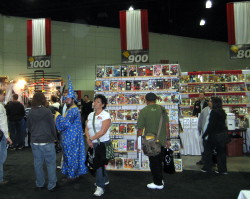
Tickets are now available for the Long Beach Comic-Con coming up in October. I’m going to have to figure out which day I want to go!

This Week (June 24): JSA, JLA, Animal Man

Justice Society of America #28

Justice Society of America #28Written by Jerry Ordway
Art by Jerry Ordway & Bob Wiacek
Cover by Jerry Ordway

A Japanese spirit has appeared to exact revenge on the living symbols of America’s atomic warfare while the rest of the JSA reaches out to another founding member for assistance: The Spectre! Continuing the haunting new arc by Jerry Ordway and Bob Wiacek.

32 pg, FC, $2.99 US

The Last Days of Animal Man #2

The Last Days of Animal Man #2Written by Gerry Conway
Art by Chris Batista & Dave Meikis
Cover by Brian Bolland

Buddy Baker’s powers have picked the wrong time to desert him — a thousand feet above the San Diego skyline! He’ll have to rely on the help of a most unlikely ally if he wants to survive his rematch with Bloodrage. But there’s more than one homicidal maniac out there with designs on his life, and the Mirror Master’s daughter won’t settle for the scraps Bloodrage plans on leaving behind!

2 of 6 · 32 pg, FC, $2.99 US

Justice League of America #34

Justice League of America #34Written by Len Wein
Art by Jose Luis & JP Mayer
Cover by Ed Benes & Rob Hunter

The cards are against the remnants of the Justice League! And those cards are the Royal Flush Gang! Can even Superman and Wonder Woman save a team whose luck has run out? Featuring the deadly return of an old foe in part 1 of a 2-part story.

32 pg, FC, $2.99 US

Notes: I’m not certain the Flash is in this book anymore.

JLA Deluxe Edition Vol.2 HC

JLA Deluxe Vol.2 thumbnailWritten by Grant Morrison
Art by Howard Porter, Gary Frank, Greg Land, Val Semeiks and others
Cover by Howard Porter & John Dell

Collecting stories from JLA #10-17, Prometheus #1 and JLA/WILDCATS in Deluxe format, this volume features the Justice League facing off against Lex Luthor’s newly assembled Injustice Gang while the fate of the Earth itself hangs in the balance.

320 pg, FC, $29.99 US

Reviewing the Unwritten, the Unthinkable, the Unknown

I’d been planning to pick up Mark Waid’s The Unknown since learning about it back in February. The Unwritten sort of snuck up on me, but I read a preview in an issue of either House of Mystery or Madame Xanadu, and decided to check it out. The 99-cent first issue cemented the deal. Then there’s Unthinkable, which isn’t usually my type of story, but I was amused by the fact that all three first issues were coming out on the same day…and then I read quite a bit about it when the TSA found the script for an issue and detained the writer at an airport. So I grabbed that one as well.

Now all three series are on their second issues, and I’ve just caught up on all three of them.

The Unknown

4-issue mini by Mark Waid and Minck Oosterveer from BOOM! Studios. Cat Allingham is a world-class genius problem-solver who makes her living as a consultant to unsolved cases of all types, and has turned her attention to the greatest unsolved problem of all: what happens after death? Her assistant is a former bouncer who happens to be an expert at reading people, and has a mysterious background of his own.

It’s a combination mystery and action adventure, with some bizarre twists along the way — including one at the end of issue #2 that makes you rethink just what’s going on in the previous 40-odd pages. While the Macguffin itself strains my suspension of disbelief, the story around it has been interesting, especially the interplay between the two leads.

Verdict: Definitely on board!

Unthinkable

Mark Sable with Julian Totino Tedesco

5-issue mini, international intrigue and military action. After 9/11, a Tom-Clancy-like action writer gets hired by a think-tank to come up with doomsday scenarios — the unthinkable — before the bad guys do. Nearly a decade later, someone has started putting his ideas into practice.

The first issue is mostly setup, introducing the players and leading up to the attacks. The second issue picks up with the writer trying to get someone to listen to him and anticipate the next steps, which of course goes horribly wrong. (We’re at issue #2 or 5, after all.)

After the first issue, I was solidly onboard for #2. But after #2, I’m not sure I’m interested in continuing. It’s oddly disjointed, with a lot of critical story bits told in narration instead of being shown on the page. And characters shifting sides and motivation apparently with no cause. I’m not sure I’ll keep going with this one, but then as I said, it’s not a genre I’m usually drawn to.

Verdict: Not sure. If you like military action/adventure, you might like it better than I do.

The Unwritten

Ongoing by Mike Carey and Peter Gross, Vertigo.

The main character, Tom Taylor, was the inspiration for his vanished father’s best-selling not-quite-Harry-Potter fantasy series, and is about as self-absorbed as you might expect from the focus of a media empire. At least, that’s what he and everyone else believes until a fan’s question suggests that he’s a fraud. Then there are those who believe he’s the actual Tommy Taylor from the books, somehow brought to life in the real world…and they might not be that far off.

The first story arc is about Tom trying to learn the truth about his origins, and fighting for control of his public perception (con man or messiah?). And then there are the people who want him dead…

The books are filled with literary references (Tom’s father drilled literary geography into his head when he was a child, so he can’t help but remember details when he walks past, say, the building that was the inspiration for the Ministry of Truth in 1984), and the major theme is the intersection of fantasy and reality in the form of stories.

And let’s just say I’ve always been a sucker for stories about the nature of stories. Yes, even before I read Sandman.

Don’t forget to read the text pages. There are fragments of notes, news articles, forum discussions, chat logs, etc. and they all figure in. The first time I read issue #1, I missed the page in the back, and was glad I noticed it this time through.

Verdict: Heck, yeah! I don’t know how long they can keep this up, but I’m definitely along for the ride!