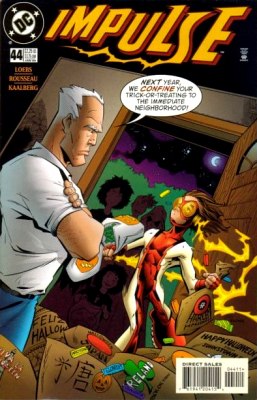
Happy Halloween, everyone! Here’s the cover to Impulse #44 (January 1999) by Craig Rousseau and Wayne Faucher, featuring everyone’s favorite hyperactive teen speedster bringing home treats from around the world… much to his guardian Max Mercury’s dismay. (cover image via GCD)
Last question – something that wasn’t mentioned as one of the pieces of 2009, but yet, fans know it’s coming – what’s the timetable for Flash: Rebirth by Geoff and Ethan Vansciver?
DD: Flash comes back in April. The reason, and I’ll be very frank here – we’ve got so much going on with [Batman] “Battle for the Cowl” that I didn’t want Flash to get lost in the shuffle, so to speak. So April will see Flash: Rebirth #1, and by that point, we’ll also be talking about the big plan for the Flash universe, and the other Flash characters.
Now we know.
I’m looking forward to hearing more about the plans for the Flash franchise, though it’s going to be frustrating to wait. Keeping them under wraps has caused an awful lot of anxiety for fans of Wally West, contributing to the friction among the still-fractured Flash fan base.
This week’s Flash appearances include Justice League of America — as Impulse! — a Justice Society of America trade paperback, and possibly DCU: Decisions and Trinity.
Justice League of America #26
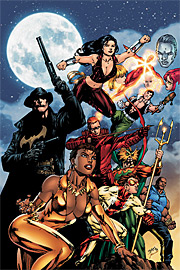
Written by Dwayne McDuffie; Art and Cover by Ed Benes
The JLA stands helpless against the power of Anansi, the African spider god who has warped their histories. Vixen makes her final stand, brokering a deal with the powerful villain. But will she be forced to sacrifice the JLA and Animal Man? Or does her last-ditch effort mean something far worse?
Justice Society of America Vol.1: The Next Age (paperback)
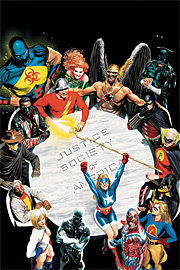
Written by Geoff Johns Cover by Alex Ross; Art by Dale Eaglesham, Art Thibert and Ruy Jose
The book collecting the first four issues of JUSTICE SOCIETY OF AMERICA is now available in trade paperback! Determined to rebuild the Justice Society, Green Lantern, Flash and Wildcat initiate a recruitment program, tracking heroes across the world and bringing in the new Starman, Damage, Liberty Belle and more!
Also likely candidates for Flash appearances: DC Universe: Decisions #4 (conclusion of the miniseries) and Trinity.

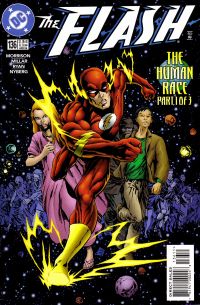
More Flash news from Collected Editions: Fall 2009 will also see the release of the trade paperback, Flash: The Human Race. No doubt this will collect Flash #136-141, containing “The Human Race” (Grant Morrison & Mark Millar, with art by Paul Ryan & John Nyberg) and “The Black Flash,” (Mark Millar with art by Pop Mhan & Chris Ivy), rounding out the Morrison/Millar run on The Flash starts with January’s release of The Flash: Emergency Stop.
Frankly, I’m surprised they went with “The Human Race” as the title. I think “The Black Flash” is a more well-remembered (and well-regarded) story, particularly given the character’s recent appearances in The Flash: The Fastest Man Alive — Full Throttle.
Now if DC will just start filling in some of the missing stories from the Mark Waid/Brian Augustyn run…
Update: Amazon now shows a release date of June 9, 2009.
“Chain Lightning” (Flash #143–150, including the lead-in) is a polarizing Flash storyline. Some fans love the look into the future of the Flash legacy. Others can’t stand that it hinges on Barry having an evil twin. (I’ve never been entirely sure how much of the objection is to the evil twin trope in general, or to the fact that Cobalt Blue is Barry’s evil twin.) Even Mark Waid admits that it didn’t work, though he maintains in The Flash Companion that the idea was sound, he just screwed up on the execution.
But this morning I had a thought: What if Cobalt Blue had appeared during the Silver Age instead of the late 1990s?
The evil twin trope hadn’t been discredited yet, so there would have been few objections on that basis. And with Barry as the new, current Flash rather than a fond memory, there would be no sense that DC was tarnishing a cherished hero’s legacy.
Consider: The Flash’s opposite number, who could have had his life but for a twist of fate, who fights against the law instead of for it, who uses magic instead of science. There’s some solid appeal there. And being a conceptual opposite makes him fill a different role than the Reverse-Flash, who is basically the Flash, but evil. (Sort of like Savitar vs. Zoom)
Obviously the big 6-issue epics didn’t exist back then, but I can imagine Chain Lightning as a recurring type of story, where once a year or so, the Flash has to go into the future to help another future Flash fight that generation’s Cobalt Blue.
So…
Is Cobalt Blue that much worse a name than Captain Cold, Professor Zoom, Pied Piper or Abra Kadabra? (Admittedly, Waid says in the same interview that he wanted to use the name Wildfire, but DC nixed it.)
Is a literal evil twin that much harder to swallow than a clone (Inertia), a mimic who has been known to alter his appearance to match the original (Professor Zoom), the product of an imperfect duplicator ray (Bizarro), or an alternate universe version (Ultraman)?
Is the concept that much more hokey than a gang boss who dresses as a clown (Joker), a talking telepathic gorilla (Grodd), a villain who spins (The Top), runs around in a parka and snow goggles in the heat of summer (Captain Cold), or throws trick boomerangs (Captain Boomerang, of course)? Look at the reactions to Final Crisis: Rogues’ Revenge from people who don’t read The Flash. They were surprised to find that the Rogues were compelling characters. Readers outside the Flash fanbase look at the Rogues’ names, costumes, and powers and figure that they’re nothing but lame jokes, but when used properly, they transcend the cheese factor.
What do you think? Am I totally off-base here, or could Cobalt Blue have worked as a classic Silver-Age villain?
(Expanded from a remark I posted on Twitter earlier, itself condensed from a post on Comic Bloc in response to Heatwave the Rogue’s assertion that Cobalt Blue is the Mopee of the modern era.)
Last week I posted a few updates to Flash: Those Who Ride the Lightning including Inertia, the Gotham Rogues, and an update to the Cover Variants list showing the final versions of the Rogues’ Revenge covers.
As a reminder, I’m posting on Twitter as SpeedForceOrg.
Austin Grossman’s novel Soon I Will Be Invincible is a fun romp through every super-hero cliché ever invented over the history of the genre. Time-travel, cyborgs, telepaths, aliens, evil geniuses, legacy heroes, secret identities, heroes going bad, villains turning good — everything. It’s an affectionate, tongue-in-cheek parody of the tights-and-flights set.
The book is narrated in alternate chapters by Dr. Impossible, a mad scientist who has held the world in his grasp a dozen times, only to be defeated by his arch-nemesis CoreFire — whom he inadvertently created — and by Fatale (as in “Femme”), a small-time cyborg hero who has just been invited to join the world’s premiere super-team, the Champions.
The book opens with Dr. Impossible still in prison, a situation that’s taken care of within the first few chapters. The world’s greatest hero CoreFire is missing, and the Champions, disbanded for nearly a decade after the death of one of their own, have re-gathered to find him. Their number one suspect: Dr. Impossible. Once he escapes, it becomes a race between him and the heroes: will he build his next doomsday device before they capture him? And where is CoreFire?
Dr. Impossible’s megalomaniacal nature (he suffers from “Malign Hypercognition Disorder,” the clinical diagnosis given most evil geniuses) suffuses every sentence as he dwells on his tortured past and schemes to take over the world. By the end of the book, he’s monologued his entire origin, down to the day his eighth grade guidance counselor told him he was a genius, and taken us on a tour of the underworld from its greatest peak to its most pathetic.
Fatale, despite being a high-tech super-soldier who can never live a normal life, comes off as the closest the book has to an ordinary person. She’s still an outsider in the upper echelons, and her loneliness is a constant presence in her chapters. She knows her new colleagues mainly from television, from news footage of their battles and from their celebrity endorsements. (One fundraises for Amnesty International. Another has her own line of beauty products.) While much of Dr. Impossible’s narration consists of flashbacks in which he tells the reader what he already knows, Fatale is entrenched firmly in the present, learning as she goes and relaying her experiences straight to the reader.
The Champions form a sort of dysfunctional Justice League (or is that redundant these days?), with CoreFire, Damsel and Blackwolf as the Superman, Wonder Woman and Batman equivalents. Except in this version, Wonder Woman and Batman are a divorced ex-couple, trying to work together. And Superman’s a bit of a jerk. (But then again…) The team is rounded out by man-tiger Feral, ageless Faerie warrior Elphin (who still has a mission to perform for Titania), magician Mr. Mystic (mainly in the Mandrake/Zatara mold, but with elements of Dr. Strange), teen pop idol Rainbow Triumph, and two newcomers: Fatale herself and Lily, a powerhouse from a distant, blighted future who once fought on the other side of the law. (The book’s website has a database of heroes and villains that doesn’t seem particularly spoilery at first glance.)
The book has its requisite battles, but for the most part it’s about what heroes and villains do in between the fighting: the endless investigations that go nowhere. Bickering at team meetings. Rivalries and affairs. Clandestine meetings in dive bars and abandoned buildings. Hunting for the components of a doomsday weapon. The same concerns as anyone else.
One disadvantage the book has is that it points out just why super-heroes tend to work best in a visual medium: the costumes. I only had strong images of a few of the characters, and most of them were taken from other comics. I never did figure out just what Damsel was supposed to look like, so I pictured her as Payback from True Believers. Fatale was somewhat like Liri Lee, a member of the Linear Men whose name I can’t recall (Thanks, West!). CoreFire, I saw as a cross between Red Star (in his red-and-yellow outfit) and Firestorm. Without pictures, the costumes are more or less pointless, and the only reason they’re included is tradition. Small wonder that colorful tights only really came in when heroic fiction made the jump from the pulps to the comics pages.
Although Dr. Impossible does make a case for why, despite Edna Mode’s warning in The Incredibles, a villain might want a cape. It makes for a much more dramatic entrance.
Welcome to SpeedForce.org, a blog focusing on DC Comics' super-hero, The Flash. It's a companion site to Flash: Those Who Ride the Lightning, a fan reference site for the Fastest Man Alive.