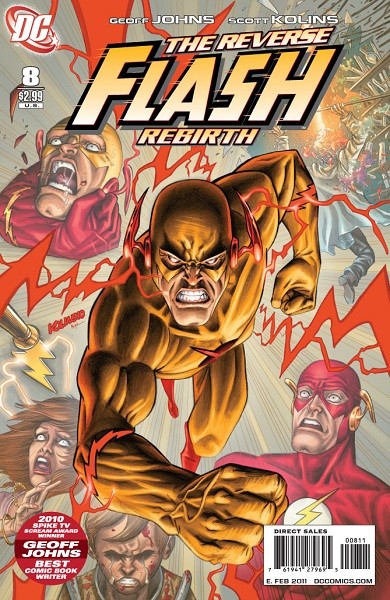
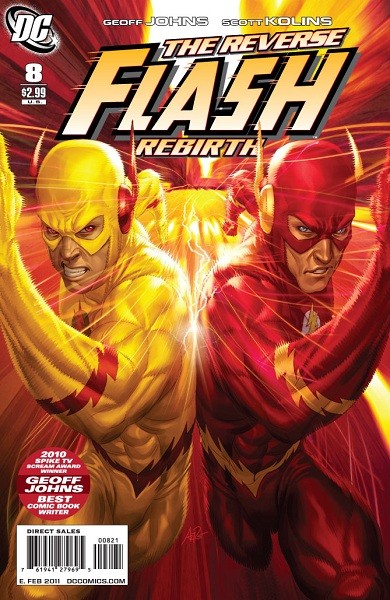
Flash #8 Cover – in Full Color!

Over at The Source, DC has posted several variant covers, including both the standard and variant covers for The Flash #8 starring Professor Zoom. We’ve seen the variant by Stanley “Artgerm” Lau before, but through unofficial channels. This confirms it. This is also the first time we’ve seen Scott Kolins’ cover in full color!

Flash #7 arrives in stores next week, with Flash #8 scheduled to reach stores on December 29.

Mayfairstivus – Celebrating Flash in the DC Heroes RPG

Today we’re featuring the first of two guest posts by fellow blogger The Irredeemable Shag (from ONCE UPON A GEEK and FIRESTORM FAN)!

Dear Speed Force readers,

Welcome to Mayfairstivus! That’s right, it’s time once again for the beloved annual celebration of Mayfair Games’ DC Heroes Role-Playing Game! This time honored tradition dates back to 1985 when the first edition of this role-playing game was released … or maybe this is a fake holiday some comic book bloggers just cooked up as an excuse to post related content from Mayfair’s long-running DC Heroes line.

Mayfair Games DC Heroes Role-Playing Game box set 1985 art by George Perez

Today we’ll look at a few different Flash entries from the role-playing game (RPG) and learn how the first box set shattered my fragile little comic reader world.

Continue reading

Adapting Origins

Today’s guest post is by Dave Huang.

One of Flash franchise’s greatest strengths is the diversity of the Rogues. That strength, however, may prove a challenge when being modernized or adapted to film. Whether or not combining origins is a good thing, it certainly is a trend. Every Superman film has presented a Kryptonian threat (kryptonite, phantom zone criminals, synthetic kryptonite, synthetic kryptonian, kryptonian crystals). In Batman Begins, Scarecrow’s formula, Falcone’s involvement, the main threat, and Bruce’s training all trace back to Ra’s. In The Dark Knight, Batman’s escalation begets Joker who begets Two-Face. In updating Spider-Man, radioactivity is discarded in favor of genetics with organic webshooters (one origin for all powers). The list goes on….

How then does one adapt a speedster with enemies from the far future, prehistoric past, and all manner of scientific disciplines?

If past is prologue, one starts with the hero’s origin. The origin of The Flash is a little thematically weak. It’s an accident without purpose or meaning which grants neither chemical nor electrical powers and is unrelated to speed. Random electrified chemicals aren’t enough to rationalize all of Flash’s physics defying feats even in the comics, hence the Speed Force. However, the Speed Force is a little esoteric and geared at the comic book literate, for an adaptation you need something better grasped by general audience. My suggestion?

FTL. Continue reading

State of the Blog

Quick note – you may have noticed that the last few days have been guest posts and reposts. That’s because late Sunday night, my first son was born! I haven’t exactly had much time on the computer (other than transferring photos!), but I did schedule out 2 weeks of posts before we went into the hospital, so Speed Force will still be active while my wife and I are getting to know the baby. We’re all new at this!

Thanks to everyone who’s sent in a guest post so far, and to anyone still thinking of writing one, please submit it! I can definitely find room for it over the next few weeks!

Review: Justice League Heroes: The Flash

Today’s guest post is by liquidcross of The Indigo Tribe.

Let’s take a look back (a flashback, if you will) at a video game that fell under many fans’ radar: a sidescrolling beat-’em-up for the Game Boy Advance starring the Flash. Designed as a side story to the 2006 Justice League Heroes console game, the aptly-named Justice League Heroes: The Flash features the scarlet speedster zipping around the globe as he takes down the forces of evil. Unlike many licensed games, the end result is pretty damned good, so let’s examine why JLH:F is a hidden gem.

At its core, JLH:F is a 2D brawler reminiscent of the Streets of Rage series. You’ve got the usual punches and kicks to dispatch your foes, but since you’re the friggin’ Flash, you’ve also got his superspeed. (Note: It’s never explicitly stated within the game which Flash this is, as everyone just refers to him as "Flash." However, the developers at WayForward Technologies have stated that it’s the Wally West incarnation). The use of superspeed in the game actually works quite well; the "A" button will dash you to the closest enemy, allowing you get in some swift combo attacks ("B" is your attack button). The "R" trigger will kick you into Flash Speed mode, and everything will appear to slow down…except for you. This is what life is like from the Flash’s perspective, and you can use it to thrash opponents before they even have a chance to react! To keep things fair, though, you’ve got a Speed Force meter right below your lifebar; when it’s depleted, you can’t use Flash Speed mode until it recharges. (Fighting enemies and finding certain powerups will recharge the Speed Force meter.) Finally, if you’re in a real pinch, you can call in other Justice League members to help clear the screen: Superman, Wonder Woman, the Martian Manhunter, Black Canary, or Green Arrow will jump in if you hit the "L" trigger. Their assistance can only be called upon a limited number of times, but you can find powerups that’ll let you summon your fellow Leaguers more often.

As you progress through the game, you’ll earn new moves (like a whirlwind attack), explore new areas, and face the inevitable bosses. Most of them are classic Justice League villains like Circe, but there’s a few Flash-centric baddies in there such as Gorilla Grodd and my personal favorite, Zoom. Another Flash "villain" appears in JLH:F, but not as a stage boss. Want to find out who? Trying using Flash Speed mode right after you lose your last life.

While JLH:F is a portable game, the graphics are top-notch. WayForward have mastered the art of high quality 2D graphics, and their other games like Shantae, Contra 4, and Batman: The Brave and the Bold are shining examples of their craft. JLH:F is no different; the sprites may be tiny, but they’re filled with detail and fluidly animated. Last but not least, let’s take a look at the game’s audio and extras. The background music’s pretty good, and the sound effects are standard beat-’em-up fare. JLH:F is peppered with voice clips, and that really makes it feel like you’re playing an arcade title. Some of the clips might get annoying after a while, but still, it adds to the overall charm of the game. As far as extras are concerned, you can unlock the game’s cutscenes, background information, preproduction art, and more.

Overall, JLH:F is a very good game, but there are two minor flaws. One is the aforementioned focus on Justice League villains. For a Flash game, it would’ve been nice to see a game filled with the hero’s infamous Rogues. Where the hell are Captain Cold and Mirror Master?! The other downpoint is the poor quality cutscene art. I understand that WayForward probably didn’t want to hire a professional comic book artist just to do a few tiny panels here and there, but the art they did use is subpar. Even worse are some of the coloring errors, like the one seen below:

I don’t recall Wonder Woman sporting a bare midriff in the comics; this ain’t an early 1990s Image book. That’s supposed to be armor plate! I know it seems like a minor concern, but it’s a rather glaring (and annoying) error.

Fortunately, these flaws have no effect on the gameplay, and that’s all that really matters. The game engine is rock-solid, and the Flash plays just like he should, dashing around dealing out ass-kickings at superspeed. JLH:F is a great street-brawlin’ game that’ll bring back fond arcade memories for anyone who sank tons of quarters into Final Fight and its brethren. The Game Boy Advance may have been rapidly swept away by the Nintendo DS, but games like JLH:F prove that the GBA still had some life left in it towards the end. For Flash and beat-’em-up fans alike, Justice League Heroes: The Flash belongs in your library. Start diggin’ around on eBay…

Did the Flash Save Comics?

This essay was originally posted on K-Squared Ramblings in 2008.

When the New York Daily News broke the news about Barry Allen’s return, they brought up the hero’s key role in launching the Silver Age of Comics. Superheroes had fallen out of favor in the early 1950s, and comics were exploring genres like westerns, horror, romance, etc. When DC successfully relaunched the Flash in 1956, there was an explosion of new super-hero titles.

The Daily News quotes former Flash scribe Geoff Johns as saying, “Without Barry Allen, we’d still be reading comic books about cowboys.”

I don’t think that’s precisely true. Not to discount Barry’s contribution—it’s entirely possible, even likely, that super-heroes would have remained a background genre. But for one thing, we’re looking at half a century of ephemeral pop culture. For another thing, let’s consider: why were comics going after the western, crime and horror genres when super-heroes failed? Because that’s what was popular in movies and television at the time.

I’d guess that, without the Flash revitalizing super-heroes, we would have seen more science-fiction comics in the 1960s, more police comics in the 1970s, sitcom comics in the 1980s, and so on. Comics genres would probably have followed along with trends in pop culture instead of becoming heavily focused on a single genre.

We wouldn’t be reading cowboy comics today; we’d be reading reality comics.

Perhaps the presence of multiple genres would have eventually gotten rid of the “but, you know, comics are just for kids” mentality. (Not that it’s worked for cartoons or video games yet, but video games are still relatively new, and cartoons have similarly been dominated by the musical fairy tale and slapstick comedy short.)

Eh, who knows? Maybe they’d be all about pirates.