Flash Comics for December 2008 – Updated

The preview of DC’s December 2008 solicitations is are up at Newsarama and CBR. Here are the Flash-related books listed so far.

Update: Full solicitations are up. Read on!

The Flash #247

Written by Alan Burnett
Art by Carlo Barberi & Drew Geraci
Cover by Brian Stelfreeze

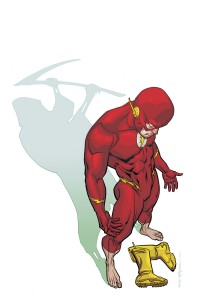
“This Was Your Life, Wally West” concludes! As Flash stands alone without his powers or family to support him, only one question remains – is this end of the Fastest Man Alive?

On sale December 24 • 32 pg, FC, $2.99 US

Notes: Surpisingly enough, the solicitation doesn’t actually say that it’s the last issue.

Team books and events appear after the cut. Continue reading

Final Crisis Should Have Been a Graphic Novel

I’m beginning to think that Final Crisis should have been an original graphic novel, not a miniseries.

I understand there are many reasons to do a big event as a miniseries. People are more willing to spend $3.50 a month for 7 months than to drop $20-25 all at once. And they’re more willing to pick up a first issue to try it, knowing that if they don’t like it, they don’t have to pay for the rest of the series (while with a book it’s all or nothing). It’s easier to schedule tie-ins. Plus it keeps the hype engine going for longer.

But those are all business reasons. Let’s look at artistic reasons. Specifically this one: it’s clear that Final Crisis will read better all at once than in serialized chapters.

After the contention that the series requires the reader to be a walking encyclopedia of arcane DC knowledge (a claim with which I disagree), the biggest complaint about Final Crisis is that it isn’t clear what’s going on. There’s a sense that you need to have read interviews and annotations just to follow it.

It seems like readers want an inverted pyramid structure to their comics. Establish all the players up front, then jump into the conflict. Which is certainly a valid way to tell a story, except that:

  • It’s not the only way to tell a story.
  • It’s not even what comics readers really want.

Movies and novels frequently tell stories where they give you only pieces of information, bit by bit, and slowly assemble them into a whole so that by the time you get to the end, or three-quarters through, or half-way through, you know what’s going on. Before the sequels soured people’s memories of the first film, The Matrix was massively popular — but it takes a long time before Neo — and the audience — find out what’s really happening.

And really, people don’t want everything spelled out ahead of time. They want to be surprised. They want the rush of a cliffhanger ending. And when you spend an entire issue establishing the situation and players, like in Final Crisis: Legion of Three Worlds, they complain that it’s all setup, and it’s like “reading a Wikipedia article.”

The problem is trying to mix the story structure Grant Morrison is using for Final Crisis with the serialized format.

A movie can spread out the exposition because it’s a whole work intended to be watched all at once. A novel can get away with it because it’s perceived as a whole work, not as series of connected stories. You can pause reading a novel and know that you can read the next part, which might explain more, anytime you want. When you have to wait a week for the next episode of a TV show, or a month (or two, or more) for the next chapter of a serialized comic, waiting for things to make sense can be a much more frustrating experience.

So doing it as a graphic novel would solve that problem. Have the whole thing come out in one volume. People can sit down, read it at their own pace, and follow the pieces as they come together. They can see how the story works as presented on the page, and then if they want to look deeper into symbolism, see how it connects to 70 years’ worth of shared universe stories, or do a literary analysis, then they can look up the annotations.

Mike Wieringo Marvel Apes Variant Benefits the Hero Initiative

The Hero Initiative has released a variant edition of Marvel Apes #1, penciled by the late Mike Wieringo and inked by Karl Kesel.

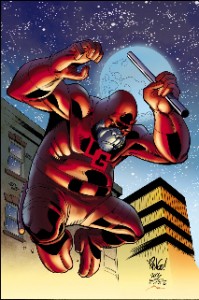
Daregorilla, the Ape Without Fear, penciled before Mike's passing.

Daregorilla, the Ape Without Fear, penciled before Mike’s passing.

Marvel Apes writer and cover inker Karl Kesel said:

It was a blast working on Marvel Apes — one of the most far-out, fun assignments I’ve ever had! And inking Mike Wieringo’s “Daregorilla” variant cover only made it better. This drawing is one of the initial inspirations for the entire mini-series — chances are the comic would have never happened without it — so this cover brings everything full circle. And it’s only fitting that it helps The Hero Initiative, because Mike was a big believer in giving back to the comics community, and that’s exactly what The Hero Initiative is all about.

The book is limited to only 3000 copies worldwide and is available now at Atomic Comics. Retail price is $8, and the book will also be available at the Hero Initiative booth at the Baltimore Comic-Con (Sep. 27–28), Mid-Ohio Con (Oct. 4–5), Adventure Con (Oct. 25–26) and Wizard World Texas (Nov. 7–9).

The Hero Initiative is dedicated to helping comic book creators in need. Hero creates a financial safety net for yesterdays’ creators who may need emergency medical aid, financial support for essentials of life, and an avenue back into paying work.

(Adapted from the Hero Initiative’s press release.)

(Edit: Fixed the typo in the title. *sigh*)

Mackenzie Ryan: The Flash Who Never Was

In the previous post I made a joke about Mackenzie Ryan being the new Flash. I should probably explain.

During Crisis on Infinite Earths, DC made the decision to kill Barry Allen before they had figured out how to replace him. Many ideas were suggested, and the one that got the farthest was a proposal by Len Wein and Marv Wolfman for a new character with no link to Barry except the name.

A brief note in Amazing Heroes Preview Special #2 (1986) described the proposal:

  • Mackenzie “Mac” Ryan was a lab tech at STAR Labs, linked to established character Jenet Klyburn.
  • He was a single father with a daughter between 8 and 12 years old.
  • Instead of super-speed, he had the ability to manipulate energy fields (light, sound, etc.)

Ultimately, DC decided to promote Wally West instead. Oddly enough, Mackenzie Ryan actually gets a brief mention in canon, during a phone conversation with Klyburn in The New Teen Titans #19 (written by Marv Wolfman), which gave his daughter’s name as Jamie.

Further reading:

The Flash Companion has an article about “The Unused Flash.” Comic Book Urban Legends Revealed #126 points out similarities between Mackenzie Ryan’s powers and those of the Tangent Flash. Titans Tower collects interview fragments about trying to set up the new Flash.

Gone in a Flash

We’ve known since the EVS spotlight at San Diego that the current Flash series will stop for Flash: Rebirth, though DC hasn’t yet announced the last issue. A good bet: #247, the final issue of Alan Burnett’s 4-part storyline, which should hit in December. Final Crisis, if it doesn’t get delayed too much, should also finish up in December, and they’ve talked about Rebirth starting in January.

The only real question has been whether Rebirth will be followed by one Flash series or two (and really, two is just wishful thinking), and whether it will start with #1, #248, or #351.

Now, Lying in the Gutters is reporting (with a “green light” for the rumor’s reliability):

…yes, “The Flash” will also disappear, replaced by the previously announced “Flash Rebirth” mini-series, before kicking off again with a new Flash series. With a new Flash.

Well, for some definition of “new,” anyway. (Unless DC pulls a fast one on us all and dusts off Mackenzie Ryan?)

I’m honestly not sure this is really news, but people seem to be talking about it.

(Thanks to Rockin’ Rich for pointing this out.)